Showing posts with label 2010s. Show all posts

Wednesday, 26 June 2013

Week Twenty-Five - Jeanette

The Weird World Of Eerie Publications by Mike Howlett (2010)
Recommended by Mike
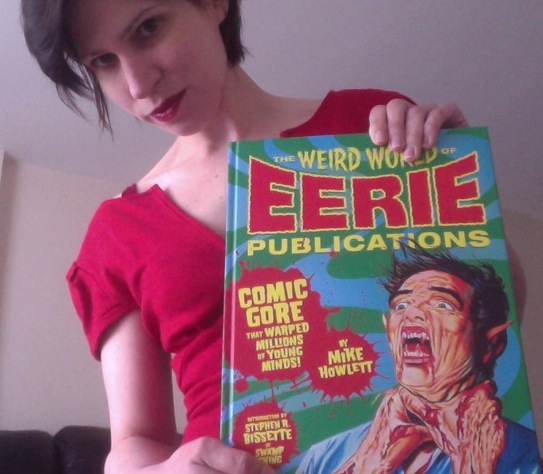
It was my birthday. Kathryn directed me to an unlabelled VHS tape.

‘It’s from me and someone else,’ she said. ‘Play it! Play it!’


I screamed in delight and threw my arms around her.

‘Turn it off now,’ Kathryn said, as the title sequence finished. ‘I’m not watching it.’

Cannibal Holocaust, for the uninitiated, is a notorious video nasty. You can get a flavour of it from this trailer (NSFW):


Even when considered in the later context of torture porn films like Hostel, Cannibal Holocaust is repulsive and intense in its imagery. But, (very unlike Hostel) it has a great deal to say about serious subjects – such as authenticity, Western anthropological assumptions, media exploitation of culture, and the abuse of animals. I’d wanted to see this film, (then) banned and very difficult to get hold of, for years.

So how did Kathryn, who avoids horror movies at all costs, track down Cannibal Holocaust?

The answer is Mike.

Kathryn and Mike ‘met’ on an indie-pop message board. I find it utterly brilliant that my first introduction to Mike was through Cannibal Holocaust, while Kathryn’s was through songs like this:


Mike is American, and he and I began writing letters to one another. Through our correspondence, I found out that he loved horror movies of all eras and styles. My own palate was then fixated on stylized 1970s Euro-horror and nihilistic American efforts like Last House On The Left, and I credit Mike with considerably broadening my tastes.

So when I asked Mike for a book recommendation, he came up with a lavishly illustrated and unapologetically nerdy history of a gruesome comic book company. What kind of person would write a book like this?

Mike would. And he did!

If anyone’s thinking Mike recommended this book to me in order to promote it, I can guarantee that’s the furthest thing from his mind. I know exactly why this most generous and enthusiastic of souls sent me this: so I could understand and love the very weird world of Eerie Publications for myself. If he’d not written this book, he probably would have shipped me over two dozen original comics instead.

Weird and its clammy ‘the world’s gone to shit’ brand of horror was one of the few pop harbingers of what was just around the corner.

Weird, along with Terror Tales, Horror Tales, Tales Of Voodoo, Witches’ Tales, Tales From The Tomb and many other shorter-lived titles, represented the empire of Myron Fass. Fass, a mixture of opportunistic capitalist and deranged gun-toter, cut his teeth in the early 1950s horror comics boom. Blood and oddness had run riot during this period, but it didn’t last. In 1954, the quasi-academic tract Seduction Of The Innocent tenuously claimed horror comics had a deleterious effect on children, and it ushered in an era of censorship (‘the code’): the comics’ bloodletting was stemmed, and unsurprisingly no-one wanted the new neutered stories. Horror comics were over.

Fast-forward a decade. In January 1966, this hit American newsstands.


The first Weird reprinted seven pre-code horror stories […] In some panels, a few extra drops of blood were added to the original art to make it a bit more gruesome.

Myron Fass had hundreds of these 1950s horror stories to mine. Once he’d printed ‘em up on cheap paper (with even cheaper ink that turned a reader’s fingers to charcoal) all Fass had to do was commission new covers.

And what covers they were: a sick, wonderful art form in themselves. In this book, Howlett generously reprints every single one (and the best get their own full-page glory). Check out the human corn-on-the-cob!


And the meat grinder!


The titles were successful, and because Fass now had so very many horror comics on the go, those 1950s stories were running dry. Did he commission new stories? Did he buggery! The man was allergic to paying for stuff. He went for the cheapest option: to give the impression of freshness, he got artists to redraw those same 1950s stories, retaining the original dialogue balloons and text, but with instructions to gore them up. A new title, and voila: a ‘new’ story.

However, it was this very workhouse that gave some talented artists freedom. They creatively interpreted the 1950s material, playing with panels, perspective and character. As long as they also shoved in an eye trauma or a disembowelment, Fass couldn’t care less if they indulged their artier side. Finally, even the redraw tactic ran dry and new stories were grudgingly included, but reprints of the same ancient shit continued right up to the magazines’ dying days in the mid-1970s.

I think my favourite part of the Eerie Publications story was the ultra-bizarre short-lived projects. Look at the mixture of Lady Gaga and Fantastic Planet that was Gasm, from November 1977…


…and the obligatory Star Wars cash-in with amusing copyright-dodging name!


There was even a magazine on the Swine Flu epidemic of 1976! Was there nothing this man couldn't exploit?

I’m so made-up for Mike. This book is a brilliant achievement. With specialist geeky subjects like this, the writing is often stale, but that’s not the case at all with The Weird World Of Eerie Publications. Mike is as funny and lovely in print as he is in real life, and I’m really proud that he’s my friend.


Monday, 13 May 2013

Week Nineteen - Jeanette


 Zona by Geoff Dyer (2012)
Recommended by Andrew


‘I’m off to see Tarkovsky’s Stalker tonight’, Andrew texted me last summer. He was in Edinburgh, spending some time at the festival.

‘Oh, Stalker!’ I replied. ‘I have opinions about Stalker. “Enjoy”.’


I shared those opinions when I next saw him. I considered Stalker overlong and indulgent: a great concept frittered away by a director too in love with his own visuals and not with his audience. I related an anecdote that, to me, summed it up: I’d been watching the film, got bored, gone off to make a cup of tea, came back, and exactly the same shot was still on the screen.

Fast forward a few months, and Andrew recommends me Zona, Geoff Dyer’s recent book about his love affair with Stalker. I’m going to have to watch the bleeder again come May, I thought.

However, through Artificial Eye being useless and happily letting important films go out of print (don’t get me started on their treatment of Rainer Werner Fassbinder), Stalker is unavailable on DVD in the UK at the moment. So I did the next best thing; I rewatched another Tarkovsky movie, Mirror.


I first saw Mirror not long after Stalker and vastly preferred it (I’ve also seen Solaris, which I consider the worst of the three). Mirror probably has even less of a plot than Stalker, but there was a warmth to its images: without wishing to sound too pretentious (very difficult to avoid when talking of Tarkovsky), Mirror evoked the curious space of childhood memory and its impact on the present with great sophistication and candour. I liked it even better on a second viewing.

Immediately, in Zona, Geoff Dyer addresses my moans about Stalker.

By any standards it’s a slow start to a movie. Officials from Gosinko, the central government agency for film production in the USSR, complained about this, hoping the film could be ‘a little more dynamic, especially at the start.’ Tarkovsky erupted: it actually needed to be slower and duller at the start so that anyone who had walked into the wrong theatre would have time to leave before the action got under way. Taken aback by the ferocity of this response, one of the officials explained that he was just trying to see things from the audience’s point of view… He was not able to finish. Tarkovsky couldn’t give a toss about the audience.

So I was right about the Tarkovskian arrogance towards the paying public! But how about that static shot when I went off to get a cup of tea?

Often, in Tarkovsky, when we think something is still it’s not; at the very least, the frame is contracting or expanding slightly, almost as if the film were breathing.

Pah. One-all.

Dyer broadly sees the total lack of interest in a cinema audience as a plus point for ol’ Tarkers: it’s exactly because of that attitude Stalker is the achievement it is. Although mostly Dyer was persuasive as to his argument, he annoyed me at one stage:

At first there can be a friction between our expectations of time and Tarkovsky-time and this friction is increasing in the twenty-first century as we move further and further away from Tarkovsky-time towards moron-time in which nothing can last – and no-one can concentrate on anything – for longer than about two seconds.

This may very well have a kernel of truth in it, yet Dyer’s tone and use of ‘moron-time’ smacks of unpleasant superiority. This was its most obvious example, yet there were other hints that Dyer occasionally didn’t care about his audience, either.

Zona – and I suspect this was the reason Andrew recommended the book to me, rather than simply to argue by proxy about Stalker – is part-autobiography. Dyer not only considers his relationship with the film, but how its various ideas and imagery offer insight into his own history.

The football pools: that, for many British people, was their equivalent of the Room, the thing that would make all their wishes come true. ‘All I’d like to do,’ my mum said with a mixture of pride and humbleness, ‘is go down to the supermarket and buy the nicest piece of steak there. That’s all I want.’

Reading these bits, which increase in frequency as the book goes on, was great, and really helped me understand why Dyer loved the film, and perhaps, also, why I did not. It seems to me that if we only admire a movie for its innovation or beauty, cinema wouldn’t work the way it does, and none of us would have a favourite movie at all, even. But those treasured films, those that do touch us deeply, they set in motion a special chemical reaction. Their content pings off our own yearnings or regrets, loves or hatreds. It’s easy when writing – or speaking – of a film to neglect this, perhaps because we don’t think others will be interested, perhaps because we don’t want to unpick our own muddled feelings, perhaps because its simply easier to praise (or criticise) an audaciously lengthy still shot than to analyse why it affects us so. And this is where I come back to Andrew: in the relatively short time I’ve known him, it’s been his unapologetic and intelligent capacity for introspection, along with an unusual and eloquent means of expressing it, that has had a striking effect on me.

So I can see why Zona has resonated with him. Dyer explicitly applies his own narrative to Stalker, and sometimes this means the structure of the book is messy – many will be frustrated with the digressions via footnotes, everything from a bitch about Lock, Stock And Two Smoking Barrels to missed opportunities for ménage a trois – but I found it a price worth paying. Zona has much more in common with House Of Leaves than, say, with a coolheaded Cahiers Du Cinéma anthology.

Another text from Andrew (yesterday):

            If we ever find a copy of Stalker I demand a gala viewing.

And what did I reply? Has Zona convinced me to sit through it again?

            You’re so ON.

Wednesday, 10 April 2013

Week Fourteen - Jude

Why Be Happy When You Could Be Normal? by Jeanette Winterson (2012)
Recommended by Kathryn Cook


Christ, what a week to read this. For the first half of it, I was in my childhood home. In the second half, Margaret Thatcher died.

I've never read any of Jeanette Winterson's books before. Which is amazing really, given the way that she writes (which I love), and the things she writes about (things I'm interested in). However, I did see the TV adaptation of Oranges Are Not The Only Fruit many years ago, and at the end of last year saw a BBC documentary about Winterson, closely linked to this book.

So I knew a few things already. From the documentary, I knew that Winterson still had a slow, strong Accrington accent. From that and from Oranges, I knew she was working-class, self-taught, and incredibly clever. That she had been adopted by a mad, cruel mother and a dad who didn't intervene. That she had read her way through the local library, very ravenously, like I had, and went to university in Oxford to read English, as I had.

I didn't know that the real story of her life was even weirder, even nastier, even tougher, than that.

But before all that: Kathryn Cook. I met Kathryn in the lovely summer of 2001, as a friend of my then-boyfriend Barry, and best friend of some other working-class girl called Jeanette (hello, lovely Jeanette). Kathryn and I shared a love of pop music, sitcoms, massive bottles of Tesco's own-brand Soave, and later shared two flats together – one when we'd both broken up with our boyfriends so did a house-swap, and then one for a year together in Hackney. Those were glorious days.

Kathryn also has an encyclopaedic brain on most subjects –with her husband Rupert, she only went on AN EPISODE OF POINTLESS and WON.  But she's not only an expert on obscure glam-rock/indiepop/rave singles, and how to accessorise an outfit just-so (she's gleefully brilliant at both). She's also razor-sharp on books and politics, and always has forthright, refreshing opinions.

(She is also someone who has helped me so much over the years with her wonderful chats and advice, and that matters most of course. She is one of my loveliest friends.)

Kathryn recommended me this book a few months ago, and I finally bought it last week. It's fantastic: beautifully written, angry, and stylistically really interesting. It's chronological, sort of, taking us through Winterson's younger years, until the moment she lasts sees her adoptive mother, then bouncing forward to the decade when she finds out her real mother is still alive. It's full of theories about love and family and loss and being a woman, like therapy through literature.

"Words always help" is a very condensed version of what she seems to be saying. I'm not half the writer she is, but words do that for me too.

For Winterson, so does fiction and the editing and filtering of our lives. In Oranges for instance, there was a character Elsie, who helped the fictional Jeanette. In real life, Winterson reveals here: "There was no Elsie. There was no one like Elsie. Things were much lonelier than that."

As a lonely child in very different circumstances - my father had died, and I missed him - I found lots of solace in this book. Lots of other passages connected with me personally. When Winterson reads T.S. Eliot for the first time, she experiences the same head-rush and heart-rattle that I did, and describes it with a thump. The stuff about Oxford struck me too, although I was a comp kid who had her own bedroom, not someone who lived in the back of a car.

The stuff about Thatcher too. Jesus. It's been a funny week, obviously, thinking about all that. Jeanette (my Jeanette again) and I talked about this on the phone last night... about how Thatcher's death brought up about so many thoughts and feelings. About how the mythologising of Maggie's time in power, and the whitewashing of her legacy, coloured by the might of her pronouncements, and the projection of her power, ignores just how much she rode roughshod over our own communities and families, and how her ideology fundamentally changed the way many people behave.

In this book, Winterson says why she voted for Thatcher in the 1979 General Election. This happened just after she had been given her place to read English at Oxford. I'm going to quote this just before I sign off – and it's long, and I hope Winterson doesn't mind (and if anyone reading this does on terms of copyright, email me through my website, juderogers.com and I'll take it down pronto). It just seems so important to post this today: the vivid, brilliant words of a girl who came from nothing, and had nothing, and here says so much. The non-italics are her own.

 "Thatcher had the vigour and the arguments and she knew the price of a loaf of bread. She was a woman - and that made me feel too that I could succeed. If a grocer's daughter could be prime minister, then a girl like me could write a book that would be on the shelves of English Literature in Prose A-Z.

I voted for her. 

It is commonplace now to say that Thatchr changed two political parties: her own, and the left-wing Labour opposition. It is less often remembered that Reagan in the US and Thatcher in the UK broke forever the post-war consensus - and that consensus had lasted for over thirty years.

Spin back to 1945, and whether you were on the Left or the Right in Britain or Western Europe, rebuilding societies after the war could not happen using the outdated and discredited neo-liberal economics of the free market – unregulated labour, unstable prices, no provision for the sick or the old or unemployed. We were going to need housing, plenty of jobs, a welfare state, nationalisation of utilities and transport.

It was a real advance in human consciousness toward collective responsibility; an understanding that we owed something not only to our flag or to our country, to our children or our families, but to each other. Society. Civilisation. Culture.

That advance in consciousness did not come out of Victorian values or philanthropy, nor did it emerge from right-wing politics; it came out of the practical lessons of the war, and – and this matters -–the superior arguments of socialism.

Britain's economic slow-down in the 1970s, our IMF bail-out, rocketing oil prices, Nixon's decision to float the dollar, unruly union disputes, and a kind of existential doubt on the Let, allowed the Reagan/Thatcher 1980s Right to skittle away annoying arguments about a fair and equal society. [...]
In 1988, Thatcher's Chancellor of The Exchequer, Nigel Lawson, called the post-war consensus the 'post-war delusion'.

I did not realise that when money becomes the core value, then education drives towards utility,  or that the life of the mind will not be counted as good unless it produces measurable results."

And so it continues, and brilliantly. But this last section seemed the right place to end this post, given how much it says about self-education.  Winterson says elsewhere in this book that "reading is where the wild things are". And that for the younger her: "Every book was a message in a bottle. Open it."

I feel this doing this blog. Every book is another trip into the life of the mind. Of our minds. Every book is another pulling-out of a stopper. A means of action that many value, but don't do enough. And we should. After all, education is our most powerful weapon.


Sunday, 24 March 2013

Week Twelve - Jeanette


Open City by Teju Cole (2011)
Recommended by Oliver

A Tale Of Two Readers reaches its first crossover point…

You may remember in Week Two, when I was cogitating on the Armenian genocide with Black Dog Of Fate, Jude was both amused and touched by Danny Baker’s autobiography, Going To Sea In A Sieve. It’s now my turn for a gift from the Oliver library.

Interestingly enough, most mutual friends of Jude and I have chosen different books for each of us. And the one Oliver picked for me is a book without a narrative arc, told by a grown-up only child, a loner without much family who feels cut off from his roots, and who likes to wander around city streets tossing around the contents of his head.

More, far more, on this in a moment. But first: Oliver.

For a good few years, during London life in my early twenties, I liked Oliver – how could one not like such a warm and funny man? – but really, I knew him only superficially. He was the first one to career onto a dancefloor. He was the last one left awake at a party. He was the music fan with every one of the good (and plenty of the shit) pop CD singles of the 1990s. He was the one who made up silly affectionate names for his friends. He was from Sheffield, and thus my first taste of a city that I came to settle(ish) in. 

In short, if there seemed an opposite to Open City’s protagonist, Oliver was it.

As we all started to grow a little older, entertainments became calmer, and it was then when I really felt Oliver and I became better friends. At that point, he was going out with my best friend and flatmate Kathryn, so there was watching CD:UK over Saturday morning breakfast as well as drinking the night away. Of course he was still a natural extrovert, and remains one of the most sociable people I’ve ever met, but it was so nice to grow into the nuances of his personality (which had previously, and perhaps inevitably, been blunted in noisy North London pubs).

One of those nuances is his love for, and knowledge of, modern fiction. Whilst I snuggle into the known-quality of past writing, Oliver is a voracious consumer of the new: so it was not a surprise, but still a delight, to get a book of such recent vintage from Oliver.

Unimaginable how many small stories people all over this city carried around with them.

Julius is a doctor-researcher, specialising in older people’s mental health. Born in Nigeria to a German mother and Nigerian father, he left the country in his late teens to study in New York. Fifteen or so years later he’s still in the city. He spends most of his time (when not working) indulging his cultural and intellectual interests, and unpicking his own opinions, observations and history.

That’s how little, and how much, Open City is about.

A typical passage from early on reads:

In that sonic fugue, I recalled St. Augustine, and his astonishment at St. Ambrose, who was reputed to have found a way to read without sounding out the words. It does seem an odd thing – it strikes me now as it did then – that we can comprehend words without voicing them. For Augustine, the weight and inner life of sentences were best experienced out loud, but much has changed in our idea of reading since then. We have for too long been taught that the sight of a man speaking to himself is a sign of eccentricity or madness.

Extracts such as these reminded me of a work that impressed me greatly last year – À Rebours by Joris-Karl Huysmans, a French book written in 1884. In that, the ‘plot’ consists of the narrator surrounding himself with intellectual stimuli and then chatting about it. Open City isn’t quite as balls-out solipsist as À Rebours, but the idea of retreat into one’s head, combing over its landscape and often in reaction to what art, literature and music tells us of life, is similar. Also, Cole’s writing is really very, very good, and almost up to Huysmans’s astonishing standard.


But what Open City has – and what À Rebours largely does not – is human contact. Julius analyses the microscopic encounters of a day.

At a light on 124th were two men in their twenties, fragments of whose conversation floated around me as we crossed the street. He come up, word? said one. He come up yo, said the other, I thought you knew that nigga. Shit, said the first, I don’t know that motherfucker. They acknowledged me, and I them, then they turned right and went down the street, toward the south.

Open City is the most layered book to deal with ethnicity that I’ve ever read. Julius considers his position as a mixed-race, non-American man in a multi-ethnic city. For instance, when he attends a classical music concert, he notes that the overwhelmingly white audience seems unsurprised and even pleased that he’s there, but is nevertheless relieved that he’s a rarity. His encounters with African-American people are often difficult. Julius is particularly uncomfortable when he meets a post office worker, who moonlights as a radical poet.

Brother Julius, he said, with great feeling, you’re a visionary, keep hope alive. I think we should see some poetry together. I can see that you instinctively get it. We must be a light for this generation. This generation is in darkness, you feel me?
[…]
I made a mental note to avoid that particular post office in the future.

Julius is not perfect, by any means; he’s a snob and show-off, and his attitudes to women and relationships leave much to be desired (and may even be very dark indeed).

      What does it mean when, in someone else’s version, I am the villain?

Despite the differences in gender, race, and geography between Julius and I, I have not felt as if a character so mirrored me, and my own mental situation and coping methods, for a long time. I responded to his only-child haughty autonomy keenly. But, even more so, I related to Julius’s relationship with Nigeria. He says he left for America ‘to begin life in the new country, fully on my own terms’. Yet, even though he never admits it explicitly, he often seems unmoored: there is a hole within him.

I wrote briefly during Week Eight (inspired by Italo Calvino) of my relationship with the city I live in, Sheffield, and the emotional dramas its streets had staged. Open City had me thinking of Norwich, my birthplace and home until I was eighteen. I have no parents and no siblings and so I rarely visit. Still, Norwich’s absence is a presence. It is like a bubble inside of me. That bubble gets bigger, taking over my whole heart, until it’s unbearable, and I pop it. There’s nothing, nothing there, and I ache for this nothing, before I shrug, and get right back on with my Julius-esque inner monologue.

Meanwhile, the bubble renews itself, hiding in a ventricle, expanding silently once more.

Monday, 21 January 2013

Week Three - Jude

The Beautiful Indifference by Sarah Hall (2011)
Recommended by Rebecca Bream


I love short stories. They don't take long to read, after all. When it's been a cow of week – as my last one has with work – reading one on the way home is always a treat. When they're good, they're  lovely half-hours of pleasure, like an episode of a soap opera when you've just got in, or a hot bath with your favourite magazine. In Sarah Hall's case though, these half-hours usually involve bigger, fuller language, and far fewer ads.

Rebecca Bream – Beck – recommended me this book. She's not long had her second son, and told me she lapped this up. Beck is cool as fuck, calm, funny, and an Actual Proper Journalist, someone who's worked down diamond mines and oil rigs while I've been at home in my 'jamas. My fondest memories are her are at my wedding, simultaneously DJing and dancing to The Breeders on a bench in stockinged feet. Aso, if you want a crash course in getting to the front of a moshpit, with charm rather than bother, then Beck's your girl.

Booker Prize-shortlisted and longlisted, Sarah Hall is also an impressive woman. Her four novels up to now (I say confidently, having had a quick scan through her website) have explored the destruction of 1930s Cumbria, dystopian sci-fi, the world of fine art, and a man who leaves Morecambe Bay for Coney Island. This is her first book of short stories, and I'll admit here and now that I found few of them tough. Hall writes the kind of prose that book reviewers call “luminous” – a metaphor that's always stuck in my craw, because words don't bloody glow. But she does describe nature in bright colours, and with plenty of texture.

Take the first page of The Nightlong River. It involves “November berries...hung and clotted in the bushes, ripe and red, like blisters of blood”. “Yarrow and rowan” hanging out “their own gaudy bunting”. Hawthorns sending “the hedgerows as ruddy as battle”. Typing those phrases out now, they read beautifully, don't they? I suppose what I wanted from that story from the start was more pace – a plot that grabbed me straightaway, that didn't take its merry time to gently weave me in. I also realise this shows my flaws as a reader, much more than it shows Sarah Hall's as a writer.

I wasn't surprised to find out that Sarah Hall's also a poet. As well as that fulsome, visual stuff she conjures up, she's always leaving little mysteries that never get solved. I loved the book's title story (are they called title stories?) and how Hall slowly unravelled the tale of its protagonist and her lover – but never completely. I also gobbled up The Agency, which I suddenly realise was another saucy offering. No, I haven't – and won't – read Fifty Shades Of Grey, but I bet this is ruder and filthier. Rather than disclosing the mucky details that are suggested within it, we find our protagonist going into her living room, hours later, to “clear up the children's mess”. The gaps in our knowledge aren't filled. We're allowed imaginations.

My favourite story was Bees, about a woman who'd just moved to London, which began with her sitting in a garden, thinking about the dead insects around her. Typical me, really: it's the second shortest story here. But its description of a character losing something – still wanting something they shouldn't really have – captured feelings I'd once had, so powerfully, so dramatically, that I found myself suddenly standing up between Tottenham Hale and Blackhose Road.

I mean, that's a proper short story, isn't it? I'll definitely allow Sarah more time. One of these days – she says, contemplating next week's book with fear – I might even allow myself some.

Monday, 14 January 2013

Week Two - Jude

Going To Sea In A Sieve: The Autobiography by Danny Baker (2012)
Recommended by Oliver Shepherd


So this week Jeanette has read a book about the Armenian genocide, and I've also read a memoir, full of drama and intrigue, which...oh Lawd, I can't go on in this vein because it's too bloomin' tasteless. I've read Danny Baker's autobiography. But first let me tell you about the person who recommended it.

When I first met Sheffield's Oliver Shepherd, he convinced gullible 23-year-old me, through the medium of drink, that he had been sacked from the original line-up of 911 because he was a) too tall and b) too fat. Initially, perhaps because of dented pride more than anything, I assumed he was a bit of a plonker, but soon realised he was, and always will be, Yorkshire's Funniest FunnyMan. Liverpool nightclubs still mourn his university years, when he pranced around the Krazy House like an indie-pop Nureyev; alternative comedy still weeps for the loss of his alter-ego Royston Royston, a contemporary dance instructor that Vic Reeves would have adored. More than a decade later, Oliver is now a very respectable manager, husband, and father-of-two, but I still miss his Victory Dance, a t-shirt-over-the head-manoeuvre often seen at Finsbury Park's Rowan's Bowling Alley in the early 2000s. Saying that, his daughter did the same move at her 2nd birthday party, while simultaneously trying to eat a bread-stick. So things are OK. The Shepherd genes are safe.

I first met Danny Baker, South-Of-The-River's Favourite Funnyman, even earlier. I was 21, fresh as a spring flower, at the start of my first (and only) shift at The Crown in Brewer Street, Soho. I had been in London about three weeks, and he was my first customer, barrelling into the pub after a shift on Virgin Radio. Here it was, I thought, giddily: proof that London was full of stars. Not that I wasn't a fan of Baker at the time. He was the rowdy git off TFI Friday, that knob from the Daz adverts. But I'd served someone famous a pint, and hooray, that made London MINE.

Four years later, I was working at Word Magazine, still completely dazzled at how such a miracle could have happened. In the first Christmas issue, we ran five pieces about the history of pop, with five writers making a case for a different decade being the best. Danny was chosen to write the '70s section, which confused me no end. At that point, I had no knowledge of his teenage years at the legendary Mayfair record-shop One Stop, of his involvement in punk fanzine Sniffin' Glue, of his time as receptionist at the NME. But then I did and how I did. Mark Ellen and Paul Du Noyer would regale me with tales of those old music-weekly days...where Danny had even done the last ever interview with Michael Jackson, you know.


And then I started listening to Baker's BBC London show. I also loved Oliver, and Oliver loved Danny Baker, so that was it. Sold.

Going To Sea In A Sieve only takes us through the first 25 years of Baker's life, but – as Noel Gallagher would say – what a liiiiiife. Here's Baker's childhood in a council house on the Rotherhithe/Deptford borders, featuring a full cast of even fuller characters. Docker Dad Baker is a particular card, always ducking-and-diving and spotting "skulduggery", but his mother, Nan Baker, is even better. Breaking her hip after falling down the stairs in her 90s because she's had a few, she still insists that she walks the two miles to see her family through the Rotherhithe Tunnel. She uses a buggy full of shopping instead of a zimmer-frame, because she's too bloody proud. Her house also features in a story from Danny's adolescence, involving a girl he's romancing called Lulu. I'll say no more, other than that it made me cringe with terror, and then it made me howl.

Baker busts myths about the mid-century working-class throughout the book, and all the way through  the punk years (reporters were so keen to see young men ranting, he says, that he happily joined in). But bloody hell, you see the rougher side as well. There's the man covered in blood in the back of a car that Baker sees with his dad on the way home from a Millwall game (he discovers later that the torture barn of notorious Kray rivals, The Richardsons, was in one of the railway arches there). There's his classmate who dies falling through the roof of a bombed-out building – although the story that follows about the same child's mohair trousers provides light relief – then come the various tragic fates that befall his old schoolteachers. But these anecdotes are never wrung out like wet rags for sentiment, or introduced to provide hard-nut credentials. They're simply batted to and fro, for entertainment, in ripe Deptford lingo. It's like being with the tearaway cousin of PG Wodehouse down the pub.

And then come the stories about music. Oh Mother! There's so many brilliant stories...about Elton John and Queen prancing around the One Stop, about how Baker did, and didn't, see the Sex Pistols at the 100 Club, about how he might, or might not have, met Madonna. And through all of these merry yarns is the sense of how ridiculously revisionist the rewriting of pop history can be. I'd love to see this turned into a film, because our boy Baker tells the truth.

He also knows that he was a lucky bugger back then, and talks about music as if his heart's about to burst. "This is happening now", he says, remembering his first epiphany to The Hollies' (brilliant) Bus Stop. "THIS is happening now." Add that to his straight gentleman's love of flamboyant campery, and I felt a kindred spirit here. He's just like Oliver, really.

Down the pub with you, my Candy Men. The lagers are on me.