Showing posts with label non-fiction. Show all posts

Sunday, 27 October 2013

Week Forty - Jeanette

The Politics Of Breastfeeding by Gabrielle Palmer (2009)
Recommended by Kris

I have never breastfed, nor have I ever been breastfed. (I will resist saying ‘and I turned out okay’ because, obviously, that is debatable.) Thus, my opinions of the subject are not grounded in any practical experience.

Doesn’t mean I don’t have any, though.

The benefits of breastfeeding are incontrovertible and to deny them would be stupid. I totally believe that it is a natural process and women should be supported to breastfeed both by healthcare systems and society at large (with the vested commercial interests of artificial milk companies kept at bay). However, what I do get troubled by in breastfeeding dogma is that it’s sometimes accompanied by an implicit (or even explicit) judgement against women who can’t breastfeed, or who choose not to. For me, the narrative can run perilously close to an antifeminist biology-is-destiny outlook, where a woman is expected to do nothing but serve her family.

The Politics Of Breastfeeding, I hoped, would give me an insight into how an innate procedure had become such a charged and emotive issue. Why should I feel that something that is such an intrinsic part of being female can be and is used against women?

It is clear from the outset that Palmer is far from a neutral chronicler of breastfeeding.

In this book I examine the political reasons for a situation which has a profound effect on the whole world from the major economic effects of squandering a natural resource to the individual misery of a sick child or an unhappy woman.

Political reasons analysed by Palmer include the desire of governments to support big business, gender stereotyping, exploitation of the developing world, the sexualisation of culture and, ultimately, the structure of capitalism itself.

Breastfeeding, she broadly argues, is denigrated because women are denigrated in society, partly because of their collectively lower economic contribution: child rearing, at least initially, takes women out of work. Individual men and other women can be supportive, but there is a general lack of will to change this situation because breastfeeding is also in tension with free market economies. Breastmilk, after all, regulates its own supply and demand, no money is exchanged, and it cannot be bettered by a substitute. It is thus immune to market forces – or it should be.

Much as they urge us to think otherwise, the infant feeding product companies are not philanthropic organisations, but competitive commercial enterprises. It is in their interests that women find it difficult to breastfeed.

Palmer is especially and justifiably critical of artificial milk company policies in the developing world. Here, she looks at the Nestle baby milk scandal. The company gave free samples in hospitals, using salespeople dressed as nurses on maternity wards, disrupting the appetite of the baby for breastmilk, and then – with a baby dependent on formula – began to charge for the product. Not only did this get mothers to introduce a pointless and expensive substitute, it caused infant death and disease since the immunising effect of breastmilk was lost. Read the powerful 1975 pamphlet The Baby Killer.


So, is this all of historical interest only? Since 2003, when the World Health Organisation and UNICEF published The Global Strategy For Infant And Young Child Feeding (‘the code’), all national governments have been compelled to promote breastfeeding, and this includes protecting it from aggressive unethical marketing by artificial baby food companies. However, it hasn’t stemmed marketing of breastmilk substitutes; Palmer now looks at the subtler strategies of today, both in the developed and developing world. These comply with the letter of the code, while violating its spirit. Tactics include retaining the name ‘formula’ – conferring a scientific and medical aura to the product – to the creation of ‘follow-on milk’ and its association with very happy and healthy babies. She convincingly argues that the powerful images created by adverts such as this one, below, work to undermine medical advice for exclusive breastfeeding.


A less successful argument for me was when Palmer tackled how women see their own bodies.

Her [a woman’s] perception of her own breasts may be as sexual objects. She may value them herself in this way and feel some anxiety that breastfeeding may take away their sexiness. For many women, displaying the allure of their bodies might be the one time they feel powerful.

Damn right they’re sexual objects! It’s not my perception; Palmer implies in this section that a woman who enjoys her breasts in an autoerotic way, or who loves partners exploring them, has somehow internalized a male way of looking at her body.

They [women] have been programmed to perceive suckling as a sexual activity performed by adults.

I haven’t been 'programmed' to perceive anything of the sort. It feels nice to do that.

I believe there is an argument to be made here: that the aggressive sexualised culture we are in means the breast is treated as an erotic plaything, and that breastfeeding is so troubling to some because it highlights the breast’s other (practical) fuction. But if Palmer was driving at this, she fails to express it clearly; and her near-denial of the especial sexual pleasure found in the breast is plain wrong.

I was also angered by her analysis of feminism and breastfeeding.

Some 1970s feminists had ambivalent attitudes to their bodies and reproduction. In the striving for equality, some women came to scorn birth and breastfeeding.

I absolutely disagree with this sweeping statement. Reproductive rights – from abortion to paid maternity leave – were cornerstones of 1970s feminism. The fight for women to control their own bodies encompassed supporting a woman to give birth, and to breastfeed unimpeded if she so chose. But because some women decided not to – for any number of reasons – doesn’t mean they had ‘ambivalent attitudes' to their bodies. I would say these women had a very clear attitude to their bodies. For instance, Palmer brings up Shulamith Firestone who wrote, in 1970's The Dialectic Of Sex, that reproduction and child-rearing should be as artificial as possible.


Now Firestone’s argument for laboratory reproduction is a nuanced one. It is part of her analysis of how the family, and reproduction, oppress women in culture. Creating and raising children outside of women’s bodies and the traditional family unit, Firestone argues, will help eradicate the gender differences used to subjugate. Now this wasn’t (and still isn’t) a mainstream viewpoint, but Palmer dismisses and mocks Firestone without covering her argument properly, and this does her a great disservice.

Palmer’s use of the first person, and her reliance on anecdotes alongside research, generally sat ill with me. It was more conversational than I would have liked, and the overall book structure wasn’t too logical. There were also areas that she didn’t cover that I feel would have enhanced the book: for instance, it would have been interesting to understand more about the link with cancer prevention (and to look at a different image of the breast: as a site of disease and death).

But, I’m glad I read this: I feel more informed about how breastfeeding has become imbued with dozens of meanings over the years, many of which damage women. I suppose, not being a mother, and never having talked to my own mother about this, I look at the issue from a societal point of view over a child right perspective. Seeing the strands of this book that I’ve teased out in this post confirms this.

Kris herself is very eloquent in discussions of pregnancy, birth and parenthood. I don’t always agree with her viewpoints, or she with mine (but that’s the beautiful milk of life). She more than puts her money where her mouth is: Kris works tirelessly to support women in the transition to motherhood, and helps them to experience positive birth and parenting.

I remember my favourite Kris moment. Someone trotted out the line about how people get more conservative as they become parents. Kris fixed her with a steady glance, and said that no, certainly not in her case. On the contrary, Kris said she had become more radical because parenting made her question societal ‘givens’. She thought far more about the world her daughter was now part of.

It’s really hard to stand up to inequality, especially if the first task is to convince that there even is an inequality. Those who are driven and articulate enough to do this are rare. Kris is one of them.

Wednesday, 21 August 2013

Week Thirty-One - Jeanette

Voices Of The Old Sea by Norman Lewis (1984)
Recommended by Mark & Roxy


Mark is this Mark.


I first spoke to Mark via telephone, interviewing him for Seasons They Change. Not only did we talk of 1971’s Dreaming With Alice sessions – constituting some of my favourite of all acid-folk – he told me of the new record he was making with The A. Lords, which turned out to be another masterpiece: 2011’s I Lived In Trees.


I met Mark in person when we both performed at Cecil Sharp House: he with The A. Lords, me in the inaugural reading from Seasons (before the thing was even published and I had to, very glamourously, read from a printed PDF). Mark is modest, charming, and intelligent, as well as an awesomely talented musician and painter. Through Mark, I met Roxy, too. Phenomenally kind, generous, mega-smart, with a whip-fast humour… oh, they’re just two of the best people going.

Mark and Roxy invited me to stay with them, and their pug Missy, in Normandy last year. I could have cried it was so good. Not only was it the beautiful surroundings, it was simply being around them in their home. As they bantered with each other, it was proof positive to me of enduring love.

Their joint recommendation, Voices Of The Old Sea, has been a welcome constant of the past fortnight. For these two weeks have otherwise been engorged with sensation. A writing retreat in Suffolk with Jude, a serious illness in my family (and another upsetting trip back to bloody Norwich), a visitor from Japan, and all capped off by the sheer exhilaration of the Woolf Music festival.

With the pace of a particularly timid glacier, Voices Of The Old Sea tells of the change in (and to) the secluded Spanish village of Farol. As he explains in his foreword, Norman Lewis tackled the subject for psychological (as opposed to anthropological) reasons.

After three war years in the Army overseas I looked for the familiar in England, but found change. Perhaps it was the search for vanished times that drew me back to Spain, which in some ways I knew better than my own country – a second homeland to be revisited when I could. Here the past, I suspected, would have been embalmed, and outside influence held at bay.

When Lewis first takes us to Farol, in the middle of the twentieth century, he is correct. This tiny community is wholly reliant on fishing and wits for its economic and social survival. The currency of the village is of and for itself, with barely a by-your-leave to anything other than its immediate neighbours.

What was I doing here? he asked, and I told him I was on holiday. In a place like this? He looked through the window at the vacant beach. The fishermen were sleeping off the exhaustion of the previous day and had pulled the boats out of the water and gone off without bothering to clean up the mess. A number of cats like mangy little grey tigers were doing what they could to remedy this.
               […]
               ‘Nobody comes to a place like this unless they have to.’

Lewis’s prose, as he writes of his first summer in Farol, reflects the village’s everyday rhythms. His words undulate like waves gently rocking the fishing boats. Farol, with its stalwart rituals, customs, melancholia, and flat sea mist, is the book’s main character; everyone else (Lewis included) forms the supporting cast.

Farol had been like this for decades, centuries; wider forces might have nudged it (the Spanish civil war and Franco were not renowned for leaving people to their own devices) but the people there remained largely untouched. They felt the outside world at best as an irrelevance and at worst as a malevolent spirit, yet they could brush off any attempted incursions by it as easily as hanging up on a salesman.

Until that incursion was a salesman, or a salesman of sorts. Farol may have resisted fascism but it could not last against tourism. At first, the presence of outsiders (and, lest we forget, Lewis himself is one such beast) is greeted with bemusement.

There was a great increase of amateurs from Sort trying their hand at fishing. In the autumn the men had come down and fished with rods using the wrong bait, at the wrong time of day, and usually there were no fish to be caught anyway.

An entrepreneur named Jaime Muga arrives. He turns the local fonda (a basic tavern) into the Hotel Brisas del Mar, increasing the price from 8 to 50 pesetas a day (‘causing the locals to burst into peals of disbelieving laughter’), and encourages the shop to stock cheap carvings of Don Quixote. The villagers roundly mock Muga’s paying guests, just as they mock the useless fishermen.

But such laughs are hollow. For Farol is part of what we now know as the Costa Brava.


When I cleared out my dad’s stuff after his death, I found that he had not cleared out my mum’s stuff after her death. Thus, I was treated to a whole wealth of crazy crap like quilted flamenco postcards hoarded from her cheap holiday to the Costa in the late 1960s. Although I don’t know for sure, I’m betting that my mother wasn’t concerned with appreciating local untouched culture. Her life was hard enough and she didn’t want to spend her week off on a scabby cat-strewn beach. Rather, she did what thousands of other young working class Brits of the time also did: she drank sangria, she made eyes at Sergio, and she came home with a tan.

As slowly as he writes of Farol’s traditional life in his first season in the village, Lewis now tells us of the rise of Costa Brava tourism. Yet, now, Lewis’s stately pace is not relaxing, but deeply sinister. Its languor is like that of the zombies in Night Of The Living Dead. The tourists will overwhelm with sheer mass even if, individually, they’re easy to deal with.

The butcher’s had undergone a spectacular facelift. Gone were the bloodstains, the flowers stuck into jam jars, the artistic display of giblets, the beribboned tripes, and the severed heads presented on paper ruffs. The shop was as impersonal as a tax office.

Voices Of The Old Sea is a beautiful and often upsetting elegy. I believe that we shouldn’t, by rote, weep for the past. That’s the thing with the old days: they’re the old days. One also shouldn't forget people like my mother, for whom affordable tourism represented a much-needed escape from factory or domestic drudgery. But we do need works like Voices Of The Old Sea. Such stories may speak to us softly, but they can still, sometimes, be heard over modernity’s din.

Wednesday, 7 August 2013

Week Thirty - Jeanette

Hackers: Heroes Of The Computer Revolution by Steven Levy (1984)
Recommended by Simon


Simon and I were together for over eleven years, and in 2012 we broke up.

Hackers is a seminal text. Even the title itself emits history. The word ‘hacker’ has migrated significantly since Levy originally wrote the book: then, ‘hacker’ was really only used within the computer community. However, since then, it has become common negative currency. The hacker is stereotyped as a socially challenged nerd who, at best, fiddles about with technology he’s not entitled to and, at worst, sabotages organisations and governments because he’s can’t get a girlfriend.

Therefore, that subtitle is very important. While acknowledging that hackers did plenty of unauthorized and illegal things (and that many of them were awkward bachelors with interesting personal hygiene), Levy argues – very, very convincingly – without them we wouldn’t have the technology that we have today.

Think back to (or imagine, if you’re more youthful than I) where computers were in 1984. On one hand there was this:


But on the other, more realistic hand, I was in Magdalen Gates First School in Norwich, and we had but one BBC Micro for the whole school. It was wheeled out on special occasions from its cupboard. Each class could only use it for half an hour to play a spelling game before it got taken away again. In private, some kids were starting to get ZX Spectrums or Commodore 64s. I got my first one circa 1986, despite luddite opposition from my mother (‘God gave you a computer – your brain’), and I played games like Pippo until the power pack overheated.


I knew vaguely, back then, that the computers I used evolved from metal-and-LED walls of mystery. However, I had very little idea of how these digital ancestors worked, or even what they had ultimately been for: that is, beyond space travel, global thermonuclear war, and mismatching lonely hearts in British sitcoms.

Hackers begins in the late 1950s, at the Massachusetts Institute Of Technology (MIT). Here, a group of boffins sought access to the EAM Room – ‘Electric Accounting Machinery’ – where gigantic contraptions blinked teasing lights and hummed a siren song. Getting into the EAM Room was harder than getting into the special computer cupboard at Magdalen Gates First School, i.e. very hard indeed.

Hackers believe that essential lessons can be learned about the systems – about the world – from taking things apart, seeing how they work, and using this knowledge to create new and even more interesting things. They resent any person, physical barrier, or law that tries to keep them from doing this.

Those early MIT hackers, when they did gain entry to the hallowed EAM Room, set about pushing boundaries. They adhered to The Hacker Ethic: all information should be free, art and beauty can be created on a computer, and, the most dearly held principle of all, that computers can change your life for the better.

Even just reading of an early hack, Spacewar, changed my life for the better. Developed in 1962 initially by Slug Russell, Spacewar may look like an experimental film by Tony Conrad, but it is actually one of the very first computer games:


It was a two-player affair, where you tried to destroy your foe's rocket while a sun pulled at your tailfins. However, Peter Samson, another MIT hacker, had a real problem with one aspect of Spacewar.

[He] could not abide the randomly generated dots that passed themselves off as the sky. ‘We’ll have the real thing,’ Samson vowed. He obtained a thick atlas of the universe, and set about entering data into a routine he wrote that would generate the actual constellations visible to someone standing on the equator on a clear night. All stars down to the fifth magnitude were represented; Samson duplicated their relative brightness by controlling how often the computer lit the dot on the screen.

Dedication, that’s what you need, if you want to be a hacker.

In their wake came others, and Levy tells these hacker tales of the sixties, seventies, and early eighties with clarity and wit. One part of the story I found especially moving was how, as computers become big business, the original hackers – and those youngsters who adhere to the Hacker Ethic – floated away from the new corporate empires.

The Hacker Ethic, of course, held that every program should be as good as you can make it (or better), infinitely flexible, admired for its brilliance of concept and execution, and designed to extend the user’s powers. Selling computers like toothpaste was heresy. But it was happening.

The era of exactly replicating the Ursa Major constellation was over. Even more contentious was the use of copyright and copy-protection technology.

This was not MIT where software was subsidized by some institution. […] They were products. And if a person coveted a product of any sort in the United States of America, he or she had to reach into a pocket for folding green bills.

It wasn’t that hackers were broke, because many were doing well by this point, given the exploding computer industry. It wasn’t that hackers were stingy – well, some clearly were, but that wasn’t their reason for antipathy to the marketization of computers. It was that they thought information should always be at liberty, and that software should be open to improvements as the only way to drive progress. Byte-eating data protection programs harmed these principles in an unforgivable way. I’m not defending the hackers who did become pirates (or, more seriously, cyber-terrorists); but I can understand the motivation behind it.

In a rather downbeat afterword, written for the book’s twenty-fifth anniversary, Levy catches up with many of the hackers he interviewed. In the case of Richard Greenblatt, he finds a disillusioned man.

‘There’s a dynamic now that says, “Let’s format our web page so people have to push the button a lot so that they’ll see lots of ads,”’ Greenblatt says. ‘Basically, the people who win are the people who manage to make things the most inconvenient for you.’

Although all of us can nod sadly at the truth in Greenblatt’s words, for the hacker himself this must amount to nothing less than a scorching betrayal of all he holds dearest.

You don’t have to be a hacker to enjoy this book. I learned a little of computer natter when I was with Simon – one can’t help picking up, almost by osmosis, certain concepts when one lives with a PhD in Computer Science – but I rarely needed to mine this insider knowledge. My only real gripe with Hackers is that a few pictures would have been nice. However, scratching the itch of what these people and their machines look like can be easily done with this great programme.


Simon too believes that computers improve life itself: ‘they’re friends’, he once wrote to me. He’s well-placed to practice this, for now he’s in hacker heartland, living in Oakland and working in Palo Alto.

I learned a lot from Simon of silicon warmth, of how – when the right humans are at the keyboard – computers can mimic positive states: selflessness, intelligence, even compassion. Steven Levy's hackers made the world better, just as Simon made my world better.

Thursday, 11 July 2013

Week Twenty-Seven - Jeanette

Beyond The Dream Syndicate: Tony Conrad And Arts After Cage by Brandon W. Joseph (2008)
Recommended by Max


As part of my English Literature degree, I had to take a ‘multidisciplinary unit’. This was to prove I was a well-rounded learner (or some equally questionable notion).

I chose Psychoanalysis.

In fact, I enjoyed Psychoanalysis so very much that I voluntarily chose to take another ‘multidisciplinary unit’, Psychoanalysis 2. The sequel was actually better than the original. Whereas the first unit focused on Freud and Jung, Psychoanalysis 2 went into the mad orgone theories of Wilhelm Reich, the complicated but very rewarding French psychoanalytic feminisms of Hélène Cixous and Luce Irigaray, and the linguistic crossovers of Jacques Lacan. Écrits by Jacques Lacan was a supremely difficult book, and I recall one of my classmates asking the lecturer why Lacan had to be so damn obtuse.

‘Lacan believed he was expounding very intellectually demanding ideas,’ the lecturer replied. ‘He wanted the language itself to reflect that, too.’

My lecturer’s reply, which I probably hadn’t thought on since a week after she said it, popped into my mind when reading Beyond The Dream Syndicate.

From the perspective of the infrastructure of control within which The Flicker may already be seen to be functioning, the operative distinction is no longer subversion against sovereign form or autonomy against the strictures of the disciplinary institution, but rather the connection of biopolitical forces to either hegemonic apparatuses of normalization of heteronomous apparatuses of countercontrol.

You see why this book took longer than a week to read.

Who is Tony Conrad? Prior to reading this, I had heard of him very, very, very slightly due to his connection with the kosmische musik band, Faust.


Beyond that, I guessed that The Wire magazine love him, and that there’d be tape loops in there somewhere (both true, as it turns out). I’m not super-keen on minimalist, atonal modern classical or hyper-experimental music. I have tried. But mostly I think one may as well listen to the central heating fire up.

Beyond The Dream Syndicate is not biography of Conrad, nor even a straightforward critique of his work.

Although what follows will give some measure of Conrad’s activities during the 1960s and beyond, fleshing out a startlingly diverse but underresearched figure […] the text will diverge for long periods from any linear narration of Conrad’s development, exploring the contiguous networks and connections of the downtown New York scene.

Ah! And now it all makes sense as to why Max recommended it to me.

My friendship with Max is another wonderful connection that arose from Seasons They Change. It was Ptolemaic Terrascope’s Phil McMullen who put the two of us in contact. Max was writing an academic paper on free-folk music, communities and gender (published here), and Phil thought Max and I might like to know of each other. Like me, Max had interviewed a number of artists involved in what The Wire called ‘New Weird America’:


Max and I first met when he visited the UK (he’s Austrian); I don’t think I was any use at all to his academic pursuit, but we had a lovely chat over lovely beer. As well as the musical output of free-folk, he’s interested in the dynamics and structures of a ‘movement’; its power relations both within itself and in relation to wider cultures. Talking to Max about his work certainly added another dimension to my thoughts on free-folk (and on genre labelling in general, which has endured far beyond the writing of Seasons They Change).

Brandon W. Joseph’s scope for Beyond The Dream Syndicate is similarly expansive. He begins with exploring the early output of, and musical relationship between, Conrad and La Monte Young in a post-Cage landscape. I struggled here, chiefly because my knowledge of formal musical language is rudimentary at best: Conrad and Young were doing complicated things, and I grasped on with my fingernails to them as best I could. Nevertheless, the more abstract notions of hierarchy and control between audience and composer interested me, as did (on a more childish level) how amusingly bigheaded all this lot could be. Here’s Conrad:

Though I find my own oeuvre impeccably consistent and directed, its diversity (I realize) obscures the plane of this consistency from all but the most careful analyst.

And Young?

Always extremely confident in his abilities, Young already held Trio For Strings in particularly high esteem, lauding it to Conrad the next spring as one of the best works of music ever written.

That's not on YouTube, but here's something from only slightly later:


I’ll have to take your word for it, La.

I breathed a sigh of relief, and enjoyed the book a great deal more, when it moved into territory I at least know my way around a little: the New York rock, art and film avant-garde of the 1960s. In the most fascinating section of the book, Joseph traces the pre-history of The Velvet Underground and in particular The Primitives, a made-up group ‘formed’ when Reed was a hack songwriter, that released the satirical and really rather awesome dance-craze song, ‘The Ostrich’ in 1964:


‘There was something very liberating about the whole rock thing,’ Conrad said. He moved in with John Cale (clearly the best Velvet) and Primitives sessions were recorded in the loft.

Johnson also points to the links with cinema, in particular the commercial blockbusters of Jack Smith:

Flaming Creatures was a concatenation of seemingly poor technical choices that added up to a hallucinatory new aesthetic vision. Filmed entirely on the secluded rooftop of the Windsor Theatre during the summer of 1962, Smith’s film was an ecstatic homage to the North African-themed features of the 1940s.

Conrad himself branched out into film, most notably with this:


There was initially some controversy as to whether it could be considered a film at all. Other possibilities included ‘optical experiment,’ ‘medical text for the eyes,’ or ‘a detector of the photogenic migraine’.

The chapter on The Flicker was excellent. I do enjoy reading of these visual experiments and found I was able to contextualise Conrad and Smith’s work with my knowledge of Fluxus, and with other performance artists and filmmakers.

This is a long book, and it isn’t easy to read; without wishing to invoke a La Monte Young-style arrogance, I do know my theories of the text (see House Of Leaves) yet, even so, I often found it hard to accurately interpret what Joseph meant. But I can understand why he adopted this approach. The prime audience for this book is appreciators of Conrad, Young or Cage – very smart cookies who won’t want the thing dumbed down for beginners. And I’m quietly smug that Max thought I had enough in common with these very smart cookies to recommend me this book.

Wednesday, 26 June 2013

Week Twenty-Five - Jeanette

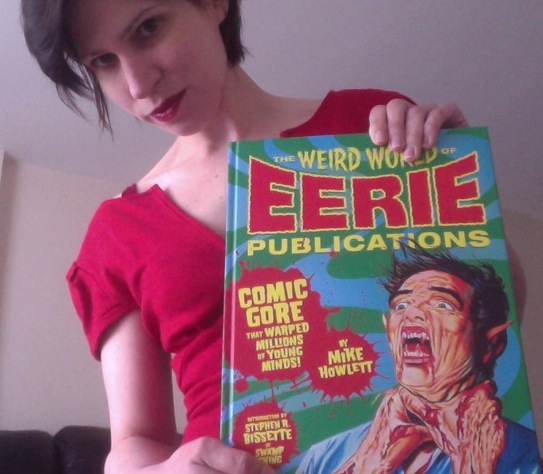
The Weird World Of Eerie Publications by Mike Howlett (2010)
Recommended by Mike

It was my birthday. Kathryn directed me to an unlabelled VHS tape.

‘It’s from me and someone else,’ she said. ‘Play it! Play it!’


I screamed in delight and threw my arms around her.

‘Turn it off now,’ Kathryn said, as the title sequence finished. ‘I’m not watching it.’

Cannibal Holocaust, for the uninitiated, is a notorious video nasty. You can get a flavour of it from this trailer (NSFW):


Even when considered in the later context of torture porn films like Hostel, Cannibal Holocaust is repulsive and intense in its imagery. But, (very unlike Hostel) it has a great deal to say about serious subjects – such as authenticity, Western anthropological assumptions, media exploitation of culture, and the abuse of animals. I’d wanted to see this film, (then) banned and very difficult to get hold of, for years.

So how did Kathryn, who avoids horror movies at all costs, track down Cannibal Holocaust?

The answer is Mike.

Kathryn and Mike ‘met’ on an indie-pop message board. I find it utterly brilliant that my first introduction to Mike was through Cannibal Holocaust, while Kathryn’s was through songs like this:


Mike is American, and he and I began writing letters to one another. Through our correspondence, I found out that he loved horror movies of all eras and styles. My own palate was then fixated on stylized 1970s Euro-horror and nihilistic American efforts like Last House On The Left, and I credit Mike with considerably broadening my tastes.

So when I asked Mike for a book recommendation, he came up with a lavishly illustrated and unapologetically nerdy history of a gruesome comic book company. What kind of person would write a book like this?

Mike would. And he did!

If anyone’s thinking Mike recommended this book to me in order to promote it, I can guarantee that’s the furthest thing from his mind. I know exactly why this most generous and enthusiastic of souls sent me this: so I could understand and love the very weird world of Eerie Publications for myself. If he’d not written this book, he probably would have shipped me over two dozen original comics instead.

Weird and its clammy ‘the world’s gone to shit’ brand of horror was one of the few pop harbingers of what was just around the corner.

Weird, along with Terror Tales, Horror Tales, Tales Of Voodoo, Witches’ Tales, Tales From The Tomb and many other shorter-lived titles, represented the empire of Myron Fass. Fass, a mixture of opportunistic capitalist and deranged gun-toter, cut his teeth in the early 1950s horror comics boom. Blood and oddness had run riot during this period, but it didn’t last. In 1954, the quasi-academic tract Seduction Of The Innocent tenuously claimed horror comics had a deleterious effect on children, and it ushered in an era of censorship (‘the code’): the comics’ bloodletting was stemmed, and unsurprisingly no-one wanted the new neutered stories. Horror comics were over.

Fast-forward a decade. In January 1966, this hit American newsstands.


The first Weird reprinted seven pre-code horror stories […] In some panels, a few extra drops of blood were added to the original art to make it a bit more gruesome.

Myron Fass had hundreds of these 1950s horror stories to mine. Once he’d printed ‘em up on cheap paper (with even cheaper ink that turned a reader’s fingers to charcoal) all Fass had to do was commission new covers.

And what covers they were: a sick, wonderful art form in themselves. In this book, Howlett generously reprints every single one (and the best get their own full-page glory). Check out the human corn-on-the-cob!


And the meat grinder!


The titles were successful, and because Fass now had so very many horror comics on the go, those 1950s stories were running dry. Did he commission new stories? Did he buggery! The man was allergic to paying for stuff. He went for the cheapest option: to give the impression of freshness, he got artists to redraw those same 1950s stories, retaining the original dialogue balloons and text, but with instructions to gore them up. A new title, and voila: a ‘new’ story.

However, it was this very workhouse that gave some talented artists freedom. They creatively interpreted the 1950s material, playing with panels, perspective and character. As long as they also shoved in an eye trauma or a disembowelment, Fass couldn’t care less if they indulged their artier side. Finally, even the redraw tactic ran dry and new stories were grudgingly included, but reprints of the same ancient shit continued right up to the magazines’ dying days in the mid-1970s.

I think my favourite part of the Eerie Publications story was the ultra-bizarre short-lived projects. Look at the mixture of Lady Gaga and Fantastic Planet that was Gasm, from November 1977…


…and the obligatory Star Wars cash-in with amusing copyright-dodging name!


There was even a magazine on the Swine Flu epidemic of 1976! Was there nothing this man couldn't exploit?

I’m so made-up for Mike. This book is a brilliant achievement. With specialist geeky subjects like this, the writing is often stale, but that’s not the case at all with The Weird World Of Eerie Publications. Mike is as funny and lovely in print as he is in real life, and I’m really proud that he’s my friend.


Monday, 13 May 2013

Week Nineteen - Jeanette


 Zona by Geoff Dyer (2012)
Recommended by Andrew


‘I’m off to see Tarkovsky’s Stalker tonight’, Andrew texted me last summer. He was in Edinburgh, spending some time at the festival.

‘Oh, Stalker!’ I replied. ‘I have opinions about Stalker. “Enjoy”.’


I shared those opinions when I next saw him. I considered Stalker overlong and indulgent: a great concept frittered away by a director too in love with his own visuals and not with his audience. I related an anecdote that, to me, summed it up: I’d been watching the film, got bored, gone off to make a cup of tea, came back, and exactly the same shot was still on the screen.

Fast forward a few months, and Andrew recommends me Zona, Geoff Dyer’s recent book about his love affair with Stalker. I’m going to have to watch the bleeder again come May, I thought.

However, through Artificial Eye being useless and happily letting important films go out of print (don’t get me started on their treatment of Rainer Werner Fassbinder), Stalker is unavailable on DVD in the UK at the moment. So I did the next best thing; I rewatched another Tarkovsky movie, Mirror.


I first saw Mirror not long after Stalker and vastly preferred it (I’ve also seen Solaris, which I consider the worst of the three). Mirror probably has even less of a plot than Stalker, but there was a warmth to its images: without wishing to sound too pretentious (very difficult to avoid when talking of Tarkovsky), Mirror evoked the curious space of childhood memory and its impact on the present with great sophistication and candour. I liked it even better on a second viewing.

Immediately, in Zona, Geoff Dyer addresses my moans about Stalker.

By any standards it’s a slow start to a movie. Officials from Gosinko, the central government agency for film production in the USSR, complained about this, hoping the film could be ‘a little more dynamic, especially at the start.’ Tarkovsky erupted: it actually needed to be slower and duller at the start so that anyone who had walked into the wrong theatre would have time to leave before the action got under way. Taken aback by the ferocity of this response, one of the officials explained that he was just trying to see things from the audience’s point of view… He was not able to finish. Tarkovsky couldn’t give a toss about the audience.

So I was right about the Tarkovskian arrogance towards the paying public! But how about that static shot when I went off to get a cup of tea?

Often, in Tarkovsky, when we think something is still it’s not; at the very least, the frame is contracting or expanding slightly, almost as if the film were breathing.

Pah. One-all.

Dyer broadly sees the total lack of interest in a cinema audience as a plus point for ol’ Tarkers: it’s exactly because of that attitude Stalker is the achievement it is. Although mostly Dyer was persuasive as to his argument, he annoyed me at one stage:

At first there can be a friction between our expectations of time and Tarkovsky-time and this friction is increasing in the twenty-first century as we move further and further away from Tarkovsky-time towards moron-time in which nothing can last – and no-one can concentrate on anything – for longer than about two seconds.

This may very well have a kernel of truth in it, yet Dyer’s tone and use of ‘moron-time’ smacks of unpleasant superiority. This was its most obvious example, yet there were other hints that Dyer occasionally didn’t care about his audience, either.

Zona – and I suspect this was the reason Andrew recommended the book to me, rather than simply to argue by proxy about Stalker – is part-autobiography. Dyer not only considers his relationship with the film, but how its various ideas and imagery offer insight into his own history.

The football pools: that, for many British people, was their equivalent of the Room, the thing that would make all their wishes come true. ‘All I’d like to do,’ my mum said with a mixture of pride and humbleness, ‘is go down to the supermarket and buy the nicest piece of steak there. That’s all I want.’

Reading these bits, which increase in frequency as the book goes on, was great, and really helped me understand why Dyer loved the film, and perhaps, also, why I did not. It seems to me that if we only admire a movie for its innovation or beauty, cinema wouldn’t work the way it does, and none of us would have a favourite movie at all, even. But those treasured films, those that do touch us deeply, they set in motion a special chemical reaction. Their content pings off our own yearnings or regrets, loves or hatreds. It’s easy when writing – or speaking – of a film to neglect this, perhaps because we don’t think others will be interested, perhaps because we don’t want to unpick our own muddled feelings, perhaps because its simply easier to praise (or criticise) an audaciously lengthy still shot than to analyse why it affects us so. And this is where I come back to Andrew: in the relatively short time I’ve known him, it’s been his unapologetic and intelligent capacity for introspection, along with an unusual and eloquent means of expressing it, that has had a striking effect on me.

So I can see why Zona has resonated with him. Dyer explicitly applies his own narrative to Stalker, and sometimes this means the structure of the book is messy – many will be frustrated with the digressions via footnotes, everything from a bitch about Lock, Stock And Two Smoking Barrels to missed opportunities for ménage a trois – but I found it a price worth paying. Zona has much more in common with House Of Leaves than, say, with a coolheaded Cahiers Du Cinéma anthology.

Another text from Andrew (yesterday):

            If we ever find a copy of Stalker I demand a gala viewing.

And what did I reply? Has Zona convinced me to sit through it again?

            You’re so ON.

Monday, 22 April 2013

Week Sixteen - Jeanette


The Art Of Travel by Alain de Botton (2002)
Recommended by Mark


Hello from LEAGRAVE!

Leagrave sounds nice, doesn’t it? Perhaps you’re thinking it's a small fishing port on the west coast of Scotland, or a quaint Cornish hamlet accessible only via a meandering B road.

It is neither. It is a soulless Luton suburb, and I am in the bar of a chain hotel, having paid £3.80 for an indifferent (small) glass of red wine and a flickering internet connection.

I’m not finding much artistry in this particular travel experience.

I know that a lot of people don’t like Alain de Botton. His detractors see him as some kind of intellectual parasite who condenses and over-simplifies the ideas of eminent minds for the lumpen proletariat. He doesn’t do much to deflect this reputation. Look at this recent article, 'Ten Commandments for Atheists': who’d ever have thought that being polite was a nice thing to do? Thanks, Alain!

However, I’ve never personally read any of his work; and I do know that de Botton’s recommender Mark needs no commandments (from de Botton or anyone else) to be polite, empathetic or funny. He is one of the two people I’ve known longest on this list. I find that quite upsetting; only two people from my home city that I wanted to get something as simple as a book recommendation from. (Well, there were three, but one didn’t recommend).

Mark used to work on Saturdays at the bread shop down the road (note, ‘bread shop’, that’s the Norwich way. ‘Bakeries’ are for people from Guildford). He was a little bit older, he was in a band, he went to indie gigs at the UEA. I was a young teen, with puppy fat and emotions written all over my face. I loved talking to him, and of course I had a little crush on him. It was one of those early pure crushes: he was way above me and there was no hope of fulfillment, and that was its point. Given that my next crush was to be serious, complex and painful, well, I appreciate those innocent earlier feelings even more.

He even got on TV! Look at this (Mark’s the guitarist with the Mr. Bubbles (??) t-shirt):


He left school, and left the bread shop; eventually he left Norwich too, and went on to have lovely children and a gorgeous wife. It was ace to get back in touch a few years ago, and particularly ace to know that he still made music. Now Mark is better known as the subtle and brilliant electronic pop project Mono Life.


Anyway: the past is another country. Here I am, in the Leagrave present with Mr. de Botton. Can he help me find the pearls among the suburban swine?

The Art Of Travel encourages reflection. Why go away in the first place, and how might we get the best from travel? Too often, de Botton says, we simply assume we’ll have a good time on our holidays, and we don’t. He relates his experience of Barbados.

My body and mind were to prove temperamental accomplices in the mission of appreciating my destination. The body found it hard to sleep, it complained of heat, flies and difficulties digesting hotel meals. The mind meanwhile revealed a commitment to anxiety, boredom, free-floating sadness and financial alarm.

He’s in Barbados and I am in Leagrave. It’s tempting to shout: down a couple of rums, and shut up.

But de Botton’s point is important (even if he expresses it in an irritating manner). We want travel and holiday to be entirely transcendental, to take us away from our problems and our normal selves. When we find our normal selves along for the ride – and usually our problems don’t take the hint to stay at home either – it doesn’t matter what the surroundings are.

How do we square this particular circle? De Botton ‘asks’ artists, writers and thinkers. He surveys how great men (and it is only men that de Botton consults) have looked at the foreign and the native alike, and then connects their words and art with various aspects of the travel experience: anticipation, arrival, sightseeing, return. When de Botton concentrates on those he admires, his style transforms. He no longer moans about non-existent problems. He’s enthusiastic about the ideas of those he writes of, and wants his readers to be so, too. It doesn’t come across as cynical or exploitative. And far from being obvious, de Botton uses a wide variety of carefully chosen source material: he’ll quote from correspondence, speeches and minor works as well as the well-known.

If it is de Botton’s aim to open up minds, then I have two words for you: Gustave Flaubert.


The chapter ‘On The Exotic’, where de Botton discusses the work of Flaubert – in particular, Flaubert’s ambivalence towards France and his attraction to the Middle East – left me wanting to abandon the rest of the Two Readers project and immediately read every scribble Flaubert has ever written. How, how, have I never read this man before? My God! He’s hardly Johnny Nobody. On the basis of the material in The Art Of Travel, Flaubert could easily be my favourite all-time writer.

My life, which I dream will be so beautiful, so poetic, so vast, so filled with love, will turn out to be like everyone else’s – monotonous, sensible, stupid.
                                          (Letter to schoolfriend)

I was really taken, not only with Flaubert’s style, but also with his more general thoughts on life. And this is where credit must go to de Botton for interpreting them in an attention-grabbing and direct way.

[Flaubert] proposed a new way of ascribing nationality: not according to the country one was born in or to which one’s family belonged, but according to the places to which one was attracted. It was only logical for him to extend this more flexible concept of identity to gender and species and for him to declare on occasion that, contrary to appearances, he was in truth a woman, a camel, and a bear.
     
I’ve Madame Bovary sitting on my shelf at home. I’m now so anxious to read it that I’m physically shaking with excitement.

The other ‘guide’ de Botton follows who especially affected me was John Ruskin. The fearlessly sharp tongue this man had! This from his speech to a group of wealthy holidaymakers in 1864:

The Alps themselves you look upon as soaped poles in a bear-garden, which you set yourselves to climb, and slide down again, with ‘shrieks of delight’.

Ruskin was not just being obnoxious (although he clearly relished being so). He was keen to shake people from their apathy, to get them to really, truly, see – not to merely glance, and not to simply understand things as they related to their own egos. And this is what de Botton is trying to do, too; he ends the book by travelling ‘at home’: around Hammersmith, peering at gravy adverts and nosing into office windows.

So let’s have another look at Leagrave.


Nope.

But I’ll have another glass of wine, and shut up.