Showing posts with label 1910s. Show all posts

Tuesday, 31 December 2013

Week Fifty-Three - Jeanette

 Collected Poems 1909-1962 by T.S. Eliot (1909-1962)
Recommended by Jude


People spend years studying the poetry of T.S. Eliot. They don’t usually chuck it into their brain at Victoria Coach Station.

I did not even have a week in which to read this. The combination of adding an extra book to Two Readers and the cumulative effect of the occasional late post left me with eight books in December. But, 2013, throw all the shit you want at me (as I just wrote, today it’s a malfunctioning laptop power pack, meaning I’m racing to do this standing up in Hillsborough's Wetherspoons as the battery life ticks down and new year revellers start piling in) but, fuck you, I’m finishing Two Readers on time.

I want my world to end with a bang, not a whimper.

Jude writes, in her dedication at the front of my copy of Collected Poems 1909-1962, that Eliot’s poetry ‘made me realise the real magic of the English language.’ Perhaps, then, it’s not such a bad thing that circumstance has forced me to pelt through it. I’m reacting in a very primal way, thinking of the way the words dance on the page, feeling the direct relevance that the poems brought to my world.

            We shall not cease from exploration.
                        (‘Little Gidding’)

I saw Jude last night – the wonderful Jude. We were with others, so we didn’t get too long to reflect on the project, but I will tell her now that Two Readers has been one of the most satisfying creative experiences of my life. Even though Jude’s posts weren’t regular, they were brilliant and inspiring, and the credit for turning my idea for book recommendations from friends into a blog entirely lies with her. That’s what true friendship does: one of you has an idea, the other has an idea, you do something amazing together. Iron sharpens iron. I have felt her hands on my back, supporting me, in so many precious ways this year.

            What are the roots that clutch, what branches grow
            Out of this stony rubbish?
                        (‘The Waste Land’)

‘The Waste Land’ came into Jude’s life when she was in sixth form, which provides a curious parallel with the book I recommended for her. We’ve often talked of what made us want to write, and what made us writers (two different things). That era, age sixteen-to-eighteen, is perhaps the key one of my life, and I know she feels similarly.

            The tiger springs in the new year.
            Us he devours.
                        (‘Gerontion’)

Jude and I have each had a very difficult 2013, for different reasons. But through it we have been there for one another. Writing about the people very very closest to me, of whom Jude is one, is not easy. Because there is so much to say about someone I love so very much. So perhaps less is more.

            Both intimate and unidentifiable.
                        (‘Little Gidding’)

Just as there’s so much to say about these bloody incredible poems. (And so little time to say it.)

The first of my favourites is ‘The Hollow Men’. I knew I’d love it just from the Heart Of Darkness epigraph. And then this comes…

            Between the idea
            And the reality
            Between the motion
            And the act
            Falls the shadow
                        (‘The Hollow Men’)

That’s exactly how I’ve felt this year. I’ve felt shadows in my mind, on my heart, in my creative process, coming between thought and result. How can one fight a shadow? I’ve tried. And I am hard on myself when I fail. But Eliot's words buoyed me, they swaddled me, they told me that I didn't need to hate my failure quite as much as I do.

Many of the poems have a strong religious element. There’s clearly a schooled element to Eliot’s Christian history, but there's also playfulness. Take ‘The Hippopotamus’. Its opening lines relate to how huge the animal is, but that it is ‘merely flesh and blood’ compared to the True Church. The poem vacillates between a seemingly genuine devotional fervour and a ludicrous piss-take, particularly with Eliot's glorious image of the hippo ‘performing on a harp of gold’.

For Eliot does have quite the sense of humour, and he sometimes tries to ‘help’ the reader with notes and references, particularly in ‘The Waste Land’.

I do not know the origin of the ballad from which these lines are taken: it was reported to me from Sydney, Australia.
                        (‘Notes on The Waste Land’)

Cheers, Thomas Stearns.

But what of ‘The Waste Land’ itself? It is astonishing. Imagine everything in English literature from Sir Gawain And The Green Knight to Lily Allen. I am simply overwhelmed. The word awesome is so overused, but with reference to 'The Waste Land', I mean it in its original I-am-struck-with-awe sense. Written in 1922, my initial impression is that its some sweep of post-Great War British culture, putting it in the context of the long Christian epoch of the country: of how societies fracture and repair, how traditions break and form. I also loved the references to Dante's Divine Comedy, my only other poetry foray this year. I haven't had the time to research anything of Eliot or his literary intentions, but I have learned from the book jacket that he was an American who settled in the UK in 1915. Perhaps that completely scuppers my theory, but perhaps not: the eyes of the new sometimes open wider, and cry fresher tears.


Since ‘The Waste Land’ is so impossible to sum up, perhaps I should just leave it there before I embarrass myself, and conclude with mentioning my other favourite poem, ‘East Coker’, part of Four Quarters.

            As we grow older
            The world becomes stranger, the pattern more complicated.
                        (‘East Coker’)

This long poem feels like a very personal reflection, a song of experience, one which lights the bonds of humanity. Those ties that transcend the spoken and pull us on to the new. I expect that’s why it has hit me so very hard on this, the old year’s night. I have read fifty-three books and I have loved fifty-three people. I'll never do it again. But I'll never forget it.

            In my end is my beginning.
                          ('East Coker')

Monday, 25 November 2013

Week Forty-Four - Jeanette

The Diary Of Vaslav Nijinsky by Vaslav Nijinsky (1919)
Recommended by Michael

Oh, Michael Tanner! Dorset’s foremost Renaissance Man.

He was really important to me in the early days of writing Seasons They Change. Not only was it so cool to know him for the music that he made, and the stuff he loved, and the books he read, and just plain who he was, he took me along to meet Shirley Collins. Shirley Collins! The interviewee whose words opened and closed Seasons They Change, and whose exploratory attitude made much of the music I wrote about in my book even possible.


When I first spoke to Michael Tanner (he’s one of those people that you somehow need to call by their full name), he was fresh from recording this piece of brilliance.


I loved and love this album for its melancholy, its grace, its subtle tragedy. He sent me MP3s and I listened a lot, but I was a lucky lady: for, at the time, Music For Smalls Lighthouse was largely unheard, unfairly stuck in label limbo. But now, two deluxe and sensitive issues later (2010 CD on Second Language, 2013 vinyl on Clay Pipe), it has found the audience it so richly deserves. It’s even making those best end-of-year lists.

Michael Tanner isn’t only Plinth; he’s been in The A. Lords, Tyneham House, Cloisters, United Bible Studies, loads I've probably forgotten, and even, sometimes, just Michael Tanner.


I was very keen to read The Diary Of Vaslav Nijinsky. Over the past few years, I’ve become incredibly taken with autobiography, correspondence and memoir: fascinated by self-representation, by unwitting testimony, by how recollection erodes and then rebuilds truth.

This diary adds another layer to all that. It is unique in the annals of memoir, since Nijinsky wrote it when he was entering a psychotic state. Shortly afterwards, he was diagnosed with schizophrenia.


I want to write this book because I want to explain what feeling is. I know many people will say that this is my own opinion about feeling, but I know that this is not true, because this opinion emanates from God’s commands. I am a man like Christ who fulfils God’s commands.

By ‘feeling’ he means unselfish and luminous instinct, derived from God’s grace and the fundamental decency of humankind. He saw ‘thinking’ as feeling’s opposite: thinking is conscious, human-derived and ultimately corrupt and corrupting. Choosing thinking above feeling leads to personal unhappiness and wider social ills.

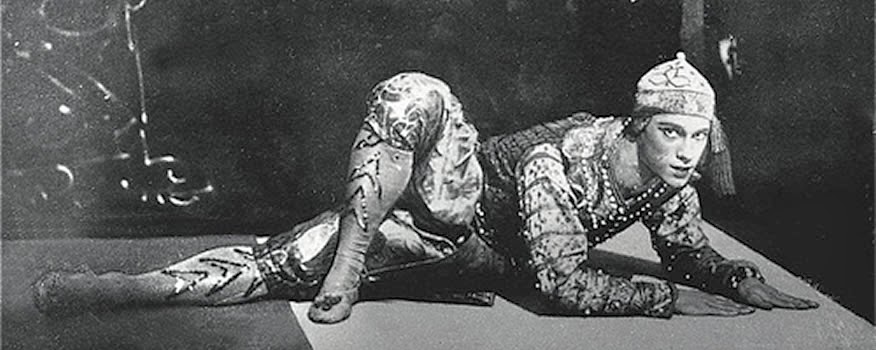
It’s difficult not to parallel Nijinsky’s elevation of feeling over thinking to his chosen career. Surely, dance is that most intuitive of art forms: nimble feet are nimble feet, and ‘thinking’ won’t make leaden ones featherlight. But Nijinsky was not only (or, by 1919, even primarily) a dancer. He was a choreographer. His works, such as Afternoon Of A Faun and Jeux, were hated and loved in equal measure for their modernist approach. Nijinsky was fresh from a disastrous tour of America as he wrote the Diary: perhaps he saw the hostile reception from audiences as their failure to ‘feel’ his work, that they were too caught up in ‘thinking’ about it. Nijinsky claims to far prefer performing for poor people, believing them to have a connection with his work that critics and learned audiences do not. Of course, Brian Molko from Placebo also spews out that kind of self-protecting junk whenever the music press slam his latest ‘opus’. But I suspect time won’t prove Brian Molko's critics wrong.

And this is where The Diary Of Vaslav Nijinsky becomes an essential part of a legend. We have not one scrap of surviving footage to judge his dance and choreography genius for ourselves. Nijinsky must be one of the last performers to occupy this position, so alien in our modern age, when seemingly every gig is marred by some twat videoing the lot on a mobile phone. Our hunger to know what Nijinsky was actually like has even led to a painstaking reconstruction of Afternoon Of A Faun, designed and shot to make us feel as far as possible that we are watching authentic film stock.


That is why this edition of the Diary, the unexpurgated one (which Michael Tanner insisted on) is so important to read, rather than the one that is more freely and cheaply available. Romola Nijinsky, his wife, was the diary’s original editor (in 1936). Not only did she snip out all the unflattering references to herself (she was a ‘thinker’: enough said) and the passages about ‘pricks’ and defecation, she also performed a more insidious form of censorship. She rearranged Nijinsky’s words, effectively making his madness seem dark-eyed and Byronic. An overspill of too much talent. Twenty years had passed since anyone had seen Nijinsky dance, and the world was comfortable with cinema, newsreels, and a seeing-is-believing approach to history. In the absence of any of this direct evidence, Romola ramped up the circumstantial case for Nijinsky’s genius.

In this new translation, all Nijinsky’s experiences are restored. And, yes, sometimes he is in dramatic despair.

I am sitting at an empty table. In the drawer of my table there are many paints. All the paints have dried up because I do not paint anymore. I used to paint a lot, and I made good progress. I want to paint, but not here, because I feel death.

But, often, his mental illness manifests in far more mundane ways. He loves having a passive-aggressive pop at people, like when he relates how Serge Diaghilev (his former Svengali and lover) dyes his hair, and when he gossips about his sister-in-law’s drunken benders. He’ll go on about his vegetarian diet for several centuries, and writes pages and pages about the inadequacy of modern fountain pens. All these are well within the realm of the usual mental health social worker chats, rather than fitting Romola’s image of splendid cape-swinging insanity.

However, sometimes, Nijinsky will provide a glimpse of how difficult Romola’s everyday life must have been.

I have told my wife that I have invented a pen that will bring me a lot of money, but she does not believe it, because she thinks that I do not understand what I am doing. I showed her a pen and a pencil in order to explain to her the pen I have just invented.

So, perhaps Romola Nijinsky did not only rejig the Diary to stoke her husband’s reputation. It was to provide dignity to the experience of watching the man she married change from a fulfilled and acclaimed artist into someone who relentlessly spouted preposterous and often hurtful statements.


There is so much in this book. Nijinsky’s devotion to the Tolstoyist religious sect (a form of anarchist Christianity, focusing on Jesus’s pacifist and classless teachings, renouncing fleshy, sensory and culinary pleasure) is a crucial thread, as is his struggle to understand the Great War and its immediate aftermath. Nijinsky was also keyed in to environmentalism, and was cognisant of the economic damage caused by unregulated stock markets, long before many gave a damn about either of those causes.

I do not know how to plow, but I know that the earth glows. Without its warmth there would be no bread.

I want to have millions in order to make the Stock Exchange crash. I want to ruin the Stock Exchange. I hate the Stock Exchange. […] The Stock Exchange robs poor people, who bring all the money they have in order to increase it, in the hope of achieving their goals in life.

Then there is the language itself: circular, rhythmic, full of unusual bridges between concepts that give the whole thing an inner logic (albeit one whose heuristic key is known only to Nijinsky himself). At points, particularly in the final ‘Fourth Notebook’, it becomes so infected with invented words and repetition that it is virtually unreadable. Even the translator gives up.

           Pa pi pa ti pa pi ti
           Ci ci ci ci ci ci ci

Nijinsky did not see this work as a private journal. Rather, he wanted it published and distributed for free; he didn’t even want it typed, but sought reproduction of his own handwriting. Thus, the text itself would not need any ‘thinking’, because in and of itself, it embodied ‘feeling’.

I adored The Diary Of Vaslav Nijinsky. I had not read its bizarrely sorrowful like before, and I suspect I shall never read anything comparable again. And, perhaps, even though it was important to read the unexpurgated edition, Romola Nijinsky was right. We want Vaslav Nijinsky to embody a romantic, tortured genius, and it is those passages of deep distress that are the ones that linger.

I am not a dying man. I am alive, and therefore I suffer. My tears rarely flow. I weep in my heart.