Showing posts with label 1960s. Show all posts

Tuesday, 31 December 2013

Week Fifty-Three - Jeanette

 Collected Poems 1909-1962 by T.S. Eliot (1909-1962)
Recommended by Jude


People spend years studying the poetry of T.S. Eliot. They don’t usually chuck it into their brain at Victoria Coach Station.

I did not even have a week in which to read this. The combination of adding an extra book to Two Readers and the cumulative effect of the occasional late post left me with eight books in December. But, 2013, throw all the shit you want at me (as I just wrote, today it’s a malfunctioning laptop power pack, meaning I’m racing to do this standing up in Hillsborough's Wetherspoons as the battery life ticks down and new year revellers start piling in) but, fuck you, I’m finishing Two Readers on time.

I want my world to end with a bang, not a whimper.

Jude writes, in her dedication at the front of my copy of Collected Poems 1909-1962, that Eliot’s poetry ‘made me realise the real magic of the English language.’ Perhaps, then, it’s not such a bad thing that circumstance has forced me to pelt through it. I’m reacting in a very primal way, thinking of the way the words dance on the page, feeling the direct relevance that the poems brought to my world.

            We shall not cease from exploration.
                        (‘Little Gidding’)

I saw Jude last night – the wonderful Jude. We were with others, so we didn’t get too long to reflect on the project, but I will tell her now that Two Readers has been one of the most satisfying creative experiences of my life. Even though Jude’s posts weren’t regular, they were brilliant and inspiring, and the credit for turning my idea for book recommendations from friends into a blog entirely lies with her. That’s what true friendship does: one of you has an idea, the other has an idea, you do something amazing together. Iron sharpens iron. I have felt her hands on my back, supporting me, in so many precious ways this year.

            What are the roots that clutch, what branches grow
            Out of this stony rubbish?
                        (‘The Waste Land’)

‘The Waste Land’ came into Jude’s life when she was in sixth form, which provides a curious parallel with the book I recommended for her. We’ve often talked of what made us want to write, and what made us writers (two different things). That era, age sixteen-to-eighteen, is perhaps the key one of my life, and I know she feels similarly.

            The tiger springs in the new year.
            Us he devours.
                        (‘Gerontion’)

Jude and I have each had a very difficult 2013, for different reasons. But through it we have been there for one another. Writing about the people very very closest to me, of whom Jude is one, is not easy. Because there is so much to say about someone I love so very much. So perhaps less is more.

            Both intimate and unidentifiable.
                        (‘Little Gidding’)

Just as there’s so much to say about these bloody incredible poems. (And so little time to say it.)

The first of my favourites is ‘The Hollow Men’. I knew I’d love it just from the Heart Of Darkness epigraph. And then this comes…

            Between the idea
            And the reality
            Between the motion
            And the act
            Falls the shadow
                        (‘The Hollow Men’)

That’s exactly how I’ve felt this year. I’ve felt shadows in my mind, on my heart, in my creative process, coming between thought and result. How can one fight a shadow? I’ve tried. And I am hard on myself when I fail. But Eliot's words buoyed me, they swaddled me, they told me that I didn't need to hate my failure quite as much as I do.

Many of the poems have a strong religious element. There’s clearly a schooled element to Eliot’s Christian history, but there's also playfulness. Take ‘The Hippopotamus’. Its opening lines relate to how huge the animal is, but that it is ‘merely flesh and blood’ compared to the True Church. The poem vacillates between a seemingly genuine devotional fervour and a ludicrous piss-take, particularly with Eliot's glorious image of the hippo ‘performing on a harp of gold’.

For Eliot does have quite the sense of humour, and he sometimes tries to ‘help’ the reader with notes and references, particularly in ‘The Waste Land’.

I do not know the origin of the ballad from which these lines are taken: it was reported to me from Sydney, Australia.
                        (‘Notes on The Waste Land’)

Cheers, Thomas Stearns.

But what of ‘The Waste Land’ itself? It is astonishing. Imagine everything in English literature from Sir Gawain And The Green Knight to Lily Allen. I am simply overwhelmed. The word awesome is so overused, but with reference to 'The Waste Land', I mean it in its original I-am-struck-with-awe sense. Written in 1922, my initial impression is that its some sweep of post-Great War British culture, putting it in the context of the long Christian epoch of the country: of how societies fracture and repair, how traditions break and form. I also loved the references to Dante's Divine Comedy, my only other poetry foray this year. I haven't had the time to research anything of Eliot or his literary intentions, but I have learned from the book jacket that he was an American who settled in the UK in 1915. Perhaps that completely scuppers my theory, but perhaps not: the eyes of the new sometimes open wider, and cry fresher tears.


Since ‘The Waste Land’ is so impossible to sum up, perhaps I should just leave it there before I embarrass myself, and conclude with mentioning my other favourite poem, ‘East Coker’, part of Four Quarters.

            As we grow older
            The world becomes stranger, the pattern more complicated.
                        (‘East Coker’)

This long poem feels like a very personal reflection, a song of experience, one which lights the bonds of humanity. Those ties that transcend the spoken and pull us on to the new. I expect that’s why it has hit me so very hard on this, the old year’s night. I have read fifty-three books and I have loved fifty-three people. I'll never do it again. But I'll never forget it.

            In my end is my beginning.
                          ('East Coker')

Thursday, 19 December 2013

Week Forty-Nine - Jeanette

The Autobiography Of Malcolm X by Malcolm X (as told to Alex Haley) (1965)
Recommended by Sarah

A little over a year ago, Sarah and I were in Egypt.

We weren’t just arsing about in the pyramids (although we did that, too): we were working as part of the TEMPUS project at the universities in Cairo and Assiut. We were there at a turbulent time. President Mohamed Morsi had granted himself unlimited power, and there were sweeping protests against this. If you remember the story, you probably recall UK news emphasising violence and disorder.

That contradicts what I saw. Sarah and I went to Tahir Square with our Egyptian host. Yes, there were some disturbing embers of conflict – rubble, tanks, streets closed off – but the protests we saw were non-threatening. They had a message to be heard, the people were determined, but the method was intelligent serious debate and not aggression. Protesters even organised the street clean-ups. This politically engaged attitude was also present in the students Sarah and I met at the universities. Apathy wasn’t on the table. Incredibly inspiring, and something Sarah and I talked of over the crazy sludge that is Egyptian coffee (which I got rather addicted to).

As the first time Sarah and I had spent much time together, I found that she herself was pretty inspiring. She is involved directly in the campaign for women bishops. I recently went to an event that she organised, and was saddened and shocked at the depth of opposition within the Church of England hierarchy to women bishops, while also being supremely impressed with the fire of those working for progressive change.

With her willingness to stand up and be counted, it makes sense to me that Sarah studied, and retains a very strong interest in, African-American history and those who fought for political and human rights.


Malcolm X is a divisive figure. While everyone (everyone non-racist) can feel comfortable with Martin Luther King, Malcolm X is often accused of ‘reverse racism’. That, in his anger at the oppression of African-Americans, he espoused an uncompromising solution: complete segregation of black and white. He had a penchant for calling white people ‘devils’ and was especially suspicious of any who supported civil rights and integration.

I very much respect Malcolm X. From my relatively privileged position, I still get so worked up over inequalities that I want to throw paint at things; fuck, if I was a black person in post-war America I’m sure I’d be angry, feel that white people were devils, and distrust their efforts to ‘help’.

My mother, with the baby in her arms, just made it into the yard before the house crashed in, showering sparks. I remember we were outside in the night in our underwear, crying and yelling our heads off. The white police and firemen came and stood around watching as the house burned down to the ground.

The Black Legion, a local version of the Ku Klux Klan, set that fire. A white man raped Malcolm’s grandmother (resulting in her pregnancy with Malcolm’s mother). White men murdered Malcolm’s father, the Reverend Earl Little, because of his vocal support for Marcus Garvey. As a child, the Little children were called ‘nigger’, ‘darkie’ and ‘Rastus’ so much ‘we thought those were our natural names’. Malcolm, academically top of his class, was told to give up any thoughts of being a lawyer and to be a carpenter instead.

Yes. I’d be really fucking angry, too.

Malcolm Little (the X came slightly later: it symbolises the true African family name that an African-American could never know) responded, at first, through hustling, drugs, pimping, crime and, as he terms it, being ‘mentally dead’. He is hard on himself for collaborating with racist America by exploiting other black people (selling drugs) and trying to ‘whiten’ his look by straightening his Afro hair. He ends up in prison, and begins to read, everything from rare anthropology texts to the dictionary itself. His curiosity is piqued as to how and why slavery and exploitation occur.

First, always ‘religiously’, he [the white man] branded ‘heathen’ and ‘pagan’ labels upon ancient non-white cultures and civilizations. The stage thus set, he then turned upon his non-white victims his weapons of war. […] Europe’s chancelleries for the next century [19th] played a chess game of naked exploitation and power from Cape Horn to Cairo.

It is during this period when he becomes taken with the Nation Of Islam (NOI), led by Elijah Muhammad. NOI teachings draw from mainstream Islam – there is no God but Allah, total adherence to the Qur’an, prohibitions on alcohol and pork, for example – but have a specific American cultural context. For instance, the ninth platform of NOI reads:

WE BELIEVE that the offer of integration is hypocritical and is made by those who are trying to deceive the Black peoples into believing that their 400-year-old open enemies of freedom, justice, and equality are, all of a sudden, their friends.

Also not a part of mainstream Islam, and far more dubiously, NOI holds its own creation myth. White people were the result of genetic engineering. Over six thousand years ago, when all humankind was black, the scientist Mr Yacub (the biblical Jacob), was embittered towards Allah. He holed up on the island of Patmos and created a ‘bleached-out white race of devils’ (the Jews). This white race stirred up trouble, until they were exiled to Europe; they remained in caves, living savagely, until Allah sent Moses to ‘civilise’ them.

This I find very troubling. I don’t have a problem with African-Americans calling white people ‘devils’ on account of their collective racist behaviour. I do have a problem with a bogus scientific explanation for devilishness that specifically targets Jewish people. We all know where that can lead.

As well as this ‘Dr Yacub’ business, the other big gripe I have with Malcolm X is his frankly atrocious attitude to women. He casually and routinely comments on a woman's attractiveness, and how women in general are manipulative, have little purpose but  to support a man and family, and should basically be treated as babies or pets. It's worth noting that this attitude predates his NOI days (although the organisation didn't exactly stop his misogyny).

Malcolm X rose through the NOI ranks very quickly, and helped membership and visibility. His rousing and inflammatory speeches brought the race debates in America to a new intensity; he explained and challenged racism on TV and in print, often in the face of stupid and insulting interviewers.


Soon, far more people knew his name than that of Elijah Muhammad. Malcolm X writes that he remained loyal to Muhammad, even when scandal broke over the latter’s fondness for impregnating his secretaries. He even massaged his speeches in light of Muhammad’s indiscretions. 

I began teaching in New York’s Mosque Seven that a man’s accomplishments in life outweighed his personal, human weaknesses. I taught that a person’s good deeds outweigh his bad deeds. I never mentioned the previously familiar subjects of adultery and fornication, and I never mentioned immoral evils.

However, like the character Syme in Nineteen Eighty-Four, who is eliminated because he ‘sees too clearly and speaks too plainly’, the eloquent and high-profile Malcolm X is expelled from the NOI. Relationships deteriorate quickly. Malcolm X tries to regroup – he undertakes a pilgrimage to Mecca, spends much time in Africa, and converts to Sunni Islam – but, by the end of the Autobiography, the mood is very sombre indeed.

I do not expect to live long enough to read this book in its finished form.

He didn’t. Nation of Islam members murdered Malcolm X in February 1965.

I felt very galvanised reading The Autobiography Of Malcolm X, just as I was when I saw those Egyptian protests. For we need people who are not going to sit down and shut up.

It’s how shit gets done in this troubled world.


Tuesday, 19 November 2013

Week Forty-Three - Jeanette

Rabbit, Run by John Updike (1960)
Recommended by Dan


So tall, he seems an unlikely rabbit, but the breadth of the white face, the pallor of his blue irises, and a nervous flutter under his brief nose as he stabs a cigarette into his mouth partially explain the nickname.

As I type, I’m on the sofa at the house Dan shares with Jude. I purposefully wanted to read Rabbit, Run this week; having liberated myself from the project’s alphabetical order, I thought it would be fitting to experience John Updike’s work while hanging out with the man whose favourite book it is.

I’ve been staying with Jude and Dan for a week. Here I am with Poppy, who lives with them (she’s my favourite cat! Any excuse for a photo).


As it turned out, Dan and I didn’t get much of a chance to talk on it. At the start of the week, and at the start of my reading, I told him that it was brilliantly written, and that I found it very unforgiving. (‘But that’s okay,’ I added).

I’ve known Dan for a long time, and how I’ve related to him has evolved a lot. In my late teens, he was the friend of a boyfriend; in my twenties, part of the ‘North London set’ of people in bands who were always at the pub; from my later twenties onwards, Jude’s partner and then husband. It’s strange, but until recently I’d seen Dan primarily through the lens of other people. That's changed over the last couple of years. Satisfying, now, to be clear-eyed, and to have my own unique friendship with him.

Dan is a fantastic musician and, like Dave, is in the awesome The Drink; he was also in Fighting Kites, Michaelmas and, many years ago, Adekola Sound. I feel I have a lot to learn from him about experimental music, minimalism, and modern classical. As I’ve pointed out before, I tend to generalise the whole thing as an impenetrable slab of cold marble, yet this week he played me Oren Ambarchi’s ‘Grapes From The Estate’ and the emotional appeal of it was plain as day to me. Maybe next time I look after Poppy I’ll turn off the internet, needle-drop Dan’s records, and binge on the impressive pile of The Wire magazines.


Rabbit, Run seems to be one of the Two Readers books that quite a lot of friends have already read, and most not only had an opinion on it but an opinion on how I might receive it. Most thought I’d admire it, but that I might not like it too much.

Hard-hearted: the word seems to clatter after them as they climb the stairs to the second floor.

Indeed, the word seems to clatter after the whole of the novel. Harry ‘Rabbit’ Angstrom is an unpleasant man who, in his lack of compassion for others, borders on the sociopathic. In the most famous line of the novel, Rabbit declares that if you have the guts to be yourself, other people will pay your price.

Guts to be yourself. Guts. That word in itself asserts what I found so incredibly impressive in Rabbit, Run's characterisation. Rabbit believes that ‘being yourself’ (in his definition, indulging your own drives and damning the consequences) stems from an inner honesty and not from selfishness. He sees the world as rabbit-eat-rabbit, and if others aren’t prepared to cannibalise or be cannibalised, then it’s their own lookout. He has nothing but contempt for them.

            ‘Forgive me. I’m in a very depressed mood.’
There’s nothing exactly wrong with his saying this, but it rubs Harry’s inner hair the wrong way. It kind of clings. It says, Pity me. Love me.

Why is he like this? The psychology in Rabbit, Run is subtly explored. Rabbit was, once, a basketball prodigy, of whom great things were expected. Now he’s demonstrating a kitchen mod-con called the MagiPeel. There comes a point in all our lives where we stop having ‘potential’ and have to actually deliver on it. If we don’t, the feeling is excruciating. Rabbit isn’t one for lengthy oh-poor-me soliloquies; instead, he expresses his frustration at underachievement in a far less sympathetic way. The book is called Rabbit, Run because that’s what he does. Nothing – not a job, friends, home, marriage, fatherhood – is for life. Rabbit is never able to withdraw his foot from its default position, that of wedging open the escape hatch.

Janice, his pregnant wife, is a constant reminder to Rabbit of how he isn’t living the life he wants. She is an alcoholic and a sloth, but with a sadness that is clear to the reader. Rabbit ignores, is ignorant of, or is simply uncaring about the reasons that may underlay Janice’s behaviour. At the start of the book, he leaves her.

            ‘I’m not that interested in her. I was, but I’m not.’

Ouch. When long-term relationships break down, whether we are the dumper, dumpee, or at some more mutual point on the spectrum, we’d like to believe it nobler than the simple dulling effect of monotony. How many of us just think, ‘I’m sick of looking at your face each morning, because all it does it get older and tireder and less attractive?’ Far, far, far more of us than would ever admit it, I’d wager.

And what do we do when we think this? Often, like Rabbit, we run, run to someone new, even if it’s only in our heads. Rabbit runs to Ruth, a more obviously sexual being than Janice. He doesn’t change his behaviour very much.

He repeats, ‘Did I?’ and pinches her arm, hard. He hadn’t meant to do it so hard; something angered him at the touch of her skin. The sullen way it yielded.
                              ‘Ow. You son of a bitch.’
Still she lies there, paying more attention to the sun than him. He gets up on an elbow and looks across her dead body to the lighter figures of two sixteen-year-olds standing sipping orange crush from cardboard cones.

I didn’t like Rabbit (but then I doubt you’re meant to). But I didn’t hate him, either. I both admired and detested his unbridled id and part of me, a very small but very honest part, recognises in him something of my own questionable past behaviour. But, right there, that’s the difference between Rabbit and I: I am, at least, a little bit ashamed of it.

A criticism levelled at Updike is that he was an unapologetic misogynist (this Guardian piece is fairly typical of the arguments). Updike’s treatment of women reminded me of my favourite laugh-a-minute playwright, August Strindberg, who was also frequently labelled as a big ol’ sexist. In Rabbit, Run, as in (e.g.) Miss Julie, women are equally complex and shitty as men, although patriarchal society moulds them into a different complexity and shittiness. This includes affecting the pose of victim, which both Ruth and Janice do, at points. Depressing, yes, sexist… I didn’t experience it as such. It was perfectly in line with Updike’s angry critique of interpersonal relationships and his brutal frankness about how people take advantage of the power handed to them. Nowhere was this more obvious than in the book’s disturbing scene of sexual coercion. I consider Rabbit, Run a depiction of misogyny, while not being misogynist in itself.

The final section of the book was a rather different beast to all this, and absolutely magnificent. If you want to avoid a spoiler, stop reading now, but I feel I can’t discuss Rabbit, Run without revealing and praising the treatment of this plot point. Janice and Rabbit’s baby daughter dies as a result of parental neglect. The guilt, blame, shock, grief, and community response that follows her death drips with profound desolation, while never once threatening melodrama.

The coffin, with handles of painted gold, rests on a platform draped with a deep purple curtain; he thinks the curtain might draw apart and reveal, like a magician’s trick, the living baby underneath.

I would have, I’m sure, applauded Rabbit, Run even had it not taken this very intense turn. However, it is this that really does push it into the realm of great achievement. It is an unflinching, uncensorious, unkind, undeniable, masterpiece.


Wednesday, 17 April 2013

Week Fifteen - Jude

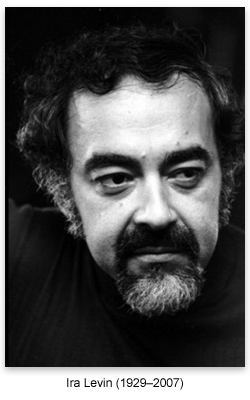
Rosemary's Baby by Ira Levin (1967)
Recommended by Eamonn Forde


Here's a book I finished on Sunday - Sunday! - but haven't written about yet because I've been up to my ears in writing for readies. But write about it I shall. And for some reason I fancy writing about it in the form of a list. So there.

1. This was recommended to me by Eamonn Forde. Now, I met Eamonn through work, sort of – he is a good pal of Andrew Harrison, my old colleague at Word, and old editor (sniff) at Q. Eamonn is The World's Eminent Music Business Journalist ((c) Neil McCormick, 2010). He has a doctorate in pop (true fact). His spiritual mentor is Blanche from Coronation Street. He has a very rude sense of humour and likes "putting" random words "in" quote marks "within" sentences to flag "up" moments of "ridiculousness". He likes Tayto crisps more than life itself.

2. Eamonn recommended me five Ira Levin books, in order of how much he liked them. I picked the second. I did because this novel the source matter for Jeanette's favourite film in the world. When I told her I was reading this, yes, she squeaked a bit.

3. It's very odd reading a story which you know so well in another form. It's unfair to the book, really. I knew what was coming from the off, and all the hints about unpleasantness flagged up early on...well, they screamed off the page like sirens. The book, therefore, seemed more pulpy than the film – but was it really? It was hard to distance myself from images I knew so well in my mind, and broach the characters without putting their words into the mouths of Mia Farrow and John Cassavetes.

4. The book is very faithful to the film in terms of dialogue. Reading it also made me appreciate how brilliant Ruth Gordon is as Minnie Castavet.  And the dialogue is bloody brilliant. It's so easy to get wrong, and sound clunky. But Levin is the master.

5. Roman Polanski's editing, I thought, made his version of the story more eerie. For instance, there's a lot more detail about Terry here, the houseguest of the Castavets, who – and this is no spoiler for those of you who haven't seen it – dies very early on. This made me wonder if books can't edit out details as much, and leave spaces in the story for us to fill in the blanks. Also, my favourite scene in the film (when Rosemary is on the phone in the phone booth to Dr Hill) didn't have my favourite detail in it in this original text: the sudden arrival of a man who stands in front of the phone booth, with his back to the camera, whose intentions aren't clear. It's a terrifying moment that wouldn't have worked in the book. It's made me "think" about the differences "between" different sorts of "text".


6. There's a bit in the book that didn't make the film about Rosemary going away for a few days to Hutch's cabin, near Brewster. I can see why this section didn't make Polanski's cut, but I really liked it. Levin goes into Rosemary's mind much more in this original story, properly exploring her internal battles about her relationship with her husband. He shows us how she craves independence, but how she feels she should trust people to look after her as that's what women 'should do'. He also shows her acknowledging, more deeply, the fact that he raped her, and how she goes against her better instincts throughout. The book feels much more like a text about feminism than the film, in some ways.

7. I loved how the political climate of the US was pushed a bit more in this book – it really feels like a story from the mid-60s, where the film doesn't as much. I also loved some of the details of Rosemary's earlier life, as a girl fresh to New York from the sticks, and how it gave her back story more depth...although this could also suggest that girls moving to the big city should beware, of course. Like me. Argh!

8.  I liked the eerieness of the inclusion of the papal visit to New York, although I thought the Catholicism sections were a bit too hammy. But Rosemary's dream of the nun early on, and the voices she actually hears...I wish I'd not seen the film at that point. The realisation of its significance later on would have been a "proper jaw-dropper".

9. The ending went on too long. Sorry, Ira. It also made me feel a bit uncomfortable that the idea that a mother's love overcomes everything. It doesn't always. So there. Put that in your pipe and smoke it.

10. I really, really liked this book, despite the whole "I've seen the film already" mind-confusions, and I want to read more of Ira Levin now. Although Eamonn's advised me to "NOT read Son Of Rosemary. It will anger you." So I won't. But The Boys From Brazil, The Stepford Wives, A Kiss Before Dying...let me at you.

Sunday, 10 February 2013

Week Six - Jeanette


Revenge Of The Lawn by Richard Brautigan (1971)
Recommended by Stephen


1998. ‘You’ll like this,’ Stephen said, pressing a 7” single on me. We were in the basement of Brighton’s Wax Factor, having only met a couple of hours previously. The single was post-punk perfection:


I not only liked it; it became one of my favourite singles of all time. I went on to buy everything else by LiLiPUT. The search for their second LP, Some Songs (released in Germany only), dragged on until 2008.

Stephen and I had been writing to each other for eighteen months or so by the time of our meeting. He had contacted me, asking for my fanzine Kirby (then on its second issue), and I had been delighted to get his letter. For Stephen was a well-known name to people who wrote fanzines. His reputation preceded him: someone with excellent taste, kind and supportive, a scourer of the charity shops down in Brighton, and the person with the best collection of books, records, and ephemera. My cultural horizons would be a whole lot narrower without Stephen in my life. He must have turned me on to well over two hundred things I would never have discovered without his guidance: from Helen And The Horns offshoot bands to obscure Caribbean dub poetry.

However, and by degrees, a new person emerged to me. Stevie was within Stephen. Because while Stephen and I would talk about books and records, Stevie and I – via letter and telephone – shared our lives.

It was a mixture of Stephen and Stevie that recommended Revenge Of The Lawn to me. Stephen, with his eclectic taste in books, was perfectly capable of dealing me an oral history of waitresses in Balham or a book of Cuban horror movie poster art; but I know Richard Brautigan is an enduring part of his collection, nestled within its heart chambers. And Stevie, who knows my inner world, felt I would react well to the book's tone, its detail, and its compassion for human eccentricity.


How many short stories can you fit into a 174-page book? Richard Brautigan can fit in 62. This is ‘The Scarlatti Tilt’ in its entirety:

‘It’s very hard to live in a studio apartment in San Jose with a man who’s learning to play the violin.’ That’s what she told the police when she handed them the empty revolver.

If the creative writing advice is true, and that in a short story every single word should count, ‘The Scarlatti Tint’ has to be the medium’s flawless exemplar. Not every one of Revenge Of The Lawn’s component parts is so concise. But, in many of the stories, Brautigan encapsulates something in a few words that other writers would need a paragraph or more to describe.
           
            They all looked like people whose names you forget.
                                                                        (‘The Pretty Office’)
           
              Love affairs that were breathing mirrors of my unhappiness.
                                                            (‘American Flag Decal’)

We see a cafĂ© resting in the snow’s leisure.
                                                 (‘Thoreau Rubber Band’)

It is the polished nucleus of writing.

I’ve often heard Brautigan’s work described as ‘surreal’ yet – in Revenge Of The Lawn, at least – I found this judgement shallow (although the titles do all sound like lost tracks from Trout Mask Replica). While a few stories do have an otherworldly aspect, such as the sad consumer daze of ‘The Wild Birds Of Heaven’, most are very human and relatable. A note of deep profundity is often struck at the end, which sometimes only makes sense in the context of the title.

Witness my favourite, the one-page ‘A Complete History Of Japan And Germany’. It begins:
           
A few years ago (World War II) I lived in a motel next to a Swift packing plant which is a nice way of saying slaughterhouse.

The narrator describes the sound made by the pigs:

                        A squealing lament equal to an opera being run through a garbage disposal.

However, he soon gets used to the anguished porcine cries. The final line:

Whenever the pigs weren’t screaming, the silence sounded as if a machine had broken down.

Thinking about that title, and the reference to the war in the first line, plus the fact it was written in 1969, during the Vietnam conflict… this story seems a subtle update of Nineteen Eighty-Four doublethink: war is peace.

I can see the huge influence of this work on modern America, and not just in literature. I would wager Larry David is a fan; ‘Complicated Banking Problems’ is nothing if not a lost Seinfeld episode. Some musicians openly acknowledge his influence, like Neko Case and Devendra Banhart, while dozens more simply rip him off, hoping their audience won’t twig.

Brautigan was also a poet, unsurprising given his talent for expressing intricate ideas in a compact package. Hear him reading 'All Watched Over By Machines Of Love And Grace':


I was glad when the bus came. There is a certain happiness sighted when your bus comes along. It is of course a small specialized form of happiness and will never be a great thing.
                                                            (‘The Old Bus’)


Stevie, your hope was realised: I did enjoy this. XXXOOO.

Wednesday, 6 February 2013

Week Five - Jude

Things: A Story Of The Sixties by Georges Perec (1965)
Recommended by Stuart Evers


From the urban streets of America to Paris we go – a journey I did on the District Line this week.

I started a Georges Perec novel about ten years ago. It was the French writer's most famous one, Life: A User's Manual, a novel of interwoven stories about people living in a housing block, written under all manner of fancily-fangled constraints. Literary puzzles and riddles ran right through its seams. Perec had also written a book without the letter "e", I recall – 1969's The Void – which was impressive, although I was also impressed by the bloke who had translated it into English, following the same rules.

I don't know why I didn't carry on reading Life: A User's Manual – I was probably half-reading ten books a time, and was more preoccupied with the pub. I remember liking it though, especially the way in which it went into intricate detail about everything (much like John Updike's Rabbit Run does, come to think of it). So when I came across it again early last year, on a wedding invitation from my friends Stuart and Lisa, I knew I had to make acquaintances with old Perec again.

But let's not forget Stuart. I've known Stuart for nearly 12 years now. When we met, he was working for a publisher, and had worked for a bookseller: he's now published a novel and ten short stories about smoking for Picador. He is funny and silly and lovely, and has remarkable hair. He also loves books so much that his success couldn't have been given to a better person.

Also, when Jeanette and I told him about this project he misunderstood it a bit: he thought we simply wanted 52 books from our friends, any friends. So what did he do? Send us a list of 52. Wowsers. I picked this for the reasons stated above, and because it was slim, but yet – Stuart promised me – also superb.

This book has been a proper escape this week. This is Perec's first novel, written when he was 29. The translation – as far as I can say this without actually knowing the original – is great, creating a swirling, compelling, meditative mood. It helps that this book involves long collections of les choses that its protagonists are obsessed by: "knitwear, silk blouses, shirts by Doucet, cotton voile ties, silk scarves, tweed, lambswool, cashmere, vicuna, leather and jerseywool, flax and, finally the great staircase of footwear leading from Churches to Westons, from Westons to Buntings and from Buntings to Lobbs". It's strange how giddying and lovely lists can be.

It's about Jerome and Sylvie, two young people floating along in the lives, working for a market research company, believing real life is around the corner. They have everything and nothing. They feel cast adrift from any moorings thanks to a feeling of lack. They need more to be happy. They want more. They never get it. But in many ways – hey, people – they have it already, and the moral of this book should feel easy-breezy on paper. But the style in which it's put across suggests something else – a cutting satire on our whims and desires, and something tragic.

This book's subtitle – A Story Of The Sixties – explains its motives. This is a story about the rise of capitalism, and its effects on people's lives, especially young people bedazzled by consumerism and choice. The book is written mainly in the conditional tense, which gives it a riddle-like feeling...they "would", they "could",  if only they these conditions could be met...then, things would be OK. These things could offer so many alternative, wonderful futures.

This novel also feels oddly fresh, just like the Jane Jacobs book last week, partly because our society is still occupied by the same concerns. And there lies the sadness, the ridiculousness, of it all. The couple's friendships unravel. They notice the Algerian War, but barely. There is also hardly anything in the story about Jerome and Sylvie's love life, or any emotional reasons as to why they are together. Of course, wanting something more in your life, and having that as a shared goal, is a fairly natural impulse. Wanting some things to do that for you implies a distance, one that slowly eats them away.

A work trip takes us somewhere else towards the end of the book – to the possibilities of escape, of rootings in a very different world – but here is no cliff-hanger here, no plunge into the deep-end, no final judgement, unless you count the Karl Marx quote at its end as a wagging finger, which of course, it is. There is only the dream of two people, feeling listless and empty, and the uneasy easiness of us seeing ourselves in these sentences. "The quest for truth", as Marx's quote goes, all too well, "must itself be true".

Tuesday, 29 January 2013

Week Four - Jude

The Death And Life Of Great American Cities by Jane Jacobs (1961)
Recommended by John Houghton


So: picking a 585-page book was probably not my best idea this week. Work has been insane, my evenings have been full,  and this book has demanded a lot of attention. Hence this entry being a day late. And this book – ulp – still not being *quite* finished. But next week, I've got a lovely short piece of fiction, so I'll be fine (breathe, BREATHE). And I'll update this entry with some final thoughts as soon as I'm done.

But bloody Nora, what a book this has been so far. Jane Jacobs, my God. A proper force of nature.


In the middle of the 20th century, this one-woman whirlwind stormed into debates about American city planning, talked absolute sense about mistakes being made, and made a lot of men (it was usually men) pretty mad. She stopped an expressway destroying Greenwich Village, and did something similar in Toronto when she moved there in the '70s. The suits in power called her "a crazy dame", questioning her lack of formal training and university education (they conveniently ignored her 25 years as a journalist). All because she said that planners should look at a city itself, before imposing ideas onto it. All because she studied the matter at hand, and put people at the heart of her politics.

This video gives a nice, short introduction to her work:


This book was recommended to me by my friend, John. John and I were at university together. Two regionally-accented squits from comprehensives, we spent some time buggering about with student politics. I ran away from it; John excelled at it. He's been working for the civil service and consultancies ever since, writing about housing, cities and regeneration, subjects I've always been interested in.

I love meeting up with John over a bottle of booze (OK, sometimes more than one), picking his brain about this stuff. I always learn something new (including a few swear words, usually). I thoroughly recommend his brilliant blog, Metropolitan Lines, especially his writing about the house he grew up in, which now lies derelict. It brings the problems of city planning, he says in one piece, "home...in a stingingly personal way".

I already knew about Jane Jacobs' book because I'd bought it for Him Indoors a few Christmasses ago (he works in a similar field to John – and don't worry, I got Dan a Chocolate Orange as well). I knew he'd enjoyed it, but I hadn't realised how brilliantly forthright Jacobs would be.

The Death and Life... begins: "This book is an attack on current city planning and rebuilding", and continues in combative, no-nonsense language. "It may be that we have become so feckless as a people that we no longer care how things do work, but only what kind of quick, easy outer impression they give," she adds later. Which could have been written yesterday. What a tragedy that is.

Throughout (OK, up to page 427), it's also hard to think of this book being 52 years old. Jacobs writes so plainly, so clearly and so persuasively...her observations have a freshness that feel brand new. "In this book we shall start ...adventuring into the real world, ourselves", she says. "The way to get at what goes on in the seemingly mysterious and perverse behaviour of cities is...to look closely, and with as little previous expectation as is possible, at the most ordinary scenes or  events."


So Jacobs looks at how sidewalks work. How children play. She explores areas that are frightening to walk in at night. Housing projects that have failed. She considers why these things have happened, clearly but sharply. Some of her relevations are brilliantly simple: areas that feel safe are always looked over by people, be they different people, at different times of day. Neighbourhoods that have short streets with frequent corners are better for us, because endless roads without intersections don't encourage different uses, or different visitors. She makes a fascinating point about how men design cities in which they don't exist in public in the daytime – they are locked away, hidden, not part of the real world. This causes other problems, naturally. For people to be happy, they need other people.

She also junks the idea that areas of grass make housing projects better places to live – very often, these are places where there is no supervision, and where people feel lonely, she says. They only work alongside mixed-use buildings, and where variety reigns. Street life is enlivening and enriching too, she says, not a sign of social decay. The fact that cities are all about chaos and diversity is at the heart of her philosophy – going back to the nature of human beings, again.

The book, I'll admit, is getting a bit repetitive four-fifths in. But still the ideas are coming: about the way city money is spent, how cars are prioritised over the people who drive them, ideas as relevant now as they were then. It's funny to think that this book was written before New York's Downtown really grew – ten years before the World Trade Center was even built. What's stranger is that it is seen as a hugely influential text by experts today, but in the real world, very little has changed.

Jane Jacobs died in 2006, at the age of 89. One day, we might see ourselves as we are, rather than as we ought to be.

(As a tribute to her, I'll finish with this great picture from 2009. Wigs and specs on. Jane LIVES.)


Monday, 7 January 2013

Week One - Jude

Rabbit, Run by John Updike (1960)
Recommended by Dan Fordham


If you're going to kick off the New Year with a project like this, then you might as well begin it with a) a hefty section of a trilogy, written in tiny dense type, b) the book that your husband recommended.

For the last two years, him indoors has been working his way through John Updike's novels, in chronological order (it's not just Jeanette who has these organisational tendencies). I'd read one Updike novel, Couples, in my early 20s but my memory of it was hazy; I remember liking it, and that it was fairly filthy. But I'd not read this, which Dan had banged on about for years. And as time went by, the fact I hadn't read it was becoming a bit of an albatross.

What had put me off? Cold, clammy fear, of course. For even though Dan and I, thankfully, do like a lot of the same things (although you can leave those Evan Parker free jazz albums in the racks if you fancy it, m'love) what if I didn't like this book? Worse still, what if I hated it? What would that mean?

And then I started reading.

Rabbit, Run - the first part of the above Rabbit Omnibus - was published in 1960. Rabbit Redux came ten years later, Rabbit Is Rich a decade after that. Each book tracks the life of Harry 'Rabbit' Angstrom, who begins the series as a 26-year-old father-of-one (with another on the way), living in a Pennsylvanian suburb with his wife, Janice. He's known as Rabbit because of the way he looks, but the nickname, of course has other meanings...they breed like rabbits, rabbits are timid in the face of real challenges, rabbits are often seen as tricksters in American pop culture, from Br'er Rabbit in those Southern folktales to Bugs Bunny in Warner Brothers' modern ones. It's also no surprise that Updike (seen below in 1960) looked rather Bugsy-like himself.


And rabbits, as the title tells us, also run away from things.

Rabbit - lets make no bones about this here - is a shitbag. Towards the end of the novel, admittedly, I started caring about his fate (his moral compass swings into action on a bus to Mount Judge, for reasons I won't disclose). Nevertheless, he could have fallen under a truck 50 pages in and I would've been bloody delighted. It's funny, really. I've loved lots of American pop culture's archetypal arseholes on TV (Don "mmmm..hello" Draper in Mad Men, Tony Soprano in The Sopranos) but somehow I couldn't give Rabbit any room. It didn't help that Updike's language rams home that his main man is smarmy to a fault, misogynistic beyond belief, possessive, that he objectifies women to a remorseless degree, and does appalling things that made my blood churn...including running out on his "dumb" pregnant wife at the beginning of the novel, shacking up with someone else who he bullies constantly, without consequences...and that's barely the start of it.

Yes, you could say that I was a little concerned.

And then the book went somewhere else. I'd forgotten - or possibly not appreciated in Couples - the degree of detail Updike uses in his descriptions of places and people's inner lives. It's insane, absurd, obsessive, even. Take this description of a club he goes to:

"with its glass-brick windows grinning back from the ridge of its face it looks like a fortress of death; the interior is furnished in the glossy low-lit style of an up-to-date funeral parlor, potted green plants here and there, music piping soothingly, and the same smell of strip rugs and fluorescent tubes
and Venetian-blind slats and, the most inner secretive smell, of alcohol"

It's amazing to read. You can't skim this stuff either, even when it threatens to bore; you have to focus on every word, and as you do, it's like getting lost in a very real, full world.

And then after page 83, the first-person, present-tense voice suddenly inhabits other characters. Here is Ruth, Rabbit's other woman, a real person at last (and a brilliantly-drawn one). Then Eccles the minister, then Eccles' wife, and then Janice...and then a passage so drowsily, woozily, upsettingly, tangibly sad, that I had to go and read it back again straightaway, to check that I actually had. (No spoilers, but I was in the bath at the time.)

At the end of it - thank God - I didn't want to question my husband's sanity after all. Neither I didn't care for Rabbit much, but I did want to read the next volume, and the next one, and the next one, mesmerised. But that'll have to wait for a while. Next week's all about light relief. Ah: she runs. Runs.