Showing posts with label 1930s. Show all posts

Tuesday, 31 December 2013

Week Fifty-Three - Jeanette

 Collected Poems 1909-1962 by T.S. Eliot (1909-1962)
Recommended by Jude


People spend years studying the poetry of T.S. Eliot. They don’t usually chuck it into their brain at Victoria Coach Station.

I did not even have a week in which to read this. The combination of adding an extra book to Two Readers and the cumulative effect of the occasional late post left me with eight books in December. But, 2013, throw all the shit you want at me (as I just wrote, today it’s a malfunctioning laptop power pack, meaning I’m racing to do this standing up in Hillsborough's Wetherspoons as the battery life ticks down and new year revellers start piling in) but, fuck you, I’m finishing Two Readers on time.

I want my world to end with a bang, not a whimper.

Jude writes, in her dedication at the front of my copy of Collected Poems 1909-1962, that Eliot’s poetry ‘made me realise the real magic of the English language.’ Perhaps, then, it’s not such a bad thing that circumstance has forced me to pelt through it. I’m reacting in a very primal way, thinking of the way the words dance on the page, feeling the direct relevance that the poems brought to my world.

            We shall not cease from exploration.
                        (‘Little Gidding’)

I saw Jude last night – the wonderful Jude. We were with others, so we didn’t get too long to reflect on the project, but I will tell her now that Two Readers has been one of the most satisfying creative experiences of my life. Even though Jude’s posts weren’t regular, they were brilliant and inspiring, and the credit for turning my idea for book recommendations from friends into a blog entirely lies with her. That’s what true friendship does: one of you has an idea, the other has an idea, you do something amazing together. Iron sharpens iron. I have felt her hands on my back, supporting me, in so many precious ways this year.

            What are the roots that clutch, what branches grow
            Out of this stony rubbish?
                        (‘The Waste Land’)

‘The Waste Land’ came into Jude’s life when she was in sixth form, which provides a curious parallel with the book I recommended for her. We’ve often talked of what made us want to write, and what made us writers (two different things). That era, age sixteen-to-eighteen, is perhaps the key one of my life, and I know she feels similarly.

            The tiger springs in the new year.
            Us he devours.
                        (‘Gerontion’)

Jude and I have each had a very difficult 2013, for different reasons. But through it we have been there for one another. Writing about the people very very closest to me, of whom Jude is one, is not easy. Because there is so much to say about someone I love so very much. So perhaps less is more.

            Both intimate and unidentifiable.
                        (‘Little Gidding’)

Just as there’s so much to say about these bloody incredible poems. (And so little time to say it.)

The first of my favourites is ‘The Hollow Men’. I knew I’d love it just from the Heart Of Darkness epigraph. And then this comes…

            Between the idea
            And the reality
            Between the motion
            And the act
            Falls the shadow
                        (‘The Hollow Men’)

That’s exactly how I’ve felt this year. I’ve felt shadows in my mind, on my heart, in my creative process, coming between thought and result. How can one fight a shadow? I’ve tried. And I am hard on myself when I fail. But Eliot's words buoyed me, they swaddled me, they told me that I didn't need to hate my failure quite as much as I do.

Many of the poems have a strong religious element. There’s clearly a schooled element to Eliot’s Christian history, but there's also playfulness. Take ‘The Hippopotamus’. Its opening lines relate to how huge the animal is, but that it is ‘merely flesh and blood’ compared to the True Church. The poem vacillates between a seemingly genuine devotional fervour and a ludicrous piss-take, particularly with Eliot's glorious image of the hippo ‘performing on a harp of gold’.

For Eliot does have quite the sense of humour, and he sometimes tries to ‘help’ the reader with notes and references, particularly in ‘The Waste Land’.

I do not know the origin of the ballad from which these lines are taken: it was reported to me from Sydney, Australia.
                        (‘Notes on The Waste Land’)

Cheers, Thomas Stearns.

But what of ‘The Waste Land’ itself? It is astonishing. Imagine everything in English literature from Sir Gawain And The Green Knight to Lily Allen. I am simply overwhelmed. The word awesome is so overused, but with reference to 'The Waste Land', I mean it in its original I-am-struck-with-awe sense. Written in 1922, my initial impression is that its some sweep of post-Great War British culture, putting it in the context of the long Christian epoch of the country: of how societies fracture and repair, how traditions break and form. I also loved the references to Dante's Divine Comedy, my only other poetry foray this year. I haven't had the time to research anything of Eliot or his literary intentions, but I have learned from the book jacket that he was an American who settled in the UK in 1915. Perhaps that completely scuppers my theory, but perhaps not: the eyes of the new sometimes open wider, and cry fresher tears.


Since ‘The Waste Land’ is so impossible to sum up, perhaps I should just leave it there before I embarrass myself, and conclude with mentioning my other favourite poem, ‘East Coker’, part of Four Quarters.

            As we grow older
            The world becomes stranger, the pattern more complicated.
                        (‘East Coker’)

This long poem feels like a very personal reflection, a song of experience, one which lights the bonds of humanity. Those ties that transcend the spoken and pull us on to the new. I expect that’s why it has hit me so very hard on this, the old year’s night. I have read fifty-three books and I have loved fifty-three people. I'll never do it again. But I'll never forget it.

            In my end is my beginning.
                          ('East Coker')

Saturday, 2 November 2013

Week Forty-One - Jeanette

A Handful Of Dust by Evelyn Waugh (1934)
Recommended by Rebecca

You know those people who carry themselves so assuredly? Those people where everything they like is spot on? Those people who never suffer from l’esprit de l’escalier – the French term for thinking of a wonderful comeback way after the moment has passed?

True, these people are useful for talking to about the latest Josephine Foster album, but overall one gives their perfect arse a wide berth. BUT NOT OUR BECK! She has all of the above – no-one, but no-one, is cooler than she – but it’s all dwarfed by her sincerity and kindness. She is a true pleasurable presence in my life.

And I get to talk to her about the latest Josephine Foster album. Bonus.


Given how exemplary Beck’s taste is (and that I’ve wanted to read Evelyn Waugh for some considerable time), I was very much looking forward to this.

            ‘I’m afraid I’ve rather bitched your evening.’

A Handful Of Dust is chockablock with these memorable expressions. In one sense, it is a black satire on the British landed gentry coming to terms with their role in a modern world that doesn’t really know what to do with them. In another sense, it’s a black satire on the British attitude to marriage, especially when divorce offers a beguiling getaway from it.

But, in yet another sense, it’s a black, but non-satirical and deeply affecting, story of how, when we take life-altering decisions, we expect to be (at least psychologically) rewarded for them. We very seldom are.

Brenda and Tony Last, married with one young son, live in the crumbling country manor Hetton Abbey.

In order to make an appearance of coffered wood, moulded slats had been nailed in a chequer across the plaster. The squares between were decorated alternatively with Tudor roses and fleurs-de-lis. But damp had penetrated into one corner, leaving a large patch where the gilt had tarnished and the colour flaked away; in another place the wooden laths had become warped and separated from the plaster.

Tony loves his family home, and that’s just as well, since the thing takes up virtually all his capital. Brenda is less enamoured, insisting on a ‘modern bed’ and seeing the whole thing as an anachronistic money pit. The Lasts have rather aimless lives: visiting people, parties, gossiping, getting out of things they don’t want to do. The depiction of this particular strata of society reminded me of Jean Renoir's 1939 film La Regle Du Jeuthere’s money, but there’s no purpose, and an impending sense that the whole class is moribund.


Brenda, uninterested in Hetton, makes frequent trips to London and eventually takes a flat there. How things haven’t changed, from then till now, in the capital’s private rented sector.

It was in a large, featureless house, typical of the district. […] After the first flight the staircase changed from a marble to a faded carpet.

Brenda uses the glorified bedsit as a base to conduct an affair with the charmless freeloader John Beaver. The relationship between John and Brenda, and how it is received in society, is where Waugh is at his spikiest.

Opinion was greatly in favour of Brenda’s adventure. The morning telephone buzzed with news of her; even people with whom she had the barest acquaintance were delighted to relate that they had seen her and Beaver the evening before at a restaurant or cinema. It had been an autumn of very sparse and meagre romance; only the most obvious people had parted or come together.

Brenda isn’t in love with John, nor he with her; they don’t even seem to be having much fun. The overriding motivation for their dalliance is boredom. But the affair doesn’t even chase that away. Rather, their relationship becomes just another thing for them to get bored of. 

As for the cuckolded Tony, even before he fully admits it, he knows his marriage is on tilt and that he is losing Brenda. But he is also powerless to stop it. Tony feels no anger towards John; he realises that, if not him, it would be someone else. Waugh, with merciless and brilliant prose, depicts a state where love has been so debased that it becomes a mockery of itself. No-one quite knows what or how to feel anymore; all that’s left are the motions to go through, which the characters do with mechanical ennui.

Fitting in with the overall cynical tone of A Handful Of Dust, divorce is the thing that’s romanticised. It’s always there within a marriage, offering an escape route, a path to carefree freedom. When Brenda initiates proceedings against Tony, the whole thing becomes a very dark farce.

            ‘How’s the old boy taking it?’
            ‘Not so well. It makes me feel rather a beast,’ said Brenda. ‘I’m afraid he minds a lot.’
            ‘Well, you wouldn’t like it if he didn’t,’ said Polly to console her.
            ‘No, I suppose not.’

Yet in the second half of the book, and especially towards the very end, Waugh does inject far more humanity. He is especially sympathetic to Tony, but even Brenda is portrayed with a measure of compassion (although Beaver remains an absolute arsehole). Divorce is not the romantic adventure one would hope for, but yet another unhappy state from which people must look to break away from. Probably back into marriage, and so the whole despairing dance sets off once again.

A cheerful read, then. As befits the cheerful Evelyn Waugh.


Fellow writer James Lees-Milne called Waugh ‘the nastiest-tempered man in England’. Waugh believed that class divisions were natural and hated any attempt to rectify inequalities. He sent a bottle of champagne to someone he’d just sued the living shit out of. He was a Christian but struggled with his faith, chiefly because it meant he was supposed to be nice to his fellow man. ‘If I weren’t a Christian,’ he once told Nancy Mitford, ‘I would be even more horrible.’

A Handful Of Dust felt like a significant book for me to read at this stage of my life, an experience beyond simply enjoying a brilliantly observed and gripping story. It made me measure my own pessimism. First achievement: I am far less cynical than Evelyn Waugh. Second, and more noteworthy, achievement: I am far less cynical than I feared myself to be.

Sunday, 28 July 2013

Week Twenty-Nine - Jeanette

Blaugast: A Novel Of Decline by Paul Leppin (c. 1933)
Recommended by Harry


There are two styles of books that majorly push my buttons.

Number one: a hefty, often depressing, English Victorian novel.
Number two: a brief, always depressing, European novel of the interwar period.

When I asked my friends for their recommendations, the request came with just one coda. ‘Please don’t make it too long,’ I said in various pubs / texts / emails. ‘I do have to read it in a week.’ Of course, a few chose to ignore this request and recommend me doorstops anyway (albeit with some cute justifications, e.g. Lizzie: ‘It’s five books, yes, but they are children’s books’; Geoff: ‘It looks thick, but on some pages there are only a few words’; Barry: ‘Well, at least I’m not recommending you Ulysses’). Anyway, I wasn’t expecting (and I didn’t get) any lengthy Victorian novels. But I was hoping to get at least one succinct slice of degenerate continental misery.

            Are you interested in catastrophes?

Always.


Blaugast: A Novel Of Decline is the final novel of the Prague German Paul Leppin. Unlike his near-contemporary Franz Kafka, there has been little posthumous celebration of this author; Blaugast, unpublished at the time, is still a very niche work (this edition, the first commercial English translation, is from 2007 on a small Czech imprint). I’d certainly never heard of Leppin, and he seems unknown to even the keenest readers of European modernism.

This is a terrible literary injustice. For my money, Blaugast ranks as one of the lost masterpieces of Mitteleuropa.

Engulfed by disasters, which he sought in vain to understand, he found himself hopelessly adrift, surrounded by an enemy that no-one ever called by its name. But its presence was irrefutable and cruel. It made itself known in faltering discussions, ejaculations, and dissolute jokes, in the cracks of doors and within the corners of rooms.

This is our anti-hero, Klaudius Blaugast. A directionless middle-aged clerk, at the start of the novel he randomly meets an old schoolfriend, Schobotzki. What, Blaugast cheerfully asks, has Schobotzki been up to since school?

‘I’m going to seed,’ he said casually. […] ‘It has to do with the research I’m involved in.’

Blaugast, intrigued, follows Schobotzki to his ‘laboratory’ where he meets Wanda.

Her eyes, serenely cold, flickered like a candle’s flame just before its death.

Prostitute and emotional sadist, Wanda soon brings Blaugast under her powerful influence. He is directionless no more. He becomes obsessed with Wanda and performs ever more humiliating acts upon his own body and psyche. Physically, it leads to syphilis; socially, it leads to financial ruin and homelessness; psychologically, it leads to complete debasement.

A novel of decline, indeed.

Yet Leppin does more than chart one person’s degradation. His unflinching portrayal of wider society mercilessly goading the fallen man is an equally strong (and even more morose) aspect of Blaugast.

The spastic goosestep of his uncontrollable legs, the result of the disease now consuming his spinal cord, his face, altered by the rigid dilation of his pupils, and the solemn rags he preferred as his wardrobe, earned him the moniker ‘Little Baron,’ which he would acknowledge with an awkward bow. The epithet was most commonly used by the children who ran behind him and by the habitués of the beer gardens and pubs, who welcomed the patient beggar with jeers and jokes.

Leppin particularly singles out the malice of the bourgeoisie. Nietzsche wrote in Beyond Good And Evil that all high culture is based on cruelty*, and perhaps Leppin is making reference to this. Leppin’s gloomy point that everyone has a propensity for sadism as long as the victim is socially marginalized is well made via one especially ugly episode. ‘Little Baron’ has been beckoned into a wine bar.

After downing a few glasses of schnapps given him, he was ordered to masturbate onto a plate in the presence of all for the succour of a meagre fee.
           
I’ve quoted from this book so much because Leppin made me gasp on every page with his inventive prose. Look, look, at how he describes nervousness:

A rat’s tooth, voracious, bespattered with carrion, gnawed at his intestines.

If I ever wrote a sentence like that, I would just stare in the mirror for about a week, grinning at my own brilliance.
 
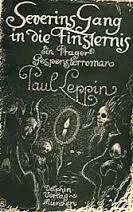
This is my second favourite book of the project (after The Underground Man). But unlike The Underground Man, which I’m sure everyone who reads this blog would enjoy, I’m far warier of pushing Blaugast on people. Although there is some redemption within, it is nevertheless a pretty nihilistic work, and certainly the kind of book you have to want to read. Next year I will explore the other works by Leppin: Severin’s Journey Into The Dark sounds incredible!


I’m interested in hearing of how Harry acquired this particular taste and discovered Blaugast.

Because, really, I know hardly anything about Harry, other than the reason why I asked him to contribute to Two Readers: that he has excellent taste. (Oh, and that he’s a prominent academic, and that two days ago he viewed the house of a former member of Brit girl group The Paper Dolls). He got in touch with me following Seasons They Change, we’ve nattered over social networks, and had one abortive attempt to meet up (trains and overrunning appointments stymied us).

I hope in the future our luck will hold for some facetime. It has to: I feel that, as time goes on, we are just stockpiling the many, many, many things we have to discuss. I’ll leave you with just one of them.


*N.B. I know I sound pompous here. However, my knowledge of this Nietzsche work comes entirely from Kevin Kline’s character in A Fish Called Wanda.