Showing posts with label 1980s. Show all posts

Tuesday, 31 December 2013

Week Fifty Two - Jeanette

Housekeeping by Marilynne Robinson (1980)
Recommended by Stuart

            Having a sister or a friend is like sitting at night in a lighted house.

I spent Christmas in Oxford, with Kathryn and her family. We played Yahtzee, we drank Lidl’s knock-off (and far nicer) version of Southern Comfort, we watched The Manchurian Candidate. Spending the festive season there was indeed like sitting at night in a lighted house. Lighted with the mini-bulbs on the tree, and a family’s love.

It’s still Christmas (ish). If I can’t be sentimental now, then when?

I also read Housekeeping. I purposefully kept this as the penultimate Two Readers book because I suspected it would be one of my very very favourites. And so it proved.

Anyone that leans to look into a pool is the woman in the pool, anyone who looks into our eyes is the image in our eyes, and these things are true without argument, and so our thoughts reflect what passes before them.

Thank you, Stuart Evers. Here he is cooking an egg. (He hates eggs).


Why is he cooking an egg on Battle Of The Pans for charity? Because he’s only an acclaimed novelist with two fabulous books to the good, Ten Stories About Smoking and If This Is Home.


I’ve known Stuart for ages now, way before either of us had a published book. (Always satisfying to say you knew them before they were famous, darling). We met during the post-university social whirl. He was friends with my friends, and a proper looker. I couldn’t fail to notice someone with his kind of louche grace! The first time I spoke to him properly I was about 22, and we were at (the now sadly closed) Rowan’s Bowling Alley in Finsbury Park. Neither of us could bowl but both of us could drink. The former was quickly abandoned for the latter, and we’ve been friends ever since.

He recommended both Jude and I fifty-two books to read. What a guy. Jude chose Georges Perec's Things; I decided to leave my book to the hand of fate. In our modern world, that hand equates to a random number generator on the internet. Although I promised the generator I would read Jack by AM Homes, I immediately broke that promise, because I saw Housekeeping at four. I knew that was the one.

(By the way, I’m keeping Stuart’s list of other novels for future reference. This year has taught me that I need to be far less sniffy about contemporary fiction. Stuart writes an excellent blog, and here is his list of this year’s best books. I shall be delving into that, too.)

Why did mine eye alight on Housekeeping? Partly because I knew it to be an important modern novel, but mainly because I was fascinated by Marilynne Robinson’s approach to fiction. Housekeeping, her first novel, was massively lauded at publication in 1980 and nominated for the Pulitzer Prize. Gilead, her second novel, was massively lauded at publication in 2004 and won the Pulitzer Prize. Twenty-four years and two masterpieces at either end. I have the hugest amount of respect for people with very high inner critics who will not dish up anything unless they are sure it’s astonishing.


Housekeeping’s power is stealthy. You get to know characters as you would in real life: they don’t dump out the contents of their individual personal history handbag on the table the first time of meeting. They’re guarded, waiting until they can trust you, sure that you understand them. And, because you’ve worked to get to know them, their tragedies become yours.

Ruth and Lucille, sisters and orphans, are well acquainted with loss. Their mother, Helen, committed suicide; their grandfather perished in a locomotive accident; their grandmother, after caring for them for five years, ‘one winter morning eschewed awakening’. They are then passed on to Lily and Nona, another pair of sisters. Uncomfortable with children, they struggle to relate to the introverted Ruth and Lucille.

‘That Lottie Donahue could help. Her children are alright.’
‘I met the son once.’
‘Yes, so you said.’
‘He had an odd look. Always blinking. His nails were chewed down past the quick.’
‘Oh, I remember. He was awaiting trial for something.’
‘I don’t remember just what.’
‘His mother never said.’
Someone filled the teapot.

Lily and Nona aren’t bad people, they just don’t really want the responsibility of bringing up two troubled little girls while in their twilight years. They connive to palm them off to Sylvie, Helen’s sister. Sylvie is a transient, who sleeps with her shoes under her pillow: an enigmatic woman who few people understand (or wish to). However, living with Ruth and Lucille brings her a sense of home, and the girls, at least initially, find solace with her unusual ways.

Not an especial amount happens in Housekeeping until the final fifty or so pages, when separation trauma becomes the primary theme. First comes a deeply upsetting schism between Ruth and Lucille, the latter growing embarrassed by Sylvie’s unusual behaviour – so much that she is prepared to forego her sister and Sylvie's defender. Very realistically, Robinson pulls out the hardness and the pity of how two formerly inseparable people grow apart.

‘It wasn’t the flowers, Ruthie.’
That sounded rehearsed. I waited, knowing that she would go on.
‘It was much more than that. We’ve spent too much time together. We need other friends.’

It isn’t only Lucille who views Sylvie as an unsuitable mother figure. The reader has been used to seeing Sylvie’s housekeeping from Ruthie’s perspective; all of a sudden we see it from a conventional viewpoint. The final act of Housekeeping is a quietly harrowing exploration of how alternative relationships and living situations are seen from the outside. Just as with Robinson’s characterisation of Lily and Nona, there’s no judgement against the people who are not comfortable with Sylvie and Ruth’s lifestyle. Although I felt Ruthie clinging on to Sylvie very strongly, also (and perhaps because I’ve worked in social care research) I understood also how they could not be left as they are. Neighbours don’t only stick their noses in because they don’t approve. There is a genuine, and laudable, desire to protect children from harm. Neglect is the hardest form of abuse to detect and to stop, and the consequences of not listening to that voice that says ‘that family down the street are worrying me’ could result in another Victoria Climbie or Baby P.

The book seems to be called Housekeeping because it looks at how we keep our homes in order: the domestic chores and the emotional well-being. Two Readers has been a sort of housekeeping, too. Reading and blogging on a book a week offers up its routine, while the critical reflection and heartbursts of love for my friends has been its emotional ballast.

Housekeeping this blog, and getting them all in before the end of the year, was something I thought I could do. I really did. But today my laptop power pack has broken: I've written my final post, Jude's recommendation of course, and I'm hoping the remainder of the battery will hold while I put it up.

2013, you bloody drama queen to the end.

Wednesday, 11 December 2013

Week Forty-Seven - Jeanette

Maus by Art Spiegelman (1980-1991)
Recommended by Matt


The Holocaust.

How can art deal with it?


Talking or writing about The Holocaust, even in a low-key blog such as this, is a fraught experience. It feels, especially as a non-Jew, that I must instantly qualify myself: state upfront about how enormous it is, that it is a unique event, how we must never forget.

This says more about the author than it does about The Holocaust. Doesn’t every thoughtful person, who’s not an idiot or a bigot, know that it is an enormous unique event that we must never forget? Yet, still, I introduce Maus this way. My own fear of being seen as, at best, a Vichy France (and at worst an Adolf Hitler) if I don’t is too strong. But the risk, when we expend our energy and words in repeating such indisputable statements, is that we don’t afford the event much, or even any, complexity. That our own neurosis hobbles the ability for analysis, and we end up with a piece of writing that browbeats the reader with banality.

With tragic irony, it seems that in more recent times – The Reader, and the critical rehabilitation of Nazi filmmaker Leni Riefenstahl spring to mind – fictional and real Nazis have been afforded that very complexity (and even sympathy). Compare this to The Boy In The Striped Pajamas. I was really quite angry when I saw this movie, for it was so very saccharine. I asked myself, is such colourless characterization of those in the camps, as so unrealistically angelic and always seen from the outside, actually damaging? Does it simply reinforce the 'them and us' rhetoric used by the Nazis?


Maus is the story of Vladek Spiegelman, Art Spiegelman’s father: not only does it narrate Vladek’s Holocaust experience, but also his current life as an older immigrant man living in America, his (difficult) relationship with his wife Mala, and his attitude to Art and Art’s comics. Vladek’s numerous quirks and flaws may have something to do with The Holocaust; or they may just be who he is. The first challenging concept of Maus is that not every disagreeable trait in a survivor’s personality is a result of The Holocaust.


Vladek, a Polish Jew, marries Anja (Art’s mother) in the mid 1930s. Anja is from a wealthy family and the couple has a good lifestyle, although Anja is vulnerable to bouts of depression. Vladek tells us of how life began to get difficult for Polish Jews at the outbreak of World War II. What is most striking about the first book of Maus is not in itself the shrinking sphere that Jews are forced to function in (via seizure of businesses and property, and the acts of violence and murder): these processes of discrimination by the Nazis are well-known. But Vladek’s story brings an insight into the ad hoc nature of this time, so different from the image of steely calculating Nazi enforcers. Sometimes Vladek would be released when he was clearly committing an executionable offence, but sometimes he or the family would suffer with not even a thin excuse given. This inconsistency (while clearly on an overall curve towards genocide) creates both looming dread and grim pockets of hope. The reader is able to root for Vladek: he does not allow himself to be a victim easily. He works hard, he is clever and resourceful, he has wealth to exchange for favours, and he is prepared to hide or collaborate when necessary.

But Auschwitz was the fate for over one million Jews, and so it is for Vladek. Book Two of Maus concentrates on Vladek’s time in the extermination camp. Vladek mentions little of the gas chambers (it’s not from ignorance: all the prisoners know that they are there, and that they are used), but rather he concentrates on the day-to-day: the hunger, the lice, the relationships with camp supervisors, and the cumulative effect of smaller humiliations.


We learn Vladek’s story as Art learns it: with digressions, arguments, and frustrations. The present-day Vladek is extraordinary. He throws away Art’s trendy coat and gives him a horrible old one of his to replace it; he returns half-eaten cereal to the store (‘The manager helped me as soon as I explained to him my health, how Mala left me, and how it was in the camps’); he fakes a heart attack to get attention; he thinks all black people are thieves. At times, Vladek is so difficult that Art worries he is actually stereotyping Jewish people as miserly and intolerant, thus giving fuel to Nazi sympathizers.

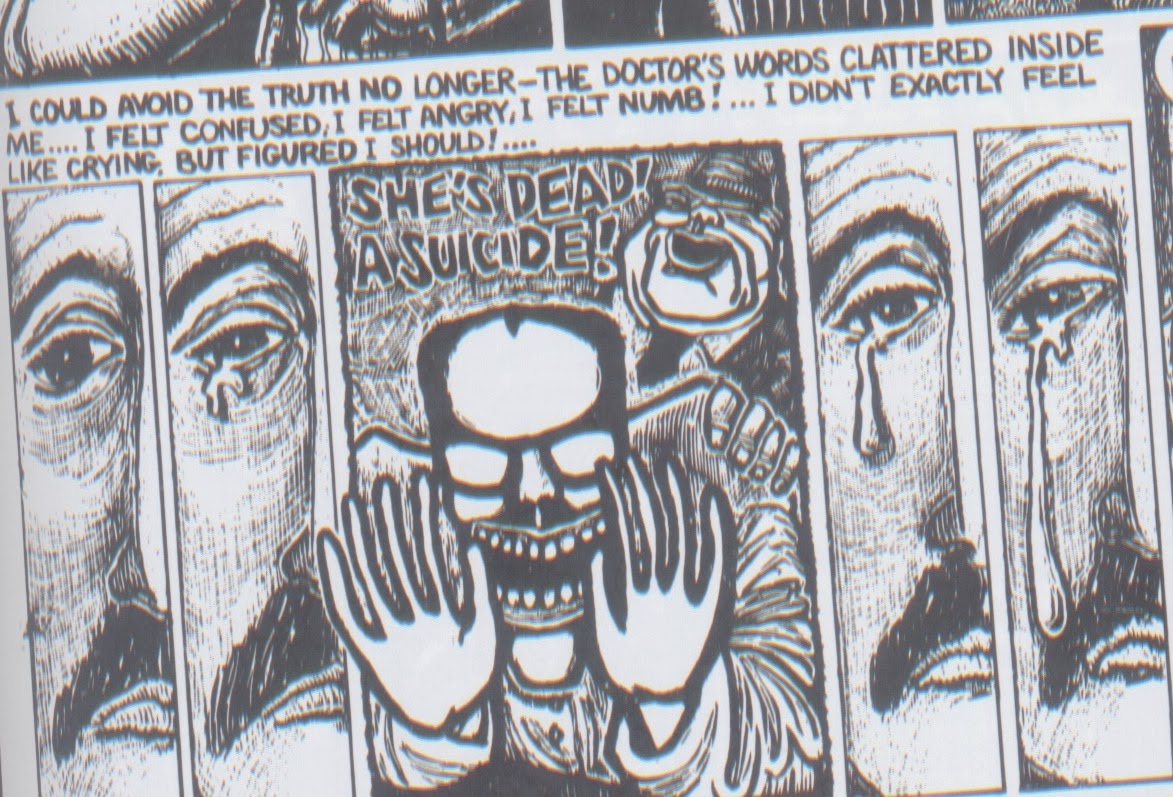
We hear of, by the process of creation, the author’s own upbringing and history. His mother, Anja – who also went to Auschwitz and survived – killed herself when Art was twenty. Spiegelman wrote a frankly amazing short comic strip about it in 1973, Prisoner On The Hell Planet (reproduced in Maus).


The strip is a piercing scream of grief: we are left to wonder how far Anja’a suicide was a legacy of Auschwitz, how far it was her own depressive nature, and how far it was her unhappy familial relationships. She kept diaries but, to Art’s fury, Vladek threw them out. We only ever know of her through Vladek and Prisoner On The Hell Planet. But, yet, Anja haunts Maus: she glides between the frames, whispering her own story.

The other highly original thing about Maus is its use of animal metaphor. The Jews are mice; the Nazis, cats; the Poles, pigs; the Americans, dogs; the French, frogs. Spiegelman’s metaphors initially seem to say that we are not all just the same people underneath our racial and national identities: that they define us, and so far so that they manifest in fundamental differences as strident as those found between animal species.

However, by emphasizing difference rather than minimizing it, Maus highlights the philosophical claptrap that The Holocaust drew oxygen from. If you’ve ever had the misfortune to read any of the mouth-foaming ‘theorists’ Hitler subscribed to, or any of Mein Kampf itself (which is so muddled it’s like slogging through hateful wet cement), you’ll know that these texts might as well be saying cats should get pigs and frogs to collaborate with them in order to kill mice. That’s how logical they are. At the same time, through using cats and mice especially, Spiegelman is able to visually evoke the power relationship between Jews and Nazis, and also to refer to, and undermine, the Nazi propaganda that equated Jews with rats (as seen in 1940's The Eternal Jew).

An incredibly important book, this, I think. And, still, within it, there is room for laughter. Not hurtful or ambiguous dark laughter, but real, beautiful big belly laughs.


Matt and I were born within a few days of one another. There’s something quite lovely about meeting someone of your own school year when you’ve left your childhood behind. We have very similar cultural tastes: Kate Bush, All About Eve, RuPaul’s Drag Race, Robyn, Love And Rockets… and it’s not only what we like, but how we like. There’s a lot of geeking about b-sides and quoting from scripts.

But, as with all friends, shared taste only gets you so far. Extremely caring, he works in HIV prevention and awareness, and his efforts helped the campaign The HIV-Hop win a national award last year. PLUS he’s a talented artist, and is prolific without compromising on quality – that in itself is an inspiration to me. Matt, with his artistry and his kindness and his passion, well, he makes me feel that I can weather any shit, and then come out of it with a Bette Davis hair-toss.

I’m unsurprised that Maus is one of Matt’s favourite books. He is moved by oppressive circumstances, and despises any form of prejudice: but he is uninterested in simply doling out platitudes. And that’s the essence of Maus.

I want to understand The Holocaust. But that doesn’t mean that I can understand The Holocaust.

Sunday, 20 October 2013

Week Thirty-Nine - Jeanette

Nausicaä Of The Valley Of Wind by Hayao Miyazaki (1982-94)
Recommended by Alex

Correct me if I’m wrong, but everyone loves Studio Ghibli.


Surely, from dedicated followers of The Fast And Furious franchise right through to Man With A Movie Camera silent film bores, all are charmed by Ghibli’s fantastical worlds. It annoys me that any shit romcom is branded a ‘feelgood' film, for it devalues something like Spirited Away: cinema that is gloriously enjoyable, yet undeniably profound.


In the early 1980s, Hayao Miyazaki, Studio Ghibli’s founder, pitched a movie about a pacifist young princess living in a world beset by environmental disaster. However Miyazaki, still largely unproven as a director, was told that he needed a manga series to secure funding for this pet project. The argument ran that animated movies based on manga did far better at the Japanese box office than did original stories.

What did Miyazaki do? Churn out a straw manga to please the money men? Or create a ridiculously intricate and multi-layered epic that ran for twelve years?


Set centuries in the future, humanity is on its knees. The industrialist societies of today pushed the earth to its limit. Unable to endure the devastation any longer, the earth roared, creating the Sea of Corruption. This is a vast forest where poisonous spores emit clouds of deadly miasma, and in which mutated and very angry insects dwell. Since the Sea of Corruption is uninhabitable, humans are relegated to its periphery, and then divided into semi-feudal autocratic states. The two primary powers, the Dorok Principalities and the Torumekian Kingdom, are perpetually at war – ostensibly over scarce resources, but there’s quite a bit of old-fashioned belligerence involved, too – while the smaller states are caught in the crossfire. Both Dorok and Torumekia use deeply unethical military strategies: biological warfare, racist inflammation, genetic engineering, and implied rape.

One of these small states is the Valley of Wind. Nausicaä is its beloved princess; she is a pure-hearted young girl who has a unique affinity with the earth. She is even able to communicate with the most feared of all the Sea Of Corruption’s insects, the giant Ohmu. Nausicaä could easily be an annoying do-gooder, but her characterisation is superb: she feels real anguish for human, animal and environmental suffering, while sometimes forced into making dubious moral decisions.

One of these dodgy compromises is her alliance with the Torumekian princess, Kushana. Nausicaä and Kushana share a complicated and fascinating relationship, almost as if they are obverse and reverse to one another.


Kushana was very much my favourite character. A brilliant tactician, ruthless and brutal when necessary, she sprung from a ‘nest of vipers’: a group of ambitious siblings fighting in Roman internecine style for (often short-lived) supremacy. The brief insights we gain into Kushana’s family are among the best panels in the whole manga. How far Nausicaä influences Kushana (and, more subtly, vice versa) is a tremendous tension in the story.

Nausicaä is in four volumes, and a real Gordian knot: it would take paragraphs and paragraphs to effectively explain the story alone. And its philosophical scope is even grander, for it examines different government structures under extreme crisis. As well as Classical history and myth (Nausicaä herself was based upon a Phaecian princess in The Odyssey), I detected influences from pre-1914 Europe, primarily the crumbling Austro-Hungarian and Ottoman Empires. Although my Japanese history is shaky, its Samurai era seems another key reference point. Miyazaki seamlessly links all this with modern theories of environmental destruction, feminism, the abuse of religion, and ethnic scapegoating. Sometimes Nausicaä is about nothing less than what it means to be human, especially when we have devastated the means of sustaining our humanity. Its ambition is as enormous as the Sea of Corruption itself.

The manga was a huge commercial and critical success. Thus, Miyazaki had no trouble getting funding for his movie, which was released in 1984.


It is far, far, far simpler work. Although it’s a good film, it’s on to a hiding to nothing after one has expended the hardcore concentration required to tackle the manga. The world, for once, should be grateful to cautious investors for without them this movie is all we would have.

Similar to my previous graphic novel recommender, Alex is a brilliant artist herself. This is my favourite of her drawings: Kirsty MacColl sitting on her bench in Soho Square, created for the board game Soho! 


She is also a respected film academic and a very good friend. I remember when I first met her about ten years ago I really didn’t know what to make of her – she was so different to anyone I’d ever, ever, ever encountered before. I soon realised what providence was telling me: that she was awesome and we should get on with this friendship lark immediately. She is extremely intelligent, highly sensitive, beautifully dressed, and incredibly magnetic. At Kathryn and Rupert’s wedding someone thought she was a film star.

I love things like Nausicaä, which trust you to hold masses of plot and character threads in your head, and then reward you a million times over for paying attention to them. If I may return to that awkward portmanteau word: feelgood. I feel good to know art has such vision, and I feel super good for knowing that I’ve been able to drink deep from its well this week.

Saturday, 7 September 2013

Week Thirty-Three - Jeanette

Love In The Time Of Cholera by Gabriel García Márquez (1986)
Recommended by Noshee

My favourite programme of 2011 was Charlie Brooker’s How TV Ruined Your Life. The fourth episode tackled love.


Love is like the flu. People often think they’re experiencing it, but most of the time it’s just a cold. And they only realise it was just a cold years later, when they finally catch the flu for real, by which time they’ve got engaged to bloody Ian.

Is love also like cholera? Let’s look at what the NHS Choices website has to say.

                          The most common symptoms of cholera are:
·      extensive, watery diarrhoea
·      nausea (feeling sick)
·      vomiting (being sick)
·      muscle cramps
Left untreated the combination of diarrhoea and vomiting can cause a person to quickly become dehydrated (lack of fluids inside their body) and go into shock (experience a massive drop in blood pressure). In the most severe cases these conditions can be fatal.

Definite crossover, then. But cholera can usually be cured. Love (and lovesickness), well, that’s open to debate.

It was the year they fell into devastating love. Neither one could do anything except think about the other, dream about the other, and wait for letters with the same impatience they felt when they answered them.

Love In The Time Of Cholera, at the beginning, chronicles how Fermina Daza and Florentino Ariza find each other. That first flush! Rhapsodising over each other to anyone who’ll listen. Introducing his or her name into conversations under the flimsiest of pretexts. Reliving every tiny interaction a million or more times. Staring into space then realising two hours has passed. Waking up with a grin the size of Greenland on your face.

How the hell do you write adequately about love? Gabriel García Márquez is one of the twentieth century’s most respected authors, not a Mills & Boon hack, so one assumes that if he’s having a bash at love’s ecstasies and convulsions it’ll be worth reading. As a bare minimum, it'll depict more than romance’s cliché: high passion, temporarily thwarted, before a happy ending dabs the tears away. Love In The Time Of Cholera is a complicated and reflective work, and what gives the story its ironic edge is that it’s about the wish for things to be simple and instinctive.

Fermina Daza, Florentino Ariza, and the other main character, Dr Juvenal Urbino (all characters are always referred to by their full names, a curious device that prevents some reader intimacy) live their lives out over this book. What Márquez tells us, via his picturesque prose, is that love might conquer all. But it might not. People are messy and do stupid things. Society is messy and encourages people to do stupid things. The past piles up behind us. Its fetid stench hangs in the air, sometimes mitigated by the over-sweet rose of nostalgia. Plus, there’s our desire to love in itself, to convince ourselves that the lie is the truth. This is another hugely complicating factor in life, and a major tension in the book.

He was aware that he did not love her. […] But as she kissed him for the first time he was sure there would be no obstacle to their inventing true love. They did not speak of it that first night, when they spoke of everything until dawn, nor would they ever speak of it.

How ideals are negotiated with reality – and the effects of doing this, both positive and negative – doesn’t only relate to love, but to our work and our creativity, too. Yet I don’t find it’s as simple as saying ‘never compromise’. People who espouse that are usually hypocrites, or wealthy, or stunted adolescents, or members of Crass. While Márquez is definitely on the side of believing in your dreams, he’s also clear that wishing and hoping alone won’t make them occur, and even with work, your effort could fail you. Although this sounds dour, actually its overall tone is very positive, because hope takes place in the real world of competing concerns, blunders, and shifting situations.

I think the narrative’s often-painful pragmatism surprised me, because Márquez is rarely mentioned without ‘magical realism’ nestling somewhere in the same paragraph. A little digging has revealed Love In The Time Of Cholera is not as ‘magically real’ as some of Márquez’s other works, but it still has snags of the fantastical.

After a time, however, she discovered when she awoke from an exhausting dream that the doll was growing: the original exquisite dress she had arrived in was up above her thighs, and her shoes had burst from the pressure of her feet.

I really liked these elements. They gave the book a hallucinatory quality at times, suiting the fugue state of love. Márquez also gives us plenty of very quotable earthy mediations.

As a young man his stream was so defined and so direct that when he was at school he won contests for marksmanship in filling bottles, but with the ravages of age it was not only decreasing, it was also becoming oblique and scattered, and had at last turned into a fantastic fountain, impossible to control despite his many efforts to direct it.


That film adaptation looks like such a heap of sentimental tripe. I bet the pissing scene isn't in it.

Noshee is one of my literary inner circle. I trust her judgement absolutely and anything she gives to me, I read (eventually; Márquez’s One Hundred Years Of Solitude, her last year’s birthday gift, is still on my shelf). The first novel she bought me was Lynne Reid Banks’ The L-Shaped Room. Her favourite books are Wilkie Collins’s The Woman In White and Salman Rushdie’s Midnight’s Children. You see: impeccable taste.

In fact, it is perfectly obvious to me how a high proportion of the world’s population could fall in love with Noshee (even me, it seems; we were once mistaken for partners). When I first saw her I thought she was one of the most beautiful women I’d ever met. Bone structure out of her, er, bones. And like Márquez, she is wise and sensitive, with the rare ability to look at the bigger picture and genuinely put herself in another’s situation. These personality traits – perspective, humanity, enthusiasm – all help when one is laid up with love (or by that less exalted illness, infatuation).

So Márquez can ‘do love’, relatively directly, and without the old chestnuts. It reminds me of why I like girl group records of the 1960s so much. They succeed in being so very affecting often because of the believable performances of the vocalists. Here is the isolated vocal track of The Ronettes’ Baby I Love You and, within it, I can find all love’s joy, and all its incipient anguish; well, all that three minutes could ever possibly deliver.


Wednesday, 21 August 2013

Week Thirty-One - Jeanette

Voices Of The Old Sea by Norman Lewis (1984)
Recommended by Mark & Roxy


Mark is this Mark.


I first spoke to Mark via telephone, interviewing him for Seasons They Change. Not only did we talk of 1971’s Dreaming With Alice sessions – constituting some of my favourite of all acid-folk – he told me of the new record he was making with The A. Lords, which turned out to be another masterpiece: 2011’s I Lived In Trees.


I met Mark in person when we both performed at Cecil Sharp House: he with The A. Lords, me in the inaugural reading from Seasons (before the thing was even published and I had to, very glamourously, read from a printed PDF). Mark is modest, charming, and intelligent, as well as an awesomely talented musician and painter. Through Mark, I met Roxy, too. Phenomenally kind, generous, mega-smart, with a whip-fast humour… oh, they’re just two of the best people going.

Mark and Roxy invited me to stay with them, and their pug Missy, in Normandy last year. I could have cried it was so good. Not only was it the beautiful surroundings, it was simply being around them in their home. As they bantered with each other, it was proof positive to me of enduring love.

Their joint recommendation, Voices Of The Old Sea, has been a welcome constant of the past fortnight. For these two weeks have otherwise been engorged with sensation. A writing retreat in Suffolk with Jude, a serious illness in my family (and another upsetting trip back to bloody Norwich), a visitor from Japan, and all capped off by the sheer exhilaration of the Woolf Music festival.

With the pace of a particularly timid glacier, Voices Of The Old Sea tells of the change in (and to) the secluded Spanish village of Farol. As he explains in his foreword, Norman Lewis tackled the subject for psychological (as opposed to anthropological) reasons.

After three war years in the Army overseas I looked for the familiar in England, but found change. Perhaps it was the search for vanished times that drew me back to Spain, which in some ways I knew better than my own country – a second homeland to be revisited when I could. Here the past, I suspected, would have been embalmed, and outside influence held at bay.

When Lewis first takes us to Farol, in the middle of the twentieth century, he is correct. This tiny community is wholly reliant on fishing and wits for its economic and social survival. The currency of the village is of and for itself, with barely a by-your-leave to anything other than its immediate neighbours.

What was I doing here? he asked, and I told him I was on holiday. In a place like this? He looked through the window at the vacant beach. The fishermen were sleeping off the exhaustion of the previous day and had pulled the boats out of the water and gone off without bothering to clean up the mess. A number of cats like mangy little grey tigers were doing what they could to remedy this.
               […]
               ‘Nobody comes to a place like this unless they have to.’

Lewis’s prose, as he writes of his first summer in Farol, reflects the village’s everyday rhythms. His words undulate like waves gently rocking the fishing boats. Farol, with its stalwart rituals, customs, melancholia, and flat sea mist, is the book’s main character; everyone else (Lewis included) forms the supporting cast.

Farol had been like this for decades, centuries; wider forces might have nudged it (the Spanish civil war and Franco were not renowned for leaving people to their own devices) but the people there remained largely untouched. They felt the outside world at best as an irrelevance and at worst as a malevolent spirit, yet they could brush off any attempted incursions by it as easily as hanging up on a salesman.

Until that incursion was a salesman, or a salesman of sorts. Farol may have resisted fascism but it could not last against tourism. At first, the presence of outsiders (and, lest we forget, Lewis himself is one such beast) is greeted with bemusement.

There was a great increase of amateurs from Sort trying their hand at fishing. In the autumn the men had come down and fished with rods using the wrong bait, at the wrong time of day, and usually there were no fish to be caught anyway.

An entrepreneur named Jaime Muga arrives. He turns the local fonda (a basic tavern) into the Hotel Brisas del Mar, increasing the price from 8 to 50 pesetas a day (‘causing the locals to burst into peals of disbelieving laughter’), and encourages the shop to stock cheap carvings of Don Quixote. The villagers roundly mock Muga’s paying guests, just as they mock the useless fishermen.

But such laughs are hollow. For Farol is part of what we now know as the Costa Brava.


When I cleared out my dad’s stuff after his death, I found that he had not cleared out my mum’s stuff after her death. Thus, I was treated to a whole wealth of crazy crap like quilted flamenco postcards hoarded from her cheap holiday to the Costa in the late 1960s. Although I don’t know for sure, I’m betting that my mother wasn’t concerned with appreciating local untouched culture. Her life was hard enough and she didn’t want to spend her week off on a scabby cat-strewn beach. Rather, she did what thousands of other young working class Brits of the time also did: she drank sangria, she made eyes at Sergio, and she came home with a tan.

As slowly as he writes of Farol’s traditional life in his first season in the village, Lewis now tells us of the rise of Costa Brava tourism. Yet, now, Lewis’s stately pace is not relaxing, but deeply sinister. Its languor is like that of the zombies in Night Of The Living Dead. The tourists will overwhelm with sheer mass even if, individually, they’re easy to deal with.

The butcher’s had undergone a spectacular facelift. Gone were the bloodstains, the flowers stuck into jam jars, the artistic display of giblets, the beribboned tripes, and the severed heads presented on paper ruffs. The shop was as impersonal as a tax office.

Voices Of The Old Sea is a beautiful and often upsetting elegy. I believe that we shouldn’t, by rote, weep for the past. That’s the thing with the old days: they’re the old days. One also shouldn't forget people like my mother, for whom affordable tourism represented a much-needed escape from factory or domestic drudgery. But we do need works like Voices Of The Old Sea. Such stories may speak to us softly, but they can still, sometimes, be heard over modernity’s din.

Wednesday, 7 August 2013

Week Thirty - Jeanette

Hackers: Heroes Of The Computer Revolution by Steven Levy (1984)
Recommended by Simon


Simon and I were together for over eleven years, and in 2012 we broke up.

Hackers is a seminal text. Even the title itself emits history. The word ‘hacker’ has migrated significantly since Levy originally wrote the book: then, ‘hacker’ was really only used within the computer community. However, since then, it has become common negative currency. The hacker is stereotyped as a socially challenged nerd who, at best, fiddles about with technology he’s not entitled to and, at worst, sabotages organisations and governments because he’s can’t get a girlfriend.

Therefore, that subtitle is very important. While acknowledging that hackers did plenty of unauthorized and illegal things (and that many of them were awkward bachelors with interesting personal hygiene), Levy argues – very, very convincingly – without them we wouldn’t have the technology that we have today.

Think back to (or imagine, if you’re more youthful than I) where computers were in 1984. On one hand there was this:


But on the other, more realistic hand, I was in Magdalen Gates First School in Norwich, and we had but one BBC Micro for the whole school. It was wheeled out on special occasions from its cupboard. Each class could only use it for half an hour to play a spelling game before it got taken away again. In private, some kids were starting to get ZX Spectrums or Commodore 64s. I got my first one circa 1986, despite luddite opposition from my mother (‘God gave you a computer – your brain’), and I played games like Pippo until the power pack overheated.


I knew vaguely, back then, that the computers I used evolved from metal-and-LED walls of mystery. However, I had very little idea of how these digital ancestors worked, or even what they had ultimately been for: that is, beyond space travel, global thermonuclear war, and mismatching lonely hearts in British sitcoms.

Hackers begins in the late 1950s, at the Massachusetts Institute Of Technology (MIT). Here, a group of boffins sought access to the EAM Room – ‘Electric Accounting Machinery’ – where gigantic contraptions blinked teasing lights and hummed a siren song. Getting into the EAM Room was harder than getting into the special computer cupboard at Magdalen Gates First School, i.e. very hard indeed.

Hackers believe that essential lessons can be learned about the systems – about the world – from taking things apart, seeing how they work, and using this knowledge to create new and even more interesting things. They resent any person, physical barrier, or law that tries to keep them from doing this.

Those early MIT hackers, when they did gain entry to the hallowed EAM Room, set about pushing boundaries. They adhered to The Hacker Ethic: all information should be free, art and beauty can be created on a computer, and, the most dearly held principle of all, that computers can change your life for the better.

Even just reading of an early hack, Spacewar, changed my life for the better. Developed in 1962 initially by Slug Russell, Spacewar may look like an experimental film by Tony Conrad, but it is actually one of the very first computer games:


It was a two-player affair, where you tried to destroy your foe's rocket while a sun pulled at your tailfins. However, Peter Samson, another MIT hacker, had a real problem with one aspect of Spacewar.

[He] could not abide the randomly generated dots that passed themselves off as the sky. ‘We’ll have the real thing,’ Samson vowed. He obtained a thick atlas of the universe, and set about entering data into a routine he wrote that would generate the actual constellations visible to someone standing on the equator on a clear night. All stars down to the fifth magnitude were represented; Samson duplicated their relative brightness by controlling how often the computer lit the dot on the screen.

Dedication, that’s what you need, if you want to be a hacker.

In their wake came others, and Levy tells these hacker tales of the sixties, seventies, and early eighties with clarity and wit. One part of the story I found especially moving was how, as computers become big business, the original hackers – and those youngsters who adhere to the Hacker Ethic – floated away from the new corporate empires.

The Hacker Ethic, of course, held that every program should be as good as you can make it (or better), infinitely flexible, admired for its brilliance of concept and execution, and designed to extend the user’s powers. Selling computers like toothpaste was heresy. But it was happening.

The era of exactly replicating the Ursa Major constellation was over. Even more contentious was the use of copyright and copy-protection technology.

This was not MIT where software was subsidized by some institution. […] They were products. And if a person coveted a product of any sort in the United States of America, he or she had to reach into a pocket for folding green bills.

It wasn’t that hackers were broke, because many were doing well by this point, given the exploding computer industry. It wasn’t that hackers were stingy – well, some clearly were, but that wasn’t their reason for antipathy to the marketization of computers. It was that they thought information should always be at liberty, and that software should be open to improvements as the only way to drive progress. Byte-eating data protection programs harmed these principles in an unforgivable way. I’m not defending the hackers who did become pirates (or, more seriously, cyber-terrorists); but I can understand the motivation behind it.

In a rather downbeat afterword, written for the book’s twenty-fifth anniversary, Levy catches up with many of the hackers he interviewed. In the case of Richard Greenblatt, he finds a disillusioned man.

‘There’s a dynamic now that says, “Let’s format our web page so people have to push the button a lot so that they’ll see lots of ads,”’ Greenblatt says. ‘Basically, the people who win are the people who manage to make things the most inconvenient for you.’

Although all of us can nod sadly at the truth in Greenblatt’s words, for the hacker himself this must amount to nothing less than a scorching betrayal of all he holds dearest.

You don’t have to be a hacker to enjoy this book. I learned a little of computer natter when I was with Simon – one can’t help picking up, almost by osmosis, certain concepts when one lives with a PhD in Computer Science – but I rarely needed to mine this insider knowledge. My only real gripe with Hackers is that a few pictures would have been nice. However, scratching the itch of what these people and their machines look like can be easily done with this great programme.


Simon too believes that computers improve life itself: ‘they’re friends’, he once wrote to me. He’s well-placed to practice this, for now he’s in hacker heartland, living in Oakland and working in Palo Alto.

I learned a lot from Simon of silicon warmth, of how – when the right humans are at the keyboard – computers can mimic positive states: selflessness, intelligence, even compassion. Steven Levy's hackers made the world better, just as Simon made my world better.

Tuesday, 2 April 2013

Week Thirteen - Jude

Like A Velvet Glove Cast In Iron by Daniel Clowes (1989-1993)
Recommended by Kristian Besley


After this week's recommender Kris read my post from last week – about Jonathan Raban's book, Coasting, irregular readers, read down for more – he was worried that he'd picked a book that wasn't deep enough.

Then I opened Like A Velvet Glove Cast In Iron.

This featherlight, wishy-washy, silly comic Kris had picked for me was actually... I'll pause for an intake of breath here... a series of interconnected stories named after a line from Russ Meyer's Faster, Pussycat! Kill! Kill! about a strange young man, a God-like drawing called Mr Jones who was tattoeed on feet and hidden on moles, a girl called Tina who looked like a potato conceived through an encounter with a mysterious creature who came from the sea, brutal cops, dogs without orifices or faces with maps on their backs, Hitler living in Mexico, a little girl who writes scripts, and a worldwide gender war.

Just like an issue of Bunty, in fact.

But that's Kris for you – putting himself down when he shouldn't. Kris is great. We've been friends since tertiary college, when he had purple hair and a beard and once let off a second world war air raid siren in the canteen... or at least my memory tells me that he did. (That's one of those situations you swear your brain has concocted on its own in a moment of madness). He was in a band called Ken though, a sort of mad-comedy band very much of the early 1990s, who had a cassette album called Unplugged In Llansamlet with a photocopy of a Barratt home pasted on the front of it, and had a song about Carl Cox, and many others with swear words in them which I won't repeat as he's a very grown up, and indeed upstanding, father-of-two now. The purple hair has gone too, I'm sorry to say.

Oh, Kris also played a massive part in my musical education, introducing me to the early works of Gorky's Zygotic Mynci and the music of Orbital, which I talk about on another blog post here. And he was in a band called Grümp – note the umlaut – for whom I made some badges using Tippex and biro. GLORY DAYS.

But back to Daniel Clowes. I knew a bit less about him: that he was one of the artists that helped popularise alternative comics in the late 1980s/early 1990s, and that he'd done some work for the brilliant Hernandez Brothers' Love And Rockets series. I'd also read Ghost World already, and of course seen the film starring Thora Birch (what happened to her?) and Scarlett Johanssen (ah what happened to her), having been a young person in the late 1990s/early '00s of an indie persuasion.


I'd loved both, but I'd not read anything else by Mr Clowes. Like A Velvet Glove Cast In Iron, I discovered, is definitely not Ghost World, although I really enjoyed it, despite not really understanding what the hell was going on in it.

The best way I could describe this graphic novel is that it's a lot like Twin Peaks in narrative style and tone – although its subject matter feels much murkier. For instance, there's a peculiar old movie at its heart that Clay sees in a dodgy porn cinema, and I felt the ghost of One-Eyed Jacks and Audrey Horne all over that. Still, the first instalment of this series was written at the same time as David Lynch was writing Twin Peaks, so they didn't overlap. Maybe there was just something (really weird) in the air.


Sex, violence, death and dread: boys and girls, they're all here. And God, you feel them. You really understand Clay  trying to make sense of some of these worlds desperately, while settling for others co-existing. When he's trying to find out the importance of Mr Jones, you feel his hunger for knowledge deeply; when the little girl he's watching is given her own voice, I felt genuine fear. There are lots of minor characters that recur too, and tons of surrealistic twists...for example, there's a moment when Clay takes a drink, then in the next panel, he and his friend are alien shapes...but even weirder than that. And the dogs without orifices. ARGH.


At points, this book made me think of the late '60s film Performance which I watched over the weekend too. Both are defined and directed – or indirected, rather – by psychedelic leaps. But I liked this book more, as it hinted at something weirder at the heart of us. My favourite bit of all was when the folk song Barbara Allen crops up towards the end, and Clowes uses it, in a way, to try and tie all his disparate, wayward threads together. Things don't end well, but then again, some things don't. This is a book I need to return to, and unpick, and spend hours poring over, just like those cassettes made for me nearly twenty years ago by a teenage boy with purple hair, from an old friend who will always, somehow, feel like a new one.