Showing posts with label 1990s. Show all posts

Saturday, 28 December 2013

Week Fifty-One - Jeanette

Written On The Body by Jeanette Winterson (1992)
Recommended by Anita

My body is written on.

I have three tattoos. Each is a carefully chosen design, patterns I knew I wanted indelibly inked upon me. The nuances shift, but their core meaning doesn’t: they represent transitions. I got each one during the final element of a pupa stage. They are memento moris of my past lives.

(We tattooed people do witter on about how deep ‘n’ meaningful the things are. Boring bores, the lot of us.)

But, lately, I’ve been wondering if there’s another, less highfalutin' reason for my tattoos. I think it’s also an expression of my background, a branch from the same root as liking amusement arcades and gaud at Christmas. Loads of people I grew up with have them. If you don’t tattoo the name of your child on your arm, well, what kind of mother are you? Don’t you love your kid?

I feel kinship with Jeanette Winterson. She has my name! There are precious few of us Little Jeans around. But, too, she was a working-class girl who found herself running with a different crowd when she went to university. For me, the process had already started before I left Norwich (a schoolfriend accused me of being a class traitor), but it certainly solidified after the age of eighteen. I never thought of it as a conscious denial of my background, although I’m sure others saw it that way. As I wrote in Week Sixteen, there are only two people from my pre-uni days involved in Two Readers.

It's a minor part of the book, but Winterson’s Oranges Are Not The Only Fruit captures this chequered experience well: the excitement and feeling of belonging with your new life, coupled with the sense of loss for the old. 


In her autobiography, Why Be Happy When You Could Be Normal?, Winterson revisits the material she drew on for Oranges. Her conflicted feelings about her upbringing (and apart from the class aspect, her family circumstances are very different to mine) continue to be source material for her. Having read those two works, I approached Written On The Body with veiled autobiography in mind.

It was an interesting book to tackle directly after The Pursuit Of Love.

I had said them many times before, dropping them like coins into a wishing well, hoping they would make me come true. I had said them many times before but not to you. I had given them as forget-me-nots to girls who should have known better. I had used them as bullets and barter. I don’t like to think of myself as an insincere person but if I say I love you and I don’t mean it then what else am I?

The gender of Written On The Body’s narrator is never revealed, yet (perhaps because of my association of Winterson with memoir) I found myself thinking of that narrator as ‘her’ throughout. I assumed one of the country’s top lesbians must be mining her own relationships with women. But of course it could be a man, or a transgendered person. (There is no Smack My Bitch Up ‘surprise’ twist ending). I also suspect Winterson was drawing attention to the difficulty of expression without gender pronouns, critiquing how binary and constricting those categories are.

We begin by reading of the narrator’s back love catalogue. The prose is graceful, charged and often erotic, although it does sometimes spill into floridness.

I watched her break and butter each piece, soak it slowly in her bowl, let it float, grow heavy and fat, sink under the deep red weight and then be resurrected to the glorious pleasure of her teeth.

I do like it when Winterson gets a bit bawdier, too.

           June. The wettest June on record. We made love every day.

Most of the narrator’s women are flowing-locked anarcho goddesses (‘I had a girlfriend once who was addicted to starlit nights.’ Not addicted to Tetris, then?), but perhaps this is intended to show how the narrator idealises love objects rather than as a parade of unrealistic females. The Helenest of these Helens Of Troy is Louise: the pair embark upon an erotic and emotional odyssey until we discover that Louise’s body is more than honey-filled breasts and love-saturated heart. It has been invaded by leukaemia.

We are beholden to our bodies and, suicide aside, it is the body that has the ultimate control: the power of life and death. (That’s another reason why I decided to get tattooed. The body does enough stuff that you don’t want it to do, might as well get it to do something you do). The narrator now has to come to terms with this, and the book’s interlude, the extended prose poem ‘The Cells, Tissues, Systems And Cavities Of The Body’, explores Louise’s physicality as something more than sexual. It is an expression of the narrator’s love, framed by the new awareness of the cancer spraying graffiti on the inside and outside of Louise’s body.

Will you let me crawl inside you, stand guard over you, trap them as they come at you? Why can’t I dam their blind tide that filthies your blood? Why are there no lock gates on your portal vein?

Like Dennis Quaid in Innerspace, the narrator roams around: you can hear fingertips running on the corrugated roof of Louise’s mouth. But, when the narrator returns to the corporeal world, the hard fact of Louise’s illness is still there. What is more important, the health of the body or that of the heart?

One of us hadn’t finished, why did the other one go? And why without warning?

This novel didn’t, for me, have the personal clout of Oranges Are Not The Only Fruit: the story seems deliberately not as strong, almost as if Winterson thinks that an abstract narrative is a more valid approach to literature. But I really enjoyed getting lost within Louise’s capilliaries, climbing her spine stepladder, being swaddled by her intestines. 

And while we’re thinking of bodies, what body do you picture when you hear ‘mermaid’? Ariel in The Little Mermaid? Daryl Hannah in Splash? Cher in fancy dress? Jerry Hall on the cover of Siren? Chances are it isn’t this…

 
Cryptozoology is a word I had never encountered before I met Anita. It refers to the study of fake or unproven creatures like the Loch Ness Monster, the Yeti, and Norfolk’s own Black Shuck. (Look at this fascinating list of cryptids – a Man-Eating Tree!). And then there’s The Buxton Mermaid, that beauty above.

Anita restored her. She is also her ambassador, telling her story to the press and to museums. Her care of The Buxton Mermaid goes beyond a job, and that is typical Anita. She will give her time and her support to those (and crypto-those) who she loves. She’s certainly done it for me. When I was in the midst of a crisis, Anita not only propped me up with words and hugs, she came to my place and did my washing-up. When everything is surreal because sadness is so huge, to have someone who can gently re-orientate your world, so you’re in no doubt it’s still worth living in because you have friends like her… it is a key to recovery.

I love conversing with Anita about books. (She's Tim's sister, equally as erudite as he) and as the year, and this project, has written itself on my body, I've realised I have my Two Readers friends to thank for more than just their book recommendation. It’s talking about the posts, sharing thoughts on the books in person, and to hear other interpretations of the stories and ideas that has been so incredibly inspiring, and the motivating factor in getting me to book fifty-one out of fifty-three.

Hold on to your hats. There are two amazing works coming down the Two Readers bridleway before midnight on the 31st of December, 2013.

Wednesday, 11 December 2013

Week Forty-Seven - Jeanette

Maus by Art Spiegelman (1980-1991)
Recommended by Matt


The Holocaust.

How can art deal with it?


Talking or writing about The Holocaust, even in a low-key blog such as this, is a fraught experience. It feels, especially as a non-Jew, that I must instantly qualify myself: state upfront about how enormous it is, that it is a unique event, how we must never forget.

This says more about the author than it does about The Holocaust. Doesn’t every thoughtful person, who’s not an idiot or a bigot, know that it is an enormous unique event that we must never forget? Yet, still, I introduce Maus this way. My own fear of being seen as, at best, a Vichy France (and at worst an Adolf Hitler) if I don’t is too strong. But the risk, when we expend our energy and words in repeating such indisputable statements, is that we don’t afford the event much, or even any, complexity. That our own neurosis hobbles the ability for analysis, and we end up with a piece of writing that browbeats the reader with banality.

With tragic irony, it seems that in more recent times – The Reader, and the critical rehabilitation of Nazi filmmaker Leni Riefenstahl spring to mind – fictional and real Nazis have been afforded that very complexity (and even sympathy). Compare this to The Boy In The Striped Pajamas. I was really quite angry when I saw this movie, for it was so very saccharine. I asked myself, is such colourless characterization of those in the camps, as so unrealistically angelic and always seen from the outside, actually damaging? Does it simply reinforce the 'them and us' rhetoric used by the Nazis?


Maus is the story of Vladek Spiegelman, Art Spiegelman’s father: not only does it narrate Vladek’s Holocaust experience, but also his current life as an older immigrant man living in America, his (difficult) relationship with his wife Mala, and his attitude to Art and Art’s comics. Vladek’s numerous quirks and flaws may have something to do with The Holocaust; or they may just be who he is. The first challenging concept of Maus is that not every disagreeable trait in a survivor’s personality is a result of The Holocaust.


Vladek, a Polish Jew, marries Anja (Art’s mother) in the mid 1930s. Anja is from a wealthy family and the couple has a good lifestyle, although Anja is vulnerable to bouts of depression. Vladek tells us of how life began to get difficult for Polish Jews at the outbreak of World War II. What is most striking about the first book of Maus is not in itself the shrinking sphere that Jews are forced to function in (via seizure of businesses and property, and the acts of violence and murder): these processes of discrimination by the Nazis are well-known. But Vladek’s story brings an insight into the ad hoc nature of this time, so different from the image of steely calculating Nazi enforcers. Sometimes Vladek would be released when he was clearly committing an executionable offence, but sometimes he or the family would suffer with not even a thin excuse given. This inconsistency (while clearly on an overall curve towards genocide) creates both looming dread and grim pockets of hope. The reader is able to root for Vladek: he does not allow himself to be a victim easily. He works hard, he is clever and resourceful, he has wealth to exchange for favours, and he is prepared to hide or collaborate when necessary.

But Auschwitz was the fate for over one million Jews, and so it is for Vladek. Book Two of Maus concentrates on Vladek’s time in the extermination camp. Vladek mentions little of the gas chambers (it’s not from ignorance: all the prisoners know that they are there, and that they are used), but rather he concentrates on the day-to-day: the hunger, the lice, the relationships with camp supervisors, and the cumulative effect of smaller humiliations.


We learn Vladek’s story as Art learns it: with digressions, arguments, and frustrations. The present-day Vladek is extraordinary. He throws away Art’s trendy coat and gives him a horrible old one of his to replace it; he returns half-eaten cereal to the store (‘The manager helped me as soon as I explained to him my health, how Mala left me, and how it was in the camps’); he fakes a heart attack to get attention; he thinks all black people are thieves. At times, Vladek is so difficult that Art worries he is actually stereotyping Jewish people as miserly and intolerant, thus giving fuel to Nazi sympathizers.

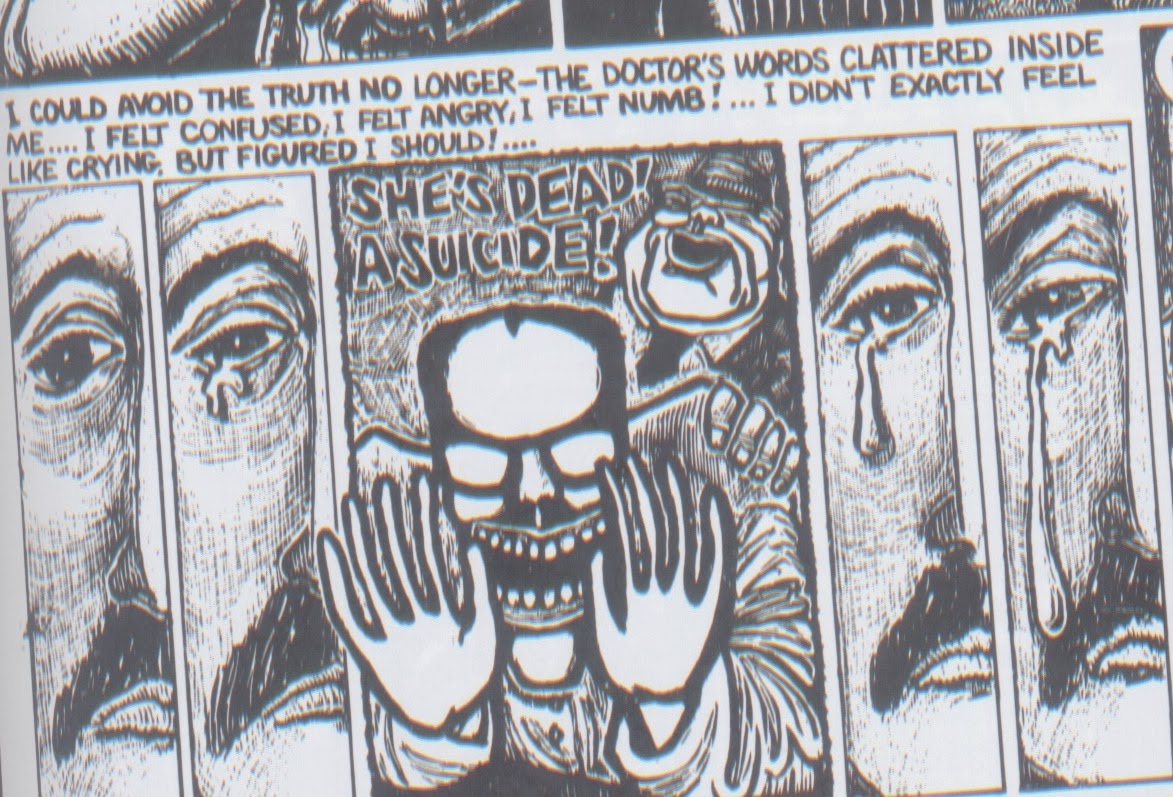
We hear of, by the process of creation, the author’s own upbringing and history. His mother, Anja – who also went to Auschwitz and survived – killed herself when Art was twenty. Spiegelman wrote a frankly amazing short comic strip about it in 1973, Prisoner On The Hell Planet (reproduced in Maus).


The strip is a piercing scream of grief: we are left to wonder how far Anja’a suicide was a legacy of Auschwitz, how far it was her own depressive nature, and how far it was her unhappy familial relationships. She kept diaries but, to Art’s fury, Vladek threw them out. We only ever know of her through Vladek and Prisoner On The Hell Planet. But, yet, Anja haunts Maus: she glides between the frames, whispering her own story.

The other highly original thing about Maus is its use of animal metaphor. The Jews are mice; the Nazis, cats; the Poles, pigs; the Americans, dogs; the French, frogs. Spiegelman’s metaphors initially seem to say that we are not all just the same people underneath our racial and national identities: that they define us, and so far so that they manifest in fundamental differences as strident as those found between animal species.

However, by emphasizing difference rather than minimizing it, Maus highlights the philosophical claptrap that The Holocaust drew oxygen from. If you’ve ever had the misfortune to read any of the mouth-foaming ‘theorists’ Hitler subscribed to, or any of Mein Kampf itself (which is so muddled it’s like slogging through hateful wet cement), you’ll know that these texts might as well be saying cats should get pigs and frogs to collaborate with them in order to kill mice. That’s how logical they are. At the same time, through using cats and mice especially, Spiegelman is able to visually evoke the power relationship between Jews and Nazis, and also to refer to, and undermine, the Nazi propaganda that equated Jews with rats (as seen in 1940's The Eternal Jew).

An incredibly important book, this, I think. And, still, within it, there is room for laughter. Not hurtful or ambiguous dark laughter, but real, beautiful big belly laughs.


Matt and I were born within a few days of one another. There’s something quite lovely about meeting someone of your own school year when you’ve left your childhood behind. We have very similar cultural tastes: Kate Bush, All About Eve, RuPaul’s Drag Race, Robyn, Love And Rockets… and it’s not only what we like, but how we like. There’s a lot of geeking about b-sides and quoting from scripts.

But, as with all friends, shared taste only gets you so far. Extremely caring, he works in HIV prevention and awareness, and his efforts helped the campaign The HIV-Hop win a national award last year. PLUS he’s a talented artist, and is prolific without compromising on quality – that in itself is an inspiration to me. Matt, with his artistry and his kindness and his passion, well, he makes me feel that I can weather any shit, and then come out of it with a Bette Davis hair-toss.

I’m unsurprised that Maus is one of Matt’s favourite books. He is moved by oppressive circumstances, and despises any form of prejudice: but he is uninterested in simply doling out platitudes. And that’s the essence of Maus.

I want to understand The Holocaust. But that doesn’t mean that I can understand The Holocaust.

Sunday, 20 October 2013

Week Thirty-Nine - Jeanette

Nausicaä Of The Valley Of Wind by Hayao Miyazaki (1982-94)
Recommended by Alex

Correct me if I’m wrong, but everyone loves Studio Ghibli.


Surely, from dedicated followers of The Fast And Furious franchise right through to Man With A Movie Camera silent film bores, all are charmed by Ghibli’s fantastical worlds. It annoys me that any shit romcom is branded a ‘feelgood' film, for it devalues something like Spirited Away: cinema that is gloriously enjoyable, yet undeniably profound.


In the early 1980s, Hayao Miyazaki, Studio Ghibli’s founder, pitched a movie about a pacifist young princess living in a world beset by environmental disaster. However Miyazaki, still largely unproven as a director, was told that he needed a manga series to secure funding for this pet project. The argument ran that animated movies based on manga did far better at the Japanese box office than did original stories.

What did Miyazaki do? Churn out a straw manga to please the money men? Or create a ridiculously intricate and multi-layered epic that ran for twelve years?


Set centuries in the future, humanity is on its knees. The industrialist societies of today pushed the earth to its limit. Unable to endure the devastation any longer, the earth roared, creating the Sea of Corruption. This is a vast forest where poisonous spores emit clouds of deadly miasma, and in which mutated and very angry insects dwell. Since the Sea of Corruption is uninhabitable, humans are relegated to its periphery, and then divided into semi-feudal autocratic states. The two primary powers, the Dorok Principalities and the Torumekian Kingdom, are perpetually at war – ostensibly over scarce resources, but there’s quite a bit of old-fashioned belligerence involved, too – while the smaller states are caught in the crossfire. Both Dorok and Torumekia use deeply unethical military strategies: biological warfare, racist inflammation, genetic engineering, and implied rape.

One of these small states is the Valley of Wind. Nausicaä is its beloved princess; she is a pure-hearted young girl who has a unique affinity with the earth. She is even able to communicate with the most feared of all the Sea Of Corruption’s insects, the giant Ohmu. Nausicaä could easily be an annoying do-gooder, but her characterisation is superb: she feels real anguish for human, animal and environmental suffering, while sometimes forced into making dubious moral decisions.

One of these dodgy compromises is her alliance with the Torumekian princess, Kushana. Nausicaä and Kushana share a complicated and fascinating relationship, almost as if they are obverse and reverse to one another.


Kushana was very much my favourite character. A brilliant tactician, ruthless and brutal when necessary, she sprung from a ‘nest of vipers’: a group of ambitious siblings fighting in Roman internecine style for (often short-lived) supremacy. The brief insights we gain into Kushana’s family are among the best panels in the whole manga. How far Nausicaä influences Kushana (and, more subtly, vice versa) is a tremendous tension in the story.

Nausicaä is in four volumes, and a real Gordian knot: it would take paragraphs and paragraphs to effectively explain the story alone. And its philosophical scope is even grander, for it examines different government structures under extreme crisis. As well as Classical history and myth (Nausicaä herself was based upon a Phaecian princess in The Odyssey), I detected influences from pre-1914 Europe, primarily the crumbling Austro-Hungarian and Ottoman Empires. Although my Japanese history is shaky, its Samurai era seems another key reference point. Miyazaki seamlessly links all this with modern theories of environmental destruction, feminism, the abuse of religion, and ethnic scapegoating. Sometimes Nausicaä is about nothing less than what it means to be human, especially when we have devastated the means of sustaining our humanity. Its ambition is as enormous as the Sea of Corruption itself.

The manga was a huge commercial and critical success. Thus, Miyazaki had no trouble getting funding for his movie, which was released in 1984.


It is far, far, far simpler work. Although it’s a good film, it’s on to a hiding to nothing after one has expended the hardcore concentration required to tackle the manga. The world, for once, should be grateful to cautious investors for without them this movie is all we would have.

Similar to my previous graphic novel recommender, Alex is a brilliant artist herself. This is my favourite of her drawings: Kirsty MacColl sitting on her bench in Soho Square, created for the board game Soho! 


She is also a respected film academic and a very good friend. I remember when I first met her about ten years ago I really didn’t know what to make of her – she was so different to anyone I’d ever, ever, ever encountered before. I soon realised what providence was telling me: that she was awesome and we should get on with this friendship lark immediately. She is extremely intelligent, highly sensitive, beautifully dressed, and incredibly magnetic. At Kathryn and Rupert’s wedding someone thought she was a film star.

I love things like Nausicaä, which trust you to hold masses of plot and character threads in your head, and then reward you a million times over for paying attention to them. If I may return to that awkward portmanteau word: feelgood. I feel good to know art has such vision, and I feel super good for knowing that I’ve been able to drink deep from its well this week.

Monday, 1 July 2013

Week Twenty-Six - Jeanette

The Underground Man by Mick Jackson (1997)
Recommended by Anna


I’m halfway through my fifty-two books!

Arbitrary milestones like this demand a bit of stock-taking. I’ve read some absolute blinders, and particularly rated Italo Calvino's Invisible Cities, Stella Gibbons's Westwood, Chester Brown's Ed The Happy Clown, Shauna Singh Baldwin's What The Body Remembers and Teju Cole's Open City. All of these are brilliantly realised achievements in themselves plus (and importantly, for the project) each expresses something about the friend who recommended the book.

I’m so pleased with myself for embarking upon this resolution, and thankful to all my friends who have stepped up to the oche with recommendations. I’m missing Jude, of course – I hope she’ll be back when the time is right – but I kind of feel she’s here with me anyway. After all, to blog about the project was her idea. I’d just have sat in my room and read ‘em.

The photo-with-the-book was also Jude’s invention. And, on that note, have another look at the one above. Two thumbs up. That’s because The Underground Man is FUCKING AWESOME AND ONE OF THE BEST BOOKS I’VE EVER READ.

And it’s all thanks to Anna. Sweet Anna, one of the people I know less well in this project but, nevertheless, a key part of my Sheffield world. Exceptionally passionate about ecological and animal issues, keen walker and allotment-owner, she’s got her feet planted firmly in South Yorkshire soil; and, as a talented designer, her brain is bubbling with creative cells. You know what? I think this unique book is going to bring us closer together.

The Underground Man concerns the fifth Duke Of Portland, a real-life Victorian aristocrat. The Duke (referred to as ‘His Grace’ throughout the book) was a figure of some public fascination in the middle nineteenth century. He was an extreme loner, and his enormous wealth allowed him to indulge his introversion to its logical conclusion. Few ever saw him, so wild rumours built up about his behaviour and his physical appearance. His most famous eccentricity was constructing a web of tunnels underneath his estate at Welbeck Abbey, in Nottinghamshire.


Mick Jackson takes these points of His Grace’s life as the starting point, and etches out the imagined thought processes behind them. He invents the demons that drove His Grace to such a peculiar routine, sympathetically analysing the thoughts and actions of a man who is getting older and finding life increasingly painful; a man who, on some level, knows that he is mentally crumbling, and is all at sea with how to react to a mind increasingly not his own; and, especially, a man who is extraordinarily, disastrously, heartbreakingly, all alone. His choices have condemned him to a life without touch, without perspective, without the steadying hands of trusted friends or family.

Each lung is in fact a tiny inverted tree with the base of the trunk coming out at my throat. When I breathe in, leaves appear on the branches. When I exhale, the leaves disappear.

The first third of The Underground Man is bathed in memorable images like this, conjured up by His Grace, showing how florid his mind has become while his body has retreated from the world. He is a refined writer (most of The Underground Man is in diary format) and can express himself perfectly in his own script. Yet, awkward and shy and too conditioned to solitude, he can never translate this to the real world. He relates an incident where he speaks to a man with psoriasis; His Grace has asked how it is treated.

‘You drink coal tar, man?’ had popped out of me, in a voice so loud and clear that the fellows who had recently returned to their digging immediately stopped again and stared.
The big chap looked me over very coolly, his eyes narrowing to two tiny slits. When he spoke it was as if he was addressing a backwards child.
              ‘Not drinks it, sir. Wipes it on.’
              […]
No doubt while I sit here recording the embarrassing event, that same labourer holds court in some nearby alehouse, telling anyone who cares to listen all about the mad old Duke who suggested drinking coal tar to cure his psoriatic scabs.

Those tiny confusions, they happen to all of us. And some of them simply won’t settle, continuing to wreak a terrible, very disproportionate, power over the mind. I don’t think I’ve ever read a book that captures this so perfectly.

As His Grace’s physical complaints multiply, he tries increasingly spurious treatments. One, towards the end of the book, is especially shocking and upsetting (Jackson’s powerful body-horror prose in this sequence is even more disturbing than the skin-peeling in Haruki Murakami’s The Wind-Up Bird Chronicle). His Grace’s sense of what is reasonable and what is extreme has completely disintegrated; and it is this, rather than the graphic nature of the medical procedure, that makes this section so very frightening.

In his quest to find refuge from his pains, His Grace can also be tragicomically bizarre. Many, many times during The Underground Man I giggled, and found myself welling up at exactly the same point.

Called down to Mrs Pledger, asking for more bacon – as hot and greasy as it would come.
When Clement arrived with the bacon I grabbed the plate and slid the rashers straight under my shirt. Buttoned it back up to keep the fellows in place […] I marched at the front, proud and barefoot, my bacon-epaulettes now showing through my shirt.

But sometimes there are simply no laughs to be found. Although, mostly, His Grace doesn’t directly address his own mental anguish, when he does, the words are raw:

She nodded at me, then mercifully turned and left me to suffer my distress alone. And as the door closed behind her I felt the bubble finally burst and I fell, as if my legs had been kicked from under me. I fell and continued falling and was at long last engulfed in my own tears.

The sway this book wielded over me in these last few days has been incredible. I thought about it incessantly, and I ran over passages in my mind as I walked around Sheffield. When I read that His Grace believed this…

All I’ve done with my life is take countless melancholy constitutionals and grow apples by the ton.

…I wanted to tell him, with a whisper piercing the impossibilities of history and fiction, that he has done something more, at least for me. He has touched me on a level that only about five or six other characters ever have.

Read this book. Seriously, read this book. I already want to read it again.

Tuesday, 2 April 2013

Week Thirteen - Jude

Like A Velvet Glove Cast In Iron by Daniel Clowes (1989-1993)
Recommended by Kristian Besley


After this week's recommender Kris read my post from last week – about Jonathan Raban's book, Coasting, irregular readers, read down for more – he was worried that he'd picked a book that wasn't deep enough.

Then I opened Like A Velvet Glove Cast In Iron.

This featherlight, wishy-washy, silly comic Kris had picked for me was actually... I'll pause for an intake of breath here... a series of interconnected stories named after a line from Russ Meyer's Faster, Pussycat! Kill! Kill! about a strange young man, a God-like drawing called Mr Jones who was tattoeed on feet and hidden on moles, a girl called Tina who looked like a potato conceived through an encounter with a mysterious creature who came from the sea, brutal cops, dogs without orifices or faces with maps on their backs, Hitler living in Mexico, a little girl who writes scripts, and a worldwide gender war.

Just like an issue of Bunty, in fact.

But that's Kris for you – putting himself down when he shouldn't. Kris is great. We've been friends since tertiary college, when he had purple hair and a beard and once let off a second world war air raid siren in the canteen... or at least my memory tells me that he did. (That's one of those situations you swear your brain has concocted on its own in a moment of madness). He was in a band called Ken though, a sort of mad-comedy band very much of the early 1990s, who had a cassette album called Unplugged In Llansamlet with a photocopy of a Barratt home pasted on the front of it, and had a song about Carl Cox, and many others with swear words in them which I won't repeat as he's a very grown up, and indeed upstanding, father-of-two now. The purple hair has gone too, I'm sorry to say.

Oh, Kris also played a massive part in my musical education, introducing me to the early works of Gorky's Zygotic Mynci and the music of Orbital, which I talk about on another blog post here. And he was in a band called Grümp – note the umlaut – for whom I made some badges using Tippex and biro. GLORY DAYS.

But back to Daniel Clowes. I knew a bit less about him: that he was one of the artists that helped popularise alternative comics in the late 1980s/early 1990s, and that he'd done some work for the brilliant Hernandez Brothers' Love And Rockets series. I'd also read Ghost World already, and of course seen the film starring Thora Birch (what happened to her?) and Scarlett Johanssen (ah what happened to her), having been a young person in the late 1990s/early '00s of an indie persuasion.


I'd loved both, but I'd not read anything else by Mr Clowes. Like A Velvet Glove Cast In Iron, I discovered, is definitely not Ghost World, although I really enjoyed it, despite not really understanding what the hell was going on in it.

The best way I could describe this graphic novel is that it's a lot like Twin Peaks in narrative style and tone – although its subject matter feels much murkier. For instance, there's a peculiar old movie at its heart that Clay sees in a dodgy porn cinema, and I felt the ghost of One-Eyed Jacks and Audrey Horne all over that. Still, the first instalment of this series was written at the same time as David Lynch was writing Twin Peaks, so they didn't overlap. Maybe there was just something (really weird) in the air.


Sex, violence, death and dread: boys and girls, they're all here. And God, you feel them. You really understand Clay  trying to make sense of some of these worlds desperately, while settling for others co-existing. When he's trying to find out the importance of Mr Jones, you feel his hunger for knowledge deeply; when the little girl he's watching is given her own voice, I felt genuine fear. There are lots of minor characters that recur too, and tons of surrealistic twists...for example, there's a moment when Clay takes a drink, then in the next panel, he and his friend are alien shapes...but even weirder than that. And the dogs without orifices. ARGH.


At points, this book made me think of the late '60s film Performance which I watched over the weekend too. Both are defined and directed – or indirected, rather – by psychedelic leaps. But I liked this book more, as it hinted at something weirder at the heart of us. My favourite bit of all was when the folk song Barbara Allen crops up towards the end, and Clowes uses it, in a way, to try and tie all his disparate, wayward threads together. Things don't end well, but then again, some things don't. This is a book I need to return to, and unpick, and spend hours poring over, just like those cassettes made for me nearly twenty years ago by a teenage boy with purple hair, from an old friend who will always, somehow, feel like a new one.


Sunday, 3 March 2013

Week Nine - Jeanette

The Panic Hand by Jonathan Carroll (1996)
Recommended by Ellen

I was on the phone to my esteemed co-blogger.

‘Yeah, I can talk, that’s fine, Jude. I’m at home. I’ve just had a tea of chips and vanilla vodka.’

After our chat, I picked up The Panic Hand and immediately read the following line:

Some people change as they grow older, while others only become more of who they were at fifteen.
           
*blushes*

I have read a Jonathan Carroll book before – actually, I’ve read it three times. I was given The Land Of Laughs, Carroll’s 1980 debut novel, in my early 20s; it was a present from a man I didn’t know very well. I was grateful, because it was a nice gesture, but I was rather perplexed. My confusion was not as to why he’d given me a book (I hoped it was because he liked me as a person, but also suspected there might have been a more, erm, ‘earthy’ motive); but rather why he’d given me this book.


As you can see, it is part of a series called ‘Fantasy Masterworks’. Orcs and elves and forests and sun gods and women in Red Sonja costumes. Not for me! I liked Fyodor Dostoyevsky and Angela Davis.

I slung The Land Of Laughs on my bookshelf and I didn’t read it.

A year passed. One day, I got sick. A week later, the lurgy still hadn’t gone anywhere. Confined to bed, wastepaper bin emptied out for a sick bucket next to me, I needed something to distract me from self-pity. Dostoyevsky and Davis weren’t about to do that. So I picked up The Land Of Laughs.

It wasn’t ‘fantasy’ in the way I had pigeonholed the genre, at all. It was easy to forget it was anything other than well-written realistic contemporary fiction until the last third. Then – holy, holy! – it slides into something completely incredible, yet at the same time, utterly logical. It’s about how we escape from the world into books. I escaped from my illness into The Land Of Laughs, and the other two times I’ve read it have also been when my body wanted to hide for a while.

The Panic Hand, a collection of Carroll’s short stories, was the trickiest of my Two Readers books to track down so far: out of print, not in the library, not in any secondhand shops. Less than twenty years old, and the recipient of great reviews, it seems to have sold little and faded quickly.

Which brings me nicely to a conversation I remember having with Ellen. A brilliant singer-songwriter, and former part of the psychedelic folk band Saint Joan, Ellen and I had met through a mutual friend at 2008’s Green Man Festival. I was immediately taken with her: charming, literary, funny. We both loved many of the female artists who had spent years in obscurity before being (re)discovered: Bonnie Dobson, Linda Perhacs, Vashti Bunyan, Susan Christie… ‘They were so good,’ Ellen said. ‘Why didn’t people pay attention at the time?’


Ellen’s own album, 2009’s The Crescent Sun, was poetic and nuanced and superb, but also served to answer her question: why people don’t pay attention at the time. Put out by a label that almost immediately went under, the album got snagged in the record industry’s cogs. The Crescent Sun wasn’t widely reviewed, and was difficult to find even in the early days of its release.


As for The Panic Hand, it too seems to have been badly served by its industry. That terribly misjudged cover must have had something to do with its failure. Just as I was put off The Land Of Laughs because of its association with stereotypically nerdish fantasy, The Panic Hand screams trashy-horror-bought-at-a-petrol-station. That embossed font! That blue demon claw! That small (i.e. not ‘literary’) paperback size! Toss it back in the bargain bin.

The panic hand is not a blue demon claw. It is a computer game played by Heidi, a twelve-year-old girl with a stutter. Heidi also conjures up a beautiful mother, Francesca, because she wants to see men falling in love and having sex with Francesca. These men always do, that is apart from our narrator: he’s far more interested in Heidi (in her personality, and in her vagina).

And that’s Carroll in a nutshell. We don’t get caught up in how Heidi created Francesca, she just did, because magic is everywhere, and the reader must accept this. In fact, it might have even been the narrator who invented both Heidi and Francesca. At the end of the story, we’re left wondering about the narrator’s intentions towards the daughter of his real-life girlfriend. Many of Carroll’s narrators are, to put it mildly, flawed.

It’s hard to précis these stories, because they usually only sound worth reading once you’ve given away the ending. The same with quoting chunks of prose: his writing is good, yet it’s the plot and its twists he excels at rather than any stand-alone lyricism.

A bizarre obsession of Carroll’s – it’s there in The Land Of Laughs, too – is of how animals watch us, judge us, relate to us. He imbues his animals, usually pets, with as much character as his humans. There’s also a powerful quasi-religious element to The Panic Hand stories. Just as Carroll accepts the personality of animals and the existence of the supernatural, he deals in hell, God, and angels throughout the book. The divine might not be conceptualised in the usual way, but its essence is consistent. It adds a magical realist morality to these tales.

I didn’t think this was as fabulous as The Land Of Laughs, but I think that’s because it frustrated me to get into one of Carroll's intriguing concepts, only to have it end five pages later. I like Carroll when he explores his ideas, revealing them slowly, rather than just exposing their raw meat. It felt as if many of these stories should have had more time invested in them.

            Nevertheless, even if those ideas aren't fully developed, they're original, and have a lot in 
            common with children's literature in both their whimsy and their scale.

For years, this small house had hosted family after family of losers, creeps, cheque-bouncers and wife-slappers who hadn’t paid their bills, loved their children, cared for anything other than their own thin skin. Then one day a family moved in and suddenly everything was different. These people loved each other, their lives, the house. […] The house gave back whatever it could to show its appreciation. It kept its windows from breaking in a storm, when the roof leaked into the parents’ bedroom, the house kept the leak from falling on the bed and ruining the patchwork quilt.

[quote ends here: Blogger won't let me unindent the text!]

So if your guttering keeps breaking, look to your humanity as well as your drainpipes. The Panic Hand: where the world is alternately sinister and hopeful.

Sunday, 20 January 2013

Week Three - Jeanette


What The Body Remembers by Shauna Singh Baldwin (1999)
Recommended by Luisa

Guess what Luisa got for Christmas?

Wilkie Collins’s autograph. Wow, wow, wow!

Given how much I too love Mr Collins (he spars for favourite author with George Eliot), I was especially excited to read Luisa’s choice for 2 Readers. I had some debate with myself as to whether this should be an ‘S’ or a ‘B’ but, using the way I file ‘Billie Ray Martin’ in my record collection (M) as a guide, I plumped for B, secretly thrilled that I would get to read Luisa’s selection sooner rather than later.

Luisa, with her Cleopatra fringe and equally sharp wit, was a big part of my four years of living in an ex-council flat in Hackney. She and her husband Hayden would spend evenings with my best friend Kathryn and I, all of us downing cheap soave, dissecting the minutiae of pop culture and laughing ourselves senseless. This, I thought, this is London life. Things moved on, as things are wont to do; I went to Sheffield, she and Hayden went to Colchester. I think I’ve only seen her once since our mutual flights from the capital. However, funnily enough, we’ve chatted more on books since we stopped seeing each other regularly.

I’d never heard of What The Body Remembers, or its author, Shauna Singh Baldwin. The Wikipedia page on Baldwin is succinct, but it does contain this rather wonderful fact:

Baldwin and her husband own The Safe House, an espionage themed restaurant in Milwaukee, Wisconson.

What The Body Remembers is not an espionage novel. But one of its main themes is how governments can smash trust between people.

Beginning in 1937, when the British still administered India, the three main characters are Sikhs living in the Punjab. Satya, fiery and complicated, has all the force of a Hedda Gabler or a Miss Julie. Infertile and outspoken, she has a tense relationship with her husband Sardarji, a skilled engineer working with the British rule and – in Satya’s opinion – collaborating with the colonists.

            That eyebrow of Satya’s had risen, ‘You did it for them, na?’

            ‘Yes of course, for them.’
            ‘Hein?’
            ‘Don’t say hein, Satya,’ he corrected. ‘It’s rude; it’s simply not done.’
            ‘What should I say? Tell me. Feed me the words you want to hear, so I can say them to you.’
            ‘You should say “Really, is that so?” if you disagree,’ he told her.
            ‘So you want me to say, “Really, is that so?” instead of telling you to your face when you are making excuses for yourself.’ And she had painstakingly learned those four English words, so her every repetition dripped sarcasm.

Sardarji, partly because of Satya’s quarrelsome ways, and partly because he wants a son, takes a second and much younger bride, Roop. Satya quickly dismisses Roop as docile and uninteresting (she isn’t), but Sardarji falls in love. He favours Roop over Satya, and a brilliantly unnerving Baby Jane-Blanche Hudson style psychological violence develops between the two wives.

Underpinning, and in some ways reflecting, this three-person melodrama is the wider three-faith political situation in India. On the opening page of the first chapter, Baldwin writes:

Hindus, Sikhs, Muslims, they are like the three strands of her hair, a strong rope against the British, but separate nevertheless.


Yet as the voices for separation of India and Pakistan louden, that rope frays. The final one hundred or so pages of What The Body Remembers deal with the events and the tragedies surrounding partition. The stories Baldwin tells are individually harrowing, but never does she dumb down or gloss over the political backdrop to the story. Readers are treated with the intelligence to understand difficult ideological machinations.

The novel is beautifully structured and many different power relationships are examined: man and woman, mother and child, colonists and colonised, religious majority and religious minority. Such tensions are cleverly and subtly brought out. For instance, Sardarji presents Roop to the Peshawari Muslim Rai Alam Khan and the Englishman Mr Farquharson.
            
           ‘Does she sing?’
Sardaji says proudly, ‘Oh yes, She sings shabads beautifully. I call her my little brown koel.’
Mr Farquharson gives Sardarji a puzzled look.
‘Our hymns.’ A little annoyed. ‘Surely you know what shabads are.’
Mr Farquharson leans back in his chair, ‘Oh’, he says scornfully, ‘yes, perhaps I do remember now.’ He pulls on the pipe again. ‘Sardarji, why don’t you teach her to sing Muslim hymns as well?’
Mr Farquharson would pull a tiger’s tail, then wonder why it mauls him.


I took my time with What The Body Remembers. The text is sprinkled with Punjabi words, whose meanings can usually be divined through careful reading, adding real texture and rhythm to the book. It’s not a difficult read, as such, but it is a book that it is pointless to skim. Even the minor characters have terrific depth to them and, although the pace is slow, it never drags.

What The Body Remembers is a profound book, a novel with real ambition, and my favourite recommendation so far.


Sunday, 13 January 2013

Week Two - Jeanette


Black Dog Of Fate by Peter Balakian (1997)
Recommended by Josh


Something you’ll read a lot about in my blog entries is the book Seasons They Change: The Story Of Acid And Psychedelic Folk. I wrote it between mid-2009 and mid-2010, and it was published at the very end of 2010. The most positive change that Seasons wrought was the entry of many fascinating new people into my life: people like Josh. He makes fissured experimental folk music, and he was a big part of the Brattleboro free-folk scene of the first half of the 2000s.

After Seasons wrapped up, Josh and I stayed in email contact as friends; over the last year or two, he has generously sent me releases from his record label, brilliant mix tapes, and his superb artwork. Our relationship is wonderfully old-fashioned. It reminds me of writing my fanzine Kirby in the latter half of the 1990s, and the friendships that arose from it (more of all that in later posts).


Josh (in common with a few other friends) couldn’t settle on just one book to recommend to me. I picked the memoir Black Dog Of Fate: An American Son Uncovers His Armenian Past simply because it was the first on his list.

Peter Balakian, an American by birth, grows up in the affluent New Jersey suburb Tenafly and wants for nothing. The first hundred pages of Black Dog, about Peter’s childhood, really tried my patience. Nothing is quicker to activate my twitchy working-class chip than whines such as ‘but Daaaaad, I don’t want to go to private school,’ or ruminations on personal inadequacy based on little more than being an under-par cellist. I repeat: there are one hundred odd pages of this. Armenia is no more than quicksilver through the paragraphs.

But, when Peter is in eighth grade (ages 13-14 to non-Americans), a process of discovery begins. He is charged with writing about a Near Eastern culture for a school social studies project. His father is pleased. ‘Here’s a chance for you to learn something about Armenia,’ he says. So Peter goes to the family’s encylopaedia:

There was not much on Armenia. Knowing that Armenia was once in Turkey, I decided to see what there was on Turkey: a sizeable entry with coloured pictures, maps, a list of export products. I checked the sources in the bibliography at the end of the entry and went to find them in the stacks of the Tenafly Public Library.

In all of these books on Turkey, Peter never found one reference to Armenia. The deadline for his project pressing, he writes about Turkey rather than Armenia, and received an A for his well-researched work. He tells his father about his good grade:

            ‘I wrote about Turkey,’ I said.
            My father stared at me, and silence hung over the table.
           ‘What?’ His voice cracked as he lingered on the t. ‘You were supposed to write about-‘
           ‘I know,’ I cut in, ‘but I couldn’t find anything.’
           He was shouting now. ‘Don’t you know what the Turks did to us?’

Balakian learns what the Turks did to us – a long campaign of hatred and oppression, culminating in the 1915 Armenian Genocide – through the 1919 book Ambassador Morgenthau’s Story, written by the American ambassador to Turkey during World War I. Balakian quotes great chunks of this book to give the reader key facts, and to illustrate his own coming into knowledge.


The Central [Turkish] Government announced its intention of gathering the two million or more Armenians living in several sections of the empire and transporting them to this desolate and inhospitable region [the Syrian desert]. The real purpose of the deportation was robbery and destruction; it really represented a new method of massacre. When the Turkish authorities gave the orders for these deportations, they were merely giving the death warrant for a whole race; they understood this well.

Scholars consider this event to be the first genocide: a state-organised attempt to murder a race of people. At least 500,000 people, and perhaps as many as 1.5 million people, were killed. The manner of death for the majority was nothing short of the absolute worst way to go: a combination of starvation, torture, rape, dehydration, exhaustion, beatings, and the psychological horror of seeing all of your family drop dead, one by one, in front of you.

The rest of Black Dog is devoted to Balakian uncovering Armenia, first through Morgenthau, and then his own family. In particular, he hears ‘Dovey’s Story’, a first-hand account of a desert death march. The story is so harrowing, so relentless, so overwhelming, and it brought me to desperate tears. Through the process of discovery, Balakian learns not only about Armenia and its history, but something that we all do: that our parents, our grandparents, matter in their own right and not just in the way they look (or do not look) after us. That we are not the be-all and end-all.

This made me rethink those first one hundred pages. Perhaps Balakian wanted the reaction of ‘what an over-privileged arsehole’ to his inconsequential angst, to contrast with the extreme suffering of his Armenian forebears, and to tell us, subtly: 'I know, I know now, that I had nothing to complain about. But I didn’t know then.' However, even in the light of this, I do think his decision to spend so much time on his own upbringing wasted too many valuable pages.

This week, I’ve mentioned Black Dog to several friends. Few knew much, if anything, about the genocide; my own limited knowledge had come via studying World War I six years ago. Before that, I couldn’t have told you one thing about it.

Why is there such a problem of ignorance around the Armenian Genocide?

Balakian offers a possible reason towards the end of Black Dog (in two excellent new chapters added to the book for its tenth anniversary edition). The present Turkish government, in common with every one of their governments since the genocide, denies that it ever happened. They sponsor historians to fabricate or skew evidence; they suppress literature that mentions the event; they send propagandists to historical conferences, who distribute anti-Armenian literature. Today, Turkey is a large and crucial part of the sensitive Near/Middle East region; Armenia is politically unimportant. Turkey’s voice drowns out that of Armenia. A shocking number of nations, including the UK, have not officially recognised the event as a genocide, even in the face of the overwhelming historical evidence. It seems that it’s just easier to simply not talk about it. This book, then, is a way in to learning of one of the most horrific, yet under-reported, events of the twentieth century. Black Dog did not completely satisfy me, but maybe it shouldn’t; I want to read Ambassador Morgenthau’s Story in full, and track down other texts mentioned in Balakian’s bibliography.

Actually, I have already visited the library with this in mind. I found exactly zero books on the subject.

For more info on the Armenian Genocide, the Wikipedia entry is an excellent introduction. The Armenian Genocide Museum website offers more depth, including a detailed chronology and (of course, highly distressing) photographic material.