Showing posts with label graphic novel. Show all posts

Wednesday, 11 December 2013

Week Forty-Seven - Jeanette

Maus by Art Spiegelman (1980-1991)
Recommended by Matt


The Holocaust.

How can art deal with it?


Talking or writing about The Holocaust, even in a low-key blog such as this, is a fraught experience. It feels, especially as a non-Jew, that I must instantly qualify myself: state upfront about how enormous it is, that it is a unique event, how we must never forget.

This says more about the author than it does about The Holocaust. Doesn’t every thoughtful person, who’s not an idiot or a bigot, know that it is an enormous unique event that we must never forget? Yet, still, I introduce Maus this way. My own fear of being seen as, at best, a Vichy France (and at worst an Adolf Hitler) if I don’t is too strong. But the risk, when we expend our energy and words in repeating such indisputable statements, is that we don’t afford the event much, or even any, complexity. That our own neurosis hobbles the ability for analysis, and we end up with a piece of writing that browbeats the reader with banality.

With tragic irony, it seems that in more recent times – The Reader, and the critical rehabilitation of Nazi filmmaker Leni Riefenstahl spring to mind – fictional and real Nazis have been afforded that very complexity (and even sympathy). Compare this to The Boy In The Striped Pajamas. I was really quite angry when I saw this movie, for it was so very saccharine. I asked myself, is such colourless characterization of those in the camps, as so unrealistically angelic and always seen from the outside, actually damaging? Does it simply reinforce the 'them and us' rhetoric used by the Nazis?


Maus is the story of Vladek Spiegelman, Art Spiegelman’s father: not only does it narrate Vladek’s Holocaust experience, but also his current life as an older immigrant man living in America, his (difficult) relationship with his wife Mala, and his attitude to Art and Art’s comics. Vladek’s numerous quirks and flaws may have something to do with The Holocaust; or they may just be who he is. The first challenging concept of Maus is that not every disagreeable trait in a survivor’s personality is a result of The Holocaust.


Vladek, a Polish Jew, marries Anja (Art’s mother) in the mid 1930s. Anja is from a wealthy family and the couple has a good lifestyle, although Anja is vulnerable to bouts of depression. Vladek tells us of how life began to get difficult for Polish Jews at the outbreak of World War II. What is most striking about the first book of Maus is not in itself the shrinking sphere that Jews are forced to function in (via seizure of businesses and property, and the acts of violence and murder): these processes of discrimination by the Nazis are well-known. But Vladek’s story brings an insight into the ad hoc nature of this time, so different from the image of steely calculating Nazi enforcers. Sometimes Vladek would be released when he was clearly committing an executionable offence, but sometimes he or the family would suffer with not even a thin excuse given. This inconsistency (while clearly on an overall curve towards genocide) creates both looming dread and grim pockets of hope. The reader is able to root for Vladek: he does not allow himself to be a victim easily. He works hard, he is clever and resourceful, he has wealth to exchange for favours, and he is prepared to hide or collaborate when necessary.

But Auschwitz was the fate for over one million Jews, and so it is for Vladek. Book Two of Maus concentrates on Vladek’s time in the extermination camp. Vladek mentions little of the gas chambers (it’s not from ignorance: all the prisoners know that they are there, and that they are used), but rather he concentrates on the day-to-day: the hunger, the lice, the relationships with camp supervisors, and the cumulative effect of smaller humiliations.


We learn Vladek’s story as Art learns it: with digressions, arguments, and frustrations. The present-day Vladek is extraordinary. He throws away Art’s trendy coat and gives him a horrible old one of his to replace it; he returns half-eaten cereal to the store (‘The manager helped me as soon as I explained to him my health, how Mala left me, and how it was in the camps’); he fakes a heart attack to get attention; he thinks all black people are thieves. At times, Vladek is so difficult that Art worries he is actually stereotyping Jewish people as miserly and intolerant, thus giving fuel to Nazi sympathizers.

We hear of, by the process of creation, the author’s own upbringing and history. His mother, Anja – who also went to Auschwitz and survived – killed herself when Art was twenty. Spiegelman wrote a frankly amazing short comic strip about it in 1973, Prisoner On The Hell Planet (reproduced in Maus).
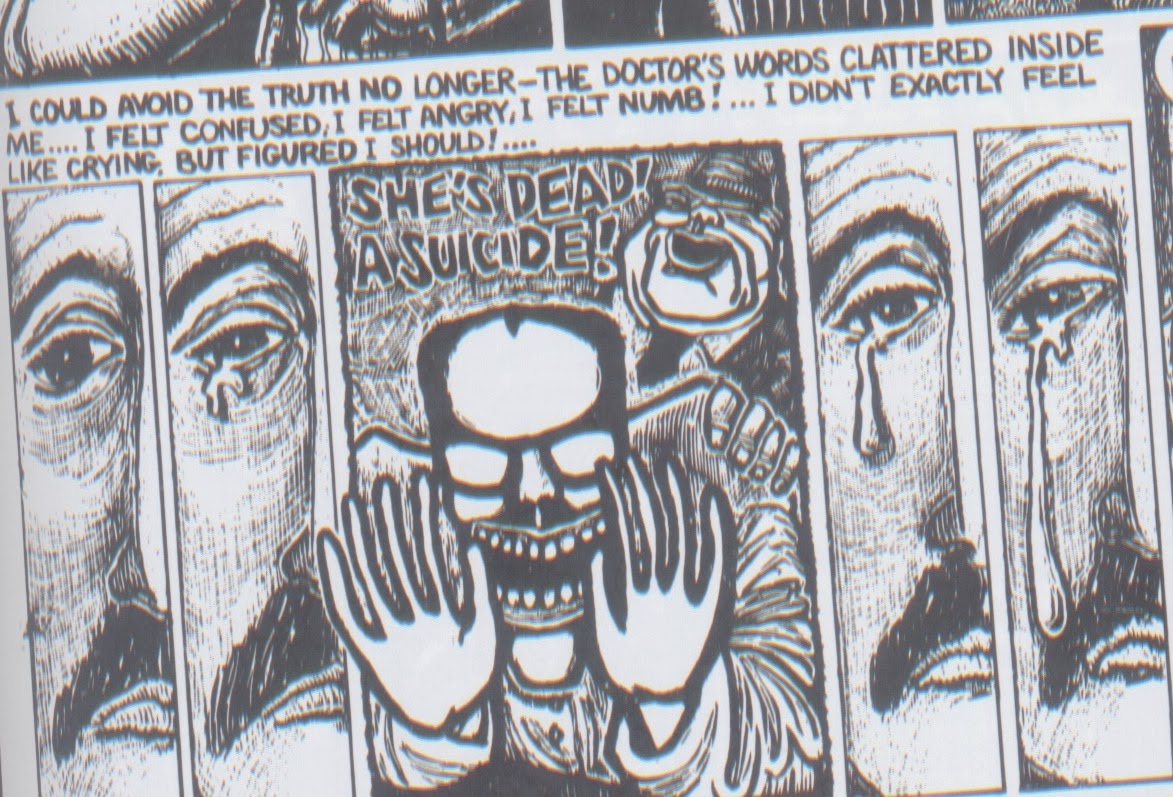

The strip is a piercing scream of grief: we are left to wonder how far Anja’a suicide was a legacy of Auschwitz, how far it was her own depressive nature, and how far it was her unhappy familial relationships. She kept diaries but, to Art’s fury, Vladek threw them out. We only ever know of her through Vladek and Prisoner On The Hell Planet. But, yet, Anja haunts Maus: she glides between the frames, whispering her own story.

The other highly original thing about Maus is its use of animal metaphor. The Jews are mice; the Nazis, cats; the Poles, pigs; the Americans, dogs; the French, frogs. Spiegelman’s metaphors initially seem to say that we are not all just the same people underneath our racial and national identities: that they define us, and so far so that they manifest in fundamental differences as strident as those found between animal species.

However, by emphasizing difference rather than minimizing it, Maus highlights the philosophical claptrap that The Holocaust drew oxygen from. If you’ve ever had the misfortune to read any of the mouth-foaming ‘theorists’ Hitler subscribed to, or any of Mein Kampf itself (which is so muddled it’s like slogging through hateful wet cement), you’ll know that these texts might as well be saying cats should get pigs and frogs to collaborate with them in order to kill mice. That’s how logical they are. At the same time, through using cats and mice especially, Spiegelman is able to visually evoke the power relationship between Jews and Nazis, and also to refer to, and undermine, the Nazi propaganda that equated Jews with rats (as seen in 1940's The Eternal Jew).

An incredibly important book, this, I think. And, still, within it, there is room for laughter. Not hurtful or ambiguous dark laughter, but real, beautiful big belly laughs.


Matt and I were born within a few days of one another. There’s something quite lovely about meeting someone of your own school year when you’ve left your childhood behind. We have very similar cultural tastes: Kate Bush, All About Eve, RuPaul’s Drag Race, Robyn, Love And Rockets… and it’s not only what we like, but how we like. There’s a lot of geeking about b-sides and quoting from scripts.

But, as with all friends, shared taste only gets you so far. Extremely caring, he works in HIV prevention and awareness, and his efforts helped the campaign The HIV-Hop win a national award last year. PLUS he’s a talented artist, and is prolific without compromising on quality – that in itself is an inspiration to me. Matt, with his artistry and his kindness and his passion, well, he makes me feel that I can weather any shit, and then come out of it with a Bette Davis hair-toss.

I’m unsurprised that Maus is one of Matt’s favourite books. He is moved by oppressive circumstances, and despises any form of prejudice: but he is uninterested in simply doling out platitudes. And that’s the essence of Maus.

I want to understand The Holocaust. But that doesn’t mean that I can understand The Holocaust.

Sunday, 20 October 2013

Week Thirty-Nine - Jeanette

Nausicaä Of The Valley Of Wind by Hayao Miyazaki (1982-94)
Recommended by Alex

Correct me if I’m wrong, but everyone loves Studio Ghibli.


Surely, from dedicated followers of The Fast And Furious franchise right through to Man With A Movie Camera silent film bores, all are charmed by Ghibli’s fantastical worlds. It annoys me that any shit romcom is branded a ‘feelgood' film, for it devalues something like Spirited Away: cinema that is gloriously enjoyable, yet undeniably profound.


In the early 1980s, Hayao Miyazaki, Studio Ghibli’s founder, pitched a movie about a pacifist young princess living in a world beset by environmental disaster. However Miyazaki, still largely unproven as a director, was told that he needed a manga series to secure funding for this pet project. The argument ran that animated movies based on manga did far better at the Japanese box office than did original stories.

What did Miyazaki do? Churn out a straw manga to please the money men? Or create a ridiculously intricate and multi-layered epic that ran for twelve years?


Set centuries in the future, humanity is on its knees. The industrialist societies of today pushed the earth to its limit. Unable to endure the devastation any longer, the earth roared, creating the Sea of Corruption. This is a vast forest where poisonous spores emit clouds of deadly miasma, and in which mutated and very angry insects dwell. Since the Sea of Corruption is uninhabitable, humans are relegated to its periphery, and then divided into semi-feudal autocratic states. The two primary powers, the Dorok Principalities and the Torumekian Kingdom, are perpetually at war – ostensibly over scarce resources, but there’s quite a bit of old-fashioned belligerence involved, too – while the smaller states are caught in the crossfire. Both Dorok and Torumekia use deeply unethical military strategies: biological warfare, racist inflammation, genetic engineering, and implied rape.

One of these small states is the Valley of Wind. Nausicaä is its beloved princess; she is a pure-hearted young girl who has a unique affinity with the earth. She is even able to communicate with the most feared of all the Sea Of Corruption’s insects, the giant Ohmu. Nausicaä could easily be an annoying do-gooder, but her characterisation is superb: she feels real anguish for human, animal and environmental suffering, while sometimes forced into making dubious moral decisions.

One of these dodgy compromises is her alliance with the Torumekian princess, Kushana. Nausicaä and Kushana share a complicated and fascinating relationship, almost as if they are obverse and reverse to one another.


Kushana was very much my favourite character. A brilliant tactician, ruthless and brutal when necessary, she sprung from a ‘nest of vipers’: a group of ambitious siblings fighting in Roman internecine style for (often short-lived) supremacy. The brief insights we gain into Kushana’s family are among the best panels in the whole manga. How far Nausicaä influences Kushana (and, more subtly, vice versa) is a tremendous tension in the story.

Nausicaä is in four volumes, and a real Gordian knot: it would take paragraphs and paragraphs to effectively explain the story alone. And its philosophical scope is even grander, for it examines different government structures under extreme crisis. As well as Classical history and myth (Nausicaä herself was based upon a Phaecian princess in The Odyssey), I detected influences from pre-1914 Europe, primarily the crumbling Austro-Hungarian and Ottoman Empires. Although my Japanese history is shaky, its Samurai era seems another key reference point. Miyazaki seamlessly links all this with modern theories of environmental destruction, feminism, the abuse of religion, and ethnic scapegoating. Sometimes Nausicaä is about nothing less than what it means to be human, especially when we have devastated the means of sustaining our humanity. Its ambition is as enormous as the Sea of Corruption itself.

The manga was a huge commercial and critical success. Thus, Miyazaki had no trouble getting funding for his movie, which was released in 1984.


It is far, far, far simpler work. Although it’s a good film, it’s on to a hiding to nothing after one has expended the hardcore concentration required to tackle the manga. The world, for once, should be grateful to cautious investors for without them this movie is all we would have.

Similar to my previous graphic novel recommender, Alex is a brilliant artist herself. This is my favourite of her drawings: Kirsty MacColl sitting on her bench in Soho Square, created for the board game Soho! 


She is also a respected film academic and a very good friend. I remember when I first met her about ten years ago I really didn’t know what to make of her – she was so different to anyone I’d ever, ever, ever encountered before. I soon realised what providence was telling me: that she was awesome and we should get on with this friendship lark immediately. She is extremely intelligent, highly sensitive, beautifully dressed, and incredibly magnetic. At Kathryn and Rupert’s wedding someone thought she was a film star.

I love things like Nausicaä, which trust you to hold masses of plot and character threads in your head, and then reward you a million times over for paying attention to them. If I may return to that awkward portmanteau word: feelgood. I feel good to know art has such vision, and I feel super good for knowing that I’ve been able to drink deep from its well this week.

Tuesday, 2 April 2013

Week Thirteen - Jude

Like A Velvet Glove Cast In Iron by Daniel Clowes (1989-1993)
Recommended by Kristian Besley


After this week's recommender Kris read my post from last week – about Jonathan Raban's book, Coasting, irregular readers, read down for more – he was worried that he'd picked a book that wasn't deep enough.

Then I opened Like A Velvet Glove Cast In Iron.

This featherlight, wishy-washy, silly comic Kris had picked for me was actually... I'll pause for an intake of breath here... a series of interconnected stories named after a line from Russ Meyer's Faster, Pussycat! Kill! Kill! about a strange young man, a God-like drawing called Mr Jones who was tattoeed on feet and hidden on moles, a girl called Tina who looked like a potato conceived through an encounter with a mysterious creature who came from the sea, brutal cops, dogs without orifices or faces with maps on their backs, Hitler living in Mexico, a little girl who writes scripts, and a worldwide gender war.

Just like an issue of Bunty, in fact.

But that's Kris for you – putting himself down when he shouldn't. Kris is great. We've been friends since tertiary college, when he had purple hair and a beard and once let off a second world war air raid siren in the canteen... or at least my memory tells me that he did. (That's one of those situations you swear your brain has concocted on its own in a moment of madness). He was in a band called Ken though, a sort of mad-comedy band very much of the early 1990s, who had a cassette album called Unplugged In Llansamlet with a photocopy of a Barratt home pasted on the front of it, and had a song about Carl Cox, and many others with swear words in them which I won't repeat as he's a very grown up, and indeed upstanding, father-of-two now. The purple hair has gone too, I'm sorry to say.

Oh, Kris also played a massive part in my musical education, introducing me to the early works of Gorky's Zygotic Mynci and the music of Orbital, which I talk about on another blog post here. And he was in a band called Grümp – note the umlaut – for whom I made some badges using Tippex and biro. GLORY DAYS.

But back to Daniel Clowes. I knew a bit less about him: that he was one of the artists that helped popularise alternative comics in the late 1980s/early 1990s, and that he'd done some work for the brilliant Hernandez Brothers' Love And Rockets series. I'd also read Ghost World already, and of course seen the film starring Thora Birch (what happened to her?) and Scarlett Johanssen (ah what happened to her), having been a young person in the late 1990s/early '00s of an indie persuasion.


I'd loved both, but I'd not read anything else by Mr Clowes. Like A Velvet Glove Cast In Iron, I discovered, is definitely not Ghost World, although I really enjoyed it, despite not really understanding what the hell was going on in it.

The best way I could describe this graphic novel is that it's a lot like Twin Peaks in narrative style and tone – although its subject matter feels much murkier. For instance, there's a peculiar old movie at its heart that Clay sees in a dodgy porn cinema, and I felt the ghost of One-Eyed Jacks and Audrey Horne all over that. Still, the first instalment of this series was written at the same time as David Lynch was writing Twin Peaks, so they didn't overlap. Maybe there was just something (really weird) in the air.


Sex, violence, death and dread: boys and girls, they're all here. And God, you feel them. You really understand Clay  trying to make sense of some of these worlds desperately, while settling for others co-existing. When he's trying to find out the importance of Mr Jones, you feel his hunger for knowledge deeply; when the little girl he's watching is given her own voice, I felt genuine fear. There are lots of minor characters that recur too, and tons of surrealistic twists...for example, there's a moment when Clay takes a drink, then in the next panel, he and his friend are alien shapes...but even weirder than that. And the dogs without orifices. ARGH.


At points, this book made me think of the late '60s film Performance which I watched over the weekend too. Both are defined and directed – or indirected, rather – by psychedelic leaps. But I liked this book more, as it hinted at something weirder at the heart of us. My favourite bit of all was when the folk song Barbara Allen crops up towards the end, and Clowes uses it, in a way, to try and tie all his disparate, wayward threads together. Things don't end well, but then again, some things don't. This is a book I need to return to, and unpick, and spend hours poring over, just like those cassettes made for me nearly twenty years ago by a teenage boy with purple hair, from an old friend who will always, somehow, feel like a new one.


Sunday, 17 February 2013

Week Seven - Jeanette


Ed The Happy Clown by Chester Brown (1982-9)
Recommended by Jeff


It’s a pain in the arse to write about Will Oldham.

Why?

Well, for a start he doesn’t do many interviews. The ones he does do, he mumbles through, and if he does say anything of merit, it usually contradicts something he said before. Then he goes on about R. Kelly for several centuries. But infuriating as that is, it’s even worse to research people’s opinions of his music. And I’m not only talking about his fans: huge swathes of music critics gibber out the purple prose when confronted with a Palace release. Cutting through the platitudes is incredibly wearisome.

That’s why this song, and its video, is so refreshing:


The only time I blocked, properly blocked, when writing Seasons They Change was when I had to tackle Will Oldham’s career. And it was Jeffrey Lewis’s song that got me through it. It was not only its mischievous take on ol’ Bonnie ‘Prince’ that spoke to me. It was the ruminations on the worth of living a creative life at all – sensations I was feeling keenly, as Seasons was already altering me (and I wasn’t sure for the better).

I emailed Jeffrey out of the blue, and asked if I could quote some ‘Williamsburg Will Oldham Horror’ lyrics in Seasons. He said yes! And he was extremely interested in the book!

We met when he came over to the UK; he asked me along to his show in Leeds, part of a joint tour with the incredible Peter Stampfel of the Holy Modal Rounders (who I had also interviewed). Seasons had just been published, so I passed on copies to Jeff and Peter, grateful for their help. Jeff swapped with me, giving me his comic book Fuff, and their joint album Come On Board. He and I stayed in touch, and have now met a good few times when he’s been in the UK. He is a complete delight to talk to, because he is so intelligent about the things he loves, and sparkles that erudition with an infectious wide-eyed enthusiasm. He cared for Seasons, and I’ve never forgotten his kind words about it.

I hoped that he would recommend me a graphic novel: as an artist himself, and a fount of knowledge on comic art and culture, I felt sure he’d come up with something memorable.


Ed The Happy Clown was originally serialised in Chester Brown’s comic book Yummy Fur during the 1980s (aside: I had heard of Yummy Fur, but only because an an engaging Scottish band of the 1990s appropriated the name). It was published as a standalone graphic novel in 1992. I have the latest version (2012) with a few changes from the initial serialisation, but with a whacking great notes section at the end.

It’s been a melancholy week. Partly it’s to do with the snow, falling, falling, falling, and trapping me in a merciless prism of cold. But, also, it’s my own fault: in this prism, I’ve only really watched miserable DVDs. So let’s just say that Ed The Happy Clown slotted in nicely between the unflinching hospital scenes in Dennis Potter’s The Singing Detective, and Rainer Werner Fassbinder’s film about prejudice and crippling isolation, Fear Eats The Soul.

Ed himself is a cheerful cove, but by the third panel there’s a fatal fire at the children’s hospital he’s about to visit. A broken leg, a rat attack, and the exploitation and subsequent death of several pygmies swiftly follow. We’re on page seven.

However, in this and the other ‘Introductory Pieces’ - written before Ed really gets going as a serial - the strips have a cartoonish quality to them. If one were in a darkly humorous mood, one could – and perhaps should – laugh at them. The fact that they upset me probably says more about me than it does about them. But, even in this earliest part, real bleakness quickly sets in.


That panel where his nose is removed cut me to the quick. Ed remains without the accoutrements of clowning for the remainder of the book.

The kind, intelligent Josie joins Ed in his misadventures. Killed early on in the story, she returns to life, first as an unquiet spirit, and then as a vampire.


If it’s possible, Josie has an even harder time of it than Ed does. The last few pages in the book see to her fate and… oh, my… it’s surely one of the most harrowing endings of all time.

The story itself, as Brown explains in the notes, was almost entirely improvised. Ed began specifically as an exercise in spontaneity – Brown had been taken with the Wallace Fowlie book The Age Of Surrealism and wanted to tap into ‘unconscious art’ – and this unplanned approach remained, to a lesser extent, throughout the comic’s lifespan. This gives Ed a really dangerous edge. It could, and frequently does, go anywhere. Overall the plot makes sense, although occasionally there are frustrating dead ends (and Brown now says he regrets some aspects of Ed that he considers racist and sexist). However, I doubt the very unusual and sustained air of chaotic menace in Ed would have been there had Brown planned the story in advance.

In a mark of how far Ed The Happy Clown ate away at me, the book invaded my dreams. In my nightmare, someone I knew got swept away in a sewer, and she blamed me; she retaliated by coming up through my toilet, showering me with shit, and grabbing at my legs. That’s a jumble of several parts of the Ed story, and it was so powerful it woke me up with a scream at 4am.

Ed The Happy Clown is really not something for the faint-hearted. It’s not just its gloom, horror, and anarchy. It’s a transgressive work, with plenty of graphic bodily functions, and a fair amount of explicit violence. Yet I absolutely adored it. It touched the same nerve in me that makes Story Of The Eye by Georges Bataille one of my favourite books. I’ve thought about Ed repeatedly ever since finishing it, and some individual panels are burned onto my brain.

Like this one. Oh, oh, oh, Ed.